Batch Enzyme Reactor Manufacturer,Supplier and Exporter in India
Product Code : EL-TWL-9079
Jlab Export is a leading Batch Enzyme Reactor Manufacturer,and suppliers in India
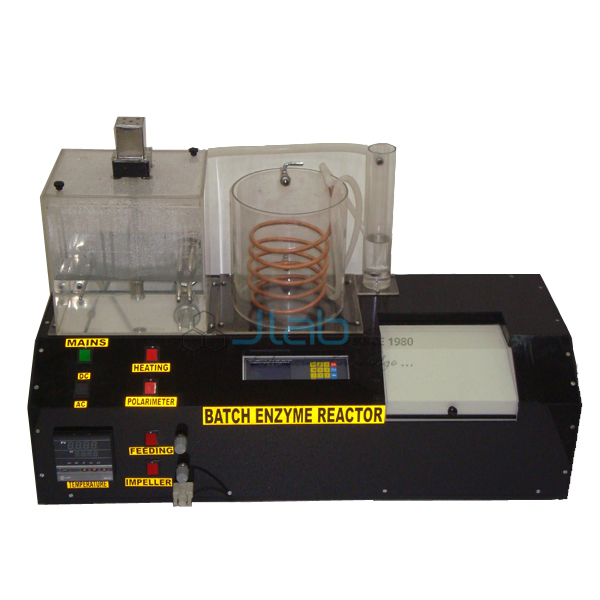
Glucose turning into fructose can be followed live on this bench-top batch enzyme reactor. Immobilised glucose isomerase is held in a stainless steel mesh impeller inside a clear acrylic vessel. A peristaltic pump draws a sample stream through a cooling coil to a built-in polarimeter, which reads the angle of rotation. The reaction is tracked this way without manual glucose assays.
Specifications
| Reactor vessel | Clear acrylic, stirred |
| Impeller | Cruciform, stainless steel mesh holding the immobilised enzyme, variable speed |
| Reaction | Glucose isomerisation by glucose isomerase |
| Temperature control | Two heaters and a sensor in the vessel, PID controller |
| Sampling loop | Peristaltic pump, tubular coil heat exchanger, polarimeter |
| Polarimeter | Measures angle of rotation and optical transmission |
| Displays | Reactor temperature (PID), angle of rotation, optical transmission or polarimeter temperature |
| Safety | Heater interlocks for low liquid level or stopped impeller, protection on all electrical circuits |
| Base and data | Vacuum-formed ABS plinth with electrical console, I/O port for a PC |
| Minimum order quantity | 1 unit |
| Dispatch time | Usually 14–18 working days |
| Manufacturer | JLab (Jain Laboratory Instruments Pvt Ltd), Ambala, India |
Enzyme Kinetics Experiments
Students run batches at set temperatures and record the angle of rotation against time. Glucose turns polarised light to the right and fructose to the left, so the angle falls as the reaction goes on and gives both sugar concentrations. Glucose and fructose standards weighed on an Electronic Analytical Balance and made up in a Volumetric Flask give the calibration.
Plotting conversion against time at several temperatures shows the rate rising with temperature and then dropping as the enzyme loses activity. Runs at different impeller speeds show whether mass transfer to the immobilised enzyme limits the rate. Initial rates from batches of different starting glucose concentration give a Michaelis-Menten or Lineweaver-Burk plot. Teachers can first show optical rotation on a Student Polarimeter.
Frequently Asked Questions
How does the polarimeter follow the reaction?
Glucose rotates polarised light to the right and fructose to the left. As glucose is converted, the measured angle moves toward the left. From the angle and the starting concentration, the amounts of both sugars can be worked out at any moment.
Why is the sample cooled before it is measured?
Optical rotation changes with temperature, so the sample stream passes through a tubular coil heat exchanger before the polarimeter. One display can show the temperature at the polarimeter, so students can check the reading conditions.
What stops the heaters running dry?
Safety interlocks keep the two heaters off when the liquid level in the vessel is low or the impeller is not turning. All electrical circuits also have protection devices.
Can readings be logged on a PC?
Yes. Sensor signals are routed to an I/O port for connection to a PC, so temperature and rotation can be recorded through a run and plotted later. Three displays on the console show reactor temperature, angle of rotation and transmission or polarimeter temperature.
Why is the enzyme held in the impeller?
The cruciform impeller is made of stainless steel mesh that keeps the immobilised enzyme in place while the liquid mixes through it. The enzyme stays in the vessel when samples are drawn, and the variable impeller speed lets students study mixing.
Other Batch and Training Reactors
For a quote, use Add To Cart or send us a message through the contact page.
Last updated: 6 November 2026