Electrostatic Kit Manufacturer,Supplier and Exporter in India
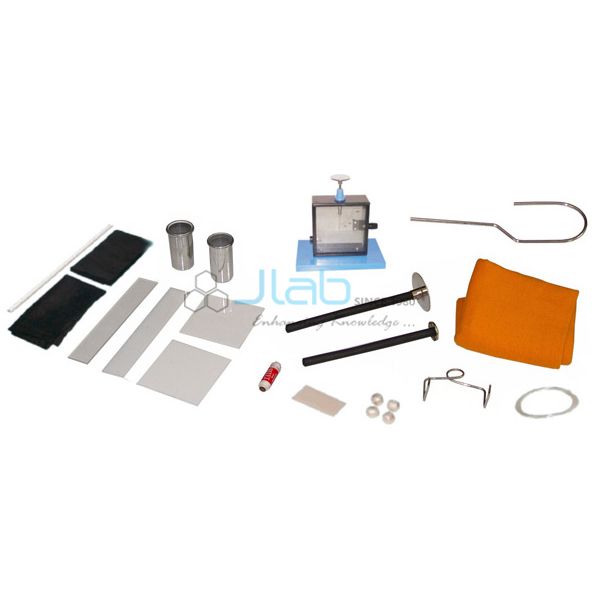
Product Code : EL-TWL-9186
Jlab Export is a leading Electrostatic Kit Manufacturer,and suppliers in India
With this kit a class can charge strips by rubbing, detect the charge on an electroscope and carry it about with an electrophorus and proof plane. It also holds four metalized polystyrene spheres, two aluminium cans, two polythene tiles, a wire stirrup and hook, and a reel of nylon.
What Is in the Kit
| Electroscope | 1 |
| Metalized polystyrene spheres | 4 |
| Nylon thread | 1 reel |
| Charging strips | One cellulose acetate strip, one polythene strip |
| Polythene tiles | 2 |
| Electrophorus | On an insulating handle, with a proof plane |
| Aluminium cans | 2 |
| Other parts | Wire stirrup, wire hook, rubber cloth |
| Minimum order quantity | 10 units |
| Dispatch time | Usually 4–6 working days |
| Manufacturer | JLab (Jain Laboratory Instruments Pvt Ltd), Ambala, India |
Static Electricity Experiments for the Classroom
Students usually start with charging by friction. They rub the polythene strip with the cloth, hang it in the wire stirrup on nylon thread and bring other charged items close. A rubbed polythene tile pushes it away, while the rubbed acetate strip pulls it in, which shows there are two kinds of charge. A rubbed Ebonite Rod also repels it, as both take a negative charge.
Next the electroscope is charged by contact and then by induction. For induction, a charged strip is held near the cap while a finger touches the cap to earth it. The finger is lifted first and the strip moved away second. The leaf then opens again, now with a charge of the opposite sign to the strip. A Gold Leaf Electroscope shows the same steps with a rising leaf.
The electrophorus gives many charges from one rubbing of a tile, and the proof plane carries small samples to the electroscope. Touching the inside and then the outside of a charged aluminium can shows that the charge sits on the outer surface. For measured values and the sign of the charge, the cans and proof plane can be used with the Charge Sensor.
Frequently Asked Questions
Why do the strips lose their charge on some days?
Damp air is the usual cause. A film of moisture lets charge leak away from the strips, tiles and electroscope. Work in a dry room, wipe the parts dry before the lesson and hold each strip by one end only.
How do I find the sign of an unknown charge?
First give the electroscope a known charge, for example from rubbed polythene, which is negative. Then bring the object near the cap. If the leaf opens further, the object has the same sign. If it closes, the object has the opposite sign or is uncharged, so only the opening test is certain.
How does the electrophorus work?
Rub a polythene tile so it carries a negative charge, then set the electrophorus plate on it. Touch the plate briefly with a finger and lift it by the handle. The plate now holds a positive charge gained by induction, and the tile keeps its own charge for further rounds.
What are the metalized spheres for?
Hang a sphere on nylon thread from the wire hook and bring a charged strip near. The light sphere is drawn to the strip, touches it, takes some of its charge and is then pushed away. This shows charge passing by contact.
Other Electrostatics Apparatus
- Pith Ball Electroscope (two pith balls on unspun silk)
- Discharger (brass spheres on an insulated handle)
- Demonstration Faraday Cage
- Electrostatic Kit (version with pith balls and glass plates)
For a quote, use Add To Cart or send us a message through the contact page.
Last updated: 6 November 2026