Stepper Motor Control Using IC SAA-1027 Manufacturer,Supplier and Exporter in India
Product Code : EL-PET-1447
Jlab Export is a leading Stepper Motor Control Using IC SAA-1027 Manufacturer,and suppliers in India
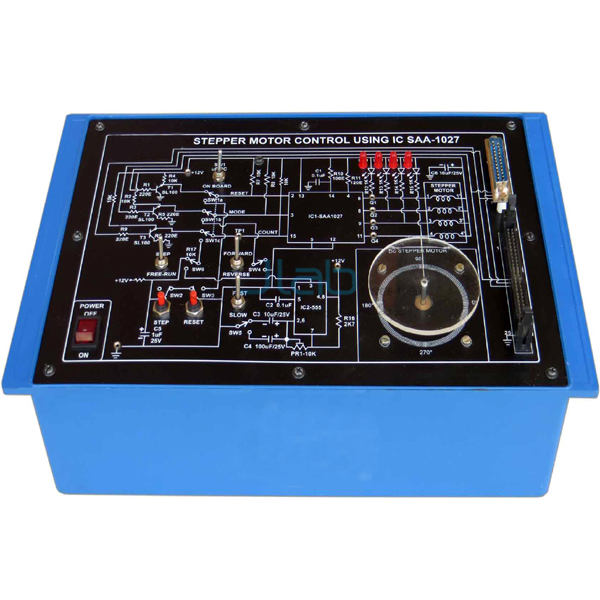
Stepper Motor Control Using IC SAA-1027 (code EL-PET-1447) is a power electronics training board for studying the functions of a stepper motor, built around the SAA-1027 driver IC and an LM 555 timer IC. The board carries its own four-winding DC stepper motor with a 1.8° step angle, and it can be interfaced with a microprocessor trainer or a personal computer. Jain Laboratory Instruments Pvt Ltd (JLab) produces it at its works in Ambala, India.
Specifications
| Parameter | Detail |
|---|---|
| Object | To study the various functions of a stepper motor |
| Stepper motor | DC stepper motor, 4 windings; torque 1.0 kg-cm; step angle 1.8°; 12 V, 0.2 A per phase |
| Driver IC | SAA-1027 |
| Timer IC | LM 555 |
| Speed selection | Fast/slow selection switch |
| Direction selection | Forward/reverse selection switch |
| Mode selection | Free run/step selection switch |
| Control source | Microprocessor/PC and on-board selector switch, with a built-in option for microprocessor or personal computer interfacing |
| DC supply | 12 V DC at 500 mA, IC regulated |
| Connections | Connectors on the panel for a microprocessor or PC; terminals for connecting an external counter |
| Other components | Adequate number of other electronic components |
| Mains controls | Mains ON/OFF switch, fuse and jewel light |
| Mains supply | 230 V ±10%, 50 Hz AC |
| Operating instructions | Detailed, giving the object, theory, design procedures, report suggestions and book references |
| Quality check | Each board is visually inspected before dispatch |
| Pack quantity | Each (sold individually) |
| Minimum order quantity | 10 units |
| Dispatch time | Usually 7–10 working days |
| Product code | EL-PET-1447 |
| Manufacturer | Jain Laboratory Instruments Pvt Ltd (JLab) — OEM |
| Country of origin | India (made in Ambala, Haryana) |
How Does It Compare with the Stepper Motor Controller Trainer?
| Board | On-board control | Microprocessor control | Motor |
|---|---|---|---|
| This board (EL-PET-1447) | SAA-1027 driver IC and LM 555 timer IC, with fast/slow, forward/reverse and free run/step switches | Through an external microprocessor trainer or personal computer, chosen with a selector switch | Four-winding DC stepper motor, 1.8° step angle |
| Stepper Motor Controller Trainer | Digital logic circuits, ICs and a transistor stage | Its own 8-bit microprocessor | Stepper motor |
Choose this board when the course works with a dedicated stepper driver IC and an existing microprocessor trainer or PC; the Stepper Motor Controller Trainer carries its own 8-bit microprocessor for programmed speed control.
What Is the Stepper Motor Control Board Used For?
A stepper motor turns in fixed angular steps, one for each pulse it receives, so its position and speed can be controlled without a feedback sensor; this is why steppers are used in printers, CNC machines and positioning systems. In controllers of this type a timer IC supplies the step pulses and the driver IC energises the motor windings in the correct sequence. Science and engineering students use the board to study the motor’s functions — running fast or slow, forward or reverse, free running or stepping one step at a time — and to drive it from a microprocessor trainer or a PC when studying interfacing.
What to Specify When Ordering
- Quantity — the number of stepper motor boards required.
- Interfacing — the microprocessor trainer or PC the board will be connected to, so the connection can be discussed.
- Companion trainers — for example a microprocessor training kit for the same lab.
Frequently Asked Questions
How many steps does the motor make per revolution?
With a step angle of 1.8°, the motor makes 200 full steps per revolution (360° divided by 1.8°).
What does the SAA-1027 do?
The SAA-1027 is a stepper motor driver IC. It takes step pulses and a direction signal and switches the four motor windings in sequence, so the motor advances one step for each pulse and reverses when the direction input changes.
Can the board be connected to a microprocessor trainer or a PC?
Yes. A microprocessor/PC and on-board selector switch is built in, and connectors on the panel take the connections to a microprocessor trainer or personal computer. Terminals are also provided for connecting an external counter.
What is the difference between free run and step mode?
In free run the motor turns continuously at the selected speed; in step mode it advances by single steps, which makes it easy to see the step angle and the winding sequence.
What should an export enquiry include?
The number of boards, the destination country and port or city, the delivery terms required (for example FOB or CIF), any packing or labelling requirements and the tender reference if there is one.
Who manufactures this stepper motor control board?
Jain Laboratory Instruments Pvt Ltd, which trades as JLab, makes it at its works in Ambala, Haryana, India.
OEM Manufacturer
JLab is the trading name of Jain Laboratory Instruments Pvt Ltd, a manufacturer of electronic lab instruments, power electronics trainers and other engineering lab equipment in India. The company was incorporated in 2017 and is located on Hargolal Road, Ambala, Haryana. This board comes from JLab’s own works rather than from a trader, so colleges, institutes, dealers and importers buy direct from the manufacturer, each board is visually inspected before dispatch, and repeat orders are made by the same works. JLab exports worldwide and ships to buyers in every region — for example Italy in Southern Europe, Japan in East Asia, Yemen in the Middle East, Romania in Eastern Europe and Malaysia in Southeast Asia. Tender information is on the JLab lab tenders page.
Related Motor Control and Microprocessor Trainers
- Stepper Motor Controller Trainer — a bench trainer for stepper motor speed control by digital logic or by its own 8-bit microprocessor.
- 8085 Microprocessor Training Kit — an 8085 trainer kit with programmable I/O lines and a 16-bit timer/counter, sold separately.
- Universal Motor Speed Control — a power electronics board for thyristor speed control of a universal motor.
- Electronic Timer — an IC-555 timer board with push-button start, delay potentiometer and 12 V relay.
See more in Power Electronics Trainers and the wider Electronics Lab Equipments range.
Request a Quote
Request a quotation with the Add To Cart button on this page or through the contact page, giving the number of boards, the delivery destination and details of the microprocessor trainer or PC you plan to use.
Last updated: 22 October 2026