
Extractors Manufacturer, Suppliers and Exporter in India
Jlabexport is a leading Extractors Manufacturer,and suppliers in India
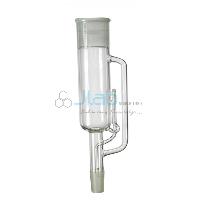
Laboratory extractors are glassware components used to transfer compounds from solid or liquid matrices during extraction procedures. This category is intended for schools, universities, TVET institutions, research laboratories and industrial buyers selecting extraction glassware by nominal capacity, socket size, cone size and flange configuration.
Jlab Export is a Manufacturer & Exporter of laboratory extractors from Ambala, India. The current category grid contains one product: Extractors Soxhlet, product code JL-E-1610. The listed configurations cover nominal capacities from 6 ml to 600 ml. Jointed options use B-series socket and cone designations, while the 600 ml entry lists a 75 mm flat flange and B34 cone.
The supplied category page identifies chemistry, biology, food science, plant-essence extraction and environmental sample analysis as application areas. Exact suitability, materials and operating conditions should be confirmed for the selected configuration.
What product is included in the Extractors category?
The current Extractors category contains one displayed product: Extractors Soxhlet, product code JL-E-1610. Its individual listing provides eight jointed capacity configurations and one 600 ml flat-flange configuration. No Clemenger extractor or micro-extraction device appears in the visible product grid.
The listed product is:
- Extractors Soxhlet — JL-E-1610
The confirmed nominal capacities are:
- 6 ml
- 20 ml
- 40 ml
- 60 ml
- 100 ml
- 200 ml
- 600 ml
The 60 ml and 100 ml capacities each appear with more than one joint combination. Buyers should therefore specify the complete capacity, socket, cone or flange configuration rather than requesting the product by capacity alone.
How do you choose a Soxhlet extractor?
Choose a Soxhlet extractor by matching the nominal capacity and every listed connection to the associated laboratory assembly. For most JL-E-1610 options, the page provides a socket size and cone size. The 600 ml option instead lists a 75 mm flat flange and a B34 cone.
Use this selection sequence:
- Confirm product code JL-E-1610.
- Select the required nominal capacity.
- Match the stated socket size.
- Match the stated cone size.
- For 600 ml, verify the 75 mm flat-flange connection.
- Request material and dimensional details not published online.
A generic request such as “100 ml Soxhlet extractor” is incomplete because two 100 ml configurations are listed. The buyer should provide the full joint combination or an approved apparatus drawing.
Which jointed Soxhlet extractor sizes are listed?
Jlab Export lists jointed Soxhlet extractor configurations from 6 ml to 200 ml. The available socket sizes range from B19 to B50, while the cone sizes range from B14 to B34. Some nominal capacities have alternative connection combinations.
|
Nominal capacity |
Socket size |
Cone size |
|
6 ml |
B19 |
B14 |
|
20 ml |
B24 |
B19 |
|
40 ml |
B29 |
B24 |
|
60 ml |
B34 |
B24 |
|
60 ml |
B34 |
B34 |
|
100 ml |
B34 |
B34 |
|
100 ml |
B40 |
B24 |
|
200 ml |
B50 |
B24 |
Buyers should reproduce all three fields in the quotation request. The listing does not state joint tolerances, interchangeability requirements, tube diameters, extractor height or siphon dimensions. These details remain available on request.
What is listed for the 600 ml Soxhlet extractor?
The 600 ml JL-E-1610 entry lists a 75 mm flat-flange size and a B34 cone. It is presented separately from the smaller socket-and-cone configurations, indicating that the buyer must identify the flange connection when requesting this capacity.
|
Nominal capacity |
Flat-flange size |
Cone size |
|
600 ml |
75 mm |
B34 |
The product table does not state whether an additional socket is included, nor does it provide the flange thickness, sealing arrangement, clamp requirement or overall dimensions.
For procurement, specify:
- Product code JL-E-1610
- Nominal capacity: 600 ml
- Flat flange: 75 mm
- Cone: B34
- Required quantity
- Required technical drawing
- Packing and destination details
What applications are stated for laboratory extractors?
The category page states that extractors are used to transfer compounds from solid or liquid matrices. It identifies chemistry, biology, food science, plant-essence extraction and environmental sample analysis as application areas.
These broad application descriptions do not confirm that every JL-E-1610 capacity is suitable for every procedure. Buyers should provide the intended method and request written confirmation of:
- Required extractor volume
- Compatible flask connection
- Compatible condenser connection
- Material specification
- Operating-temperature limits
- Chemical compatibility
- Required accessories
Suitability should be determined from the complete apparatus configuration and procedure, not from application terminology alone.
How should schools, universities and TVET institutions select an extractor?
Educational institutions should select the extractor configuration stated in the practical schedule, apparatus list or procurement specification. The correct product depends on required capacity and joint compatibility, not solely on whether it is being purchased for a school, university or TVET laboratory.
An educational procurement enquiry should include:
- Product code JL-E-1610
- Required nominal capacity
- Socket size
- Cone size
- Flat-flange size, where applicable
- Number required per laboratory
- Required supporting glassware
- Documentation requirements
- Packing and marking instructions
Where the equipment list states only “Soxhlet extractor,” the buyer should request a compliance statement showing the exact configuration proposed.
What should research and industrial buyers verify?
Research and industrial buyers should verify the extractor material, complete dimensions, joint tolerances, siphon construction and operating limitations before approval. The product page confirms nominal capacities and connections but does not provide sufficient construction data for procedure-specific technical evaluation.
Request confirmation of:
- Glass type and grade
- Wall thickness
- Body diameter and height
- Siphon tube dimensions
- Vapour-tube dimensions
- Socket and cone tolerances
- Flat-flange dimensions
- Thermal limitations
- Chemical compatibility
- Pressure or vacuum suitability
- Included components and accessories
Where a standard, certificate or traceability document is mandatory, the buyer should request documentation that identifies JL-E-1610 and the quoted configuration.
What should institutional and tender buyers include in an enquiry?
Institutional and tender buyers should provide the complete BOQ description, JL-E-1610 product code, capacity, joint or flange configuration, quantity, destination and required documents. This prevents ambiguity where the same nominal capacity appears with different connections.
Include:
- Tender or project reference
- Product name and code
- Nominal capacity
- Socket size
- Cone size
- Flat-flange size, if applicable
- Material requirement
- Complete dimensions
- Quantity
- Inspection requirements
- Packing and carton markings
- Delivery country
- Required certificates or declarations
- Submission deadline
Jlab Export states that institutional buyers can receive line-by-line BOQ quotations, technical datasheets, compliance documentation and export-grade packing for applicable orders.
Extractor Product Types
|
Type |
Key listed feature |
Typical use |
|
Jointed Soxhlet Extractor |
6–200 ml; specified B-series socket and cone combinations |
Orders requiring JL-E-1610 with jointed connections |
|
Soxhlet Extractor with Flat Flange |
600 ml; 75 mm flat flange; B34 cone |
Orders specifying the listed high-capacity flange configuration |
The table reflects only the configurations confirmed on the JL-E-1610 product page.
Extractor Selection Criteria
|
Criterion |
What to check |
|
Product type |
Confirm that the required item is the listed Soxhlet extractor |
|
Product code |
Specify JL-E-1610 |
|
Nominal capacity |
Select the listed 6–600 ml option |
|
Socket size |
Match B19, B24, B29, B34, B40 or B50 as listed |
|
Cone size |
Match B14, B19, B24 or B34 as listed |
|
Alternative configurations |
Check both available combinations for 60 ml and 100 ml |
|
Flat flange |
Confirm the listed 75 mm flange for the 600 ml option |
|
Material |
Request the glass type and grade |
|
Dimensions |
Request body, siphon, vapour-tube and overall dimensions |
|
Joint compatibility |
Confirm tolerances and matching flask or condenser connections |
|
Operating conditions |
Request temperature, chemical, pressure or vacuum suitability |
|
Included components |
Confirm whether flask, condenser, seals, clamps or other parts are included |
|
Quantity |
State units required per laboratory, institution or project |
|
Packing |
Confirm unit packing and export-protection requirements |
|
Documentation |
Specify datasheet, drawing, inspection and certification requirements |
Jlab Export Links
- Jlab Export Home
- View Product Categories
- Extractors Category
- Laboratory and TVET Tender Supply
- About Jlab Export
- Frequently Asked Questions
- Contact Jlab Export
Frequently Asked Questions
How many products are displayed in the Extractors category?
The current category grid displays one product: Extractors Soxhlet, product code JL-E-1610. Although the category introduction also mentions Clemenger extractors and micro-extraction devices, these are not shown as separate products in the visible grid.
What capacities are available for the Soxhlet extractor?
The JL-E-1610 listing includes nominal capacities of 6, 20, 40, 60, 100, 200 and 600 ml. The 60 ml and 100 ml sizes each have two connection combinations, so the socket and cone must be specified with the capacity.
What is the smallest Soxhlet extractor listed?
The smallest listed JL-E-1610 configuration has a nominal capacity of 6 ml, a B19 socket and a B14 cone. Material, overall dimensions and siphon details are not stated on the product page.
What is the largest extractor listed?
The largest listed extractor has a nominal capacity of 600 ml, a 75 mm flat flange and a B34 cone. The page does not confirm flange thickness, seal type, clamp arrangement or an additional socket connection.
Are different connections available for the same capacity?
Yes. The 60 ml extractor is listed as B34/B24 and B34/B34, while the 100 ml extractor is listed as B34/B34 and B40/B24. Buyers should specify the complete socket-and-cone combination.
Is the extractor material specified online?
No. The individual JL-E-1610 listing does not state the glass type, glass grade, wall thickness or thermal properties. These specifications should be requested before technical approval or procurement.
Are product-specific certifications confirmed?
No product-specific standard or certificate is shown on the JL-E-1610 listing. The About page contains manufacturer-stated company certification and accreditation claims, but their validity, scope and applicability to this extractor must be verified before publishing or procurement.
Can Jlab Export quote for institutional and tender orders?
Yes. Jlab Export states that it provides line-by-line BOQ quotations, technical datasheets, compliance documentation and export-grade packing for applicable institutional and tender orders. Buyers should submit the complete extractor configuration and quantity.
Request a Quote for Laboratory Extractors
Request current material specifications, dimensions, joint or flange configurations, quantity-based pricing, documentation and export-packing information for JL-E-1610 Soxhlet extractors.