Kipps Apparatus (Polyethylene) Manufacturer,Supplier and Exporter in India
Product Code : EL-GL-56
Jlab Export is a leading Kipps Apparatus (Polyethylene) Manufacturer,and suppliers in India
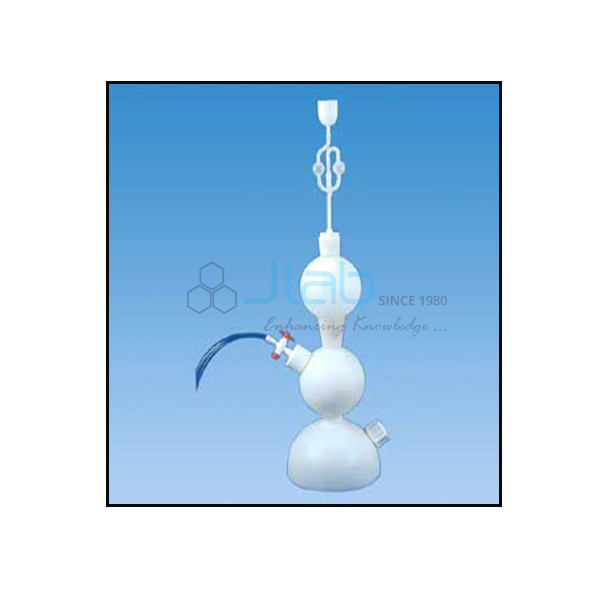
In salt analysis, the hydrogen sulphide that precipitates metal sulphides is drawn from a gas generator such as this polyethylene Kipp’s apparatus. Acid added at the top through the thistle funnel and bulb reaches the metal sulphide, and the gas collects in the middle dome until the stopcock is opened. JLab supplies it in 250, 500 and 1000 ml sizes, each packed singly.
Specifications
| Material | Polyethylene |
| Construction | Three main portions: top with thistle funnel and bulb, middle dome, base |
| Gas outlet | Leakproof stopcock with a self-lubricating PTFE plug |
| Base | Residual outlet with a cap, for cleaning |
| Gas produced | Hydrogen sulphide, from dilute acid and a metal sulphide |
| Capacities | 250 ml, 500 ml, 1000 ml |
| Pack quantity | Each (sold individually) |
| Minimum order quantity | 15 units |
| Dispatch time | Usually 4–6 working days |
| Supplied by | JLab (Jain Laboratory Instruments Pvt Ltd), Ambala, India |
Salt Analysis Practicals with Hydrogen Sulphide
In Class 12 and college qualitative analysis, students pass hydrogen sulphide through an acidified salt solution to test for group II cations. Later they pass it through an ammoniacal solution for group IV. The generator is charged with Ferrous Sulphide Sticks and dilute acid. Gas from the stopcock runs through a Delivery Tube Glass into the test tube, and students note the colour of any sulphide precipitate.
To show that the gas really is hydrogen sulphide, a strip of filter paper moistened with Lead Acetate solution is held at the outlet. It turns black as lead sulphide forms. All of this work belongs in a fume cupboard.
Frequently Asked Questions
Why does the gas stop when the stopcock is closed?
Gas that is still forming builds up pressure in the middle dome. That pressure pushes the acid back up into the top bulb and away from the sulphide, so the reaction stops. Opening the stopcock lets the acid flow back, and gas forms again.
How do I control how fast the gas comes out?
Open the stopcock a little for a slow stream of bubbles through the test solution and further for a faster flow. Close it fully between tests, so no acid is wasted and no gas escapes into the room.
Why should the outlet lead into a fume cupboard?
Hydrogen sulphide is a toxic gas that smells of rotten eggs, and the nose soon stops noticing it. Run the apparatus and the test tubes inside a fume cupboard, or at least at a well ventilated bench. Close the stopcock as soon as the test is done.
What form should the metal sulphide be in?
Use lumps or sticks, not powder. Lumps keep a steady surface in contact with the acid, so the gas comes evenly and the reaction stops cleanly when the acid is pushed back. Powder reacts too fast and clogs the outlets.
Does the stopcock need grease?
No. The PTFE plug is self-lubricating, so it turns freely without grease. Grease would only collect acid and dirt around the plug.
Other Gas Generators and Gas Jars
- Kipp Gas Generator (borosilicate glass, 1000 ml)
- Kipp’s Apparatus (Complete Set) (250 ml set)
- Gas Jar with Lid, Glass
For a quote, use Add To Cart or send us a message through the contact page.
Last updated: 20 November 2026