Plug Flow Reactor, Straight Tube Type JLab Manufacturer,Supplier and Exporter in India

Product Code : EL-TWL-6667
Jlab Export is a leading Plug Flow Reactor, Straight Tube Type JLab Manufacturer,and suppliers in India
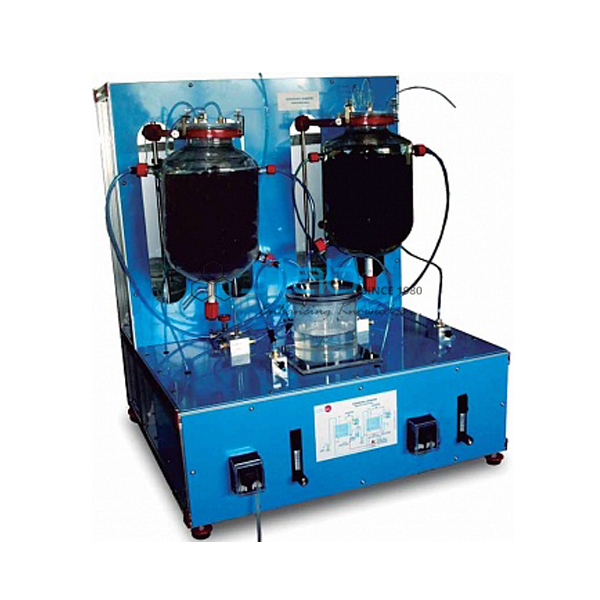
Two reactant streams meet and travel along a straight tube in this plug flow reactor, and conversion is read from samples taken where they leave. Compressed air drives each reactant from its own feed tank through a rotameter and needle valve. The tube lies horizontal and rises at the outlet end. The set-up is used for a non-catalytic homogeneous reaction at ambient conditions.
Specifications
| Reactor | Straight tube, horizontal, inclined upward at the outlet |
| Reaction studied | Non-catalytic, homogeneous, at ambient conditions |
| Feed tanks | Two, one for each reactant |
| Feed drive | Compressed air |
| Flow measurement | Rotameter with needle valve for each reactant |
| Air line fittings | Pressure regulator, pressure gauge, safety valve |
| Sampling | At the reactor outlet |
| Minimum order quantity | 1 unit |
| Dispatch time | Usually 14–18 working days |
| Manufacturer | JLab (Jain Laboratory Instruments Pvt Ltd), Ambala, India |
Rate Constant Experiments with the Reactor
A common practical is the saponification of ethyl acetate with sodium hydroxide, a second-order reaction that runs at room temperature. Students set equal flows of the two reactants, wait for steady state and collect an outlet sample. The alkali left in each sample is found by titration from a Burette into a Conical Flask, and this gives the conversion X.
Space time τ is the tube volume divided by the total volumetric flow rate. For a second-order reaction with equal feed concentrations, the PFR design equation gives k τ CA0 = X / (1 − X). Running at several flow rates and plotting X / (1 − X) against τ gives a straight line whose slope is k CA0.
Frequently Asked Questions
What makes a reactor plug flow?
In ideal plug flow there is no mixing along the direction of flow and complete mixing across it. Every element of fluid spends the same time in the tube, so concentration falls steadily from inlet to outlet but is even across any section.
Why is the feed driven by compressed air?
Air pressure on the feed tanks pushes both reactants at a steady rate, set at each needle valve, with no pump in the liquid line. A pressure regulator, a pressure gauge and a safety valve in the air line hold and limit the pressure.
Why does the tube rise at the outlet?
Inclining the outlet end upward keeps the tube full of liquid and lets trapped air escape, so the reacting volume stays the same from run to run. Samples are collected at this outlet.
How does it compare with a coiled tube reactor?
Both aim at plug flow. A straight tube is simple to see, drain and clean. A Plug Flow Reactor (Coiled Tube Type) fits more length into less space, and its bends set up secondary flow that adds mixing across the tube.
Other Plug Flow Reactor Set-Ups
For a quote, use Add To Cart or send us a message through the contact page.
Last updated: 6 November 2026