Rising Film Evaporator Manufacturer,Supplier and Exporter in India
Product Code : EL-TWL-9109
Jlab Export is a leading Rising Film Evaporator Manufacturer,and suppliers in India
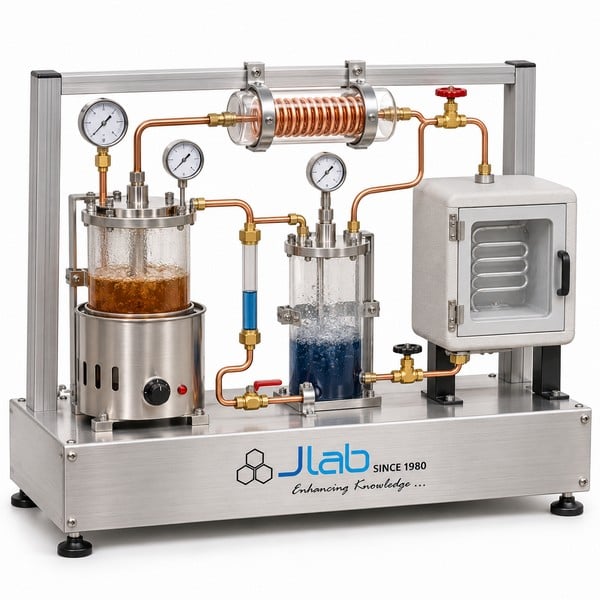
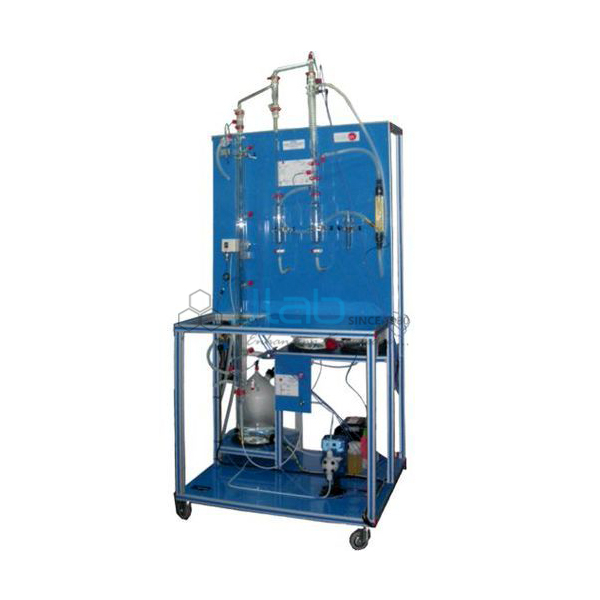
A rising film evaporator is a vertical shell and tube heat exchanger in which the feed boils on its way up the tubes. Vapour formed near the bottom pushes the liquid up the tube walls as a thin film, and this upward co-current flow keeps the liquid turbulent. The unit lets students see how a long-tube evaporator concentrates a solution.
Specifications
| Type | Rising film, vertical long-tube evaporator |
| Construction | Vertical shell and tube heat exchanger |
| Principle | Thermosiphon, with liquid and vapour rising co-currently |
| Feed entry | Bottom of the heating tubes |
| Suited to | Viscous products and products that foul heating surfaces |
| Applications | Effluent treatment, polymers, food, thermal desalination, pharmaceuticals, solvent recovery, reboilers, pre-concentrators |
| Minimum order quantity | 1 unit |
| Dispatch time | Usually 14–18 working days |
| Manufacturer | JLab (Jain Laboratory Instruments Pvt Ltd), Ambala, India |
Evaporation Experiments for Students
Students feed a dilute sugar solution at a set rate and collect the concentrate and the vapour condensate over a run timed with a Digital Stopwatch. Feed and product strength are read on a Hand Held Refractometer, and the condensate is measured in a Measuring Cylinder.
Steam economy is the water evaporated divided by the heating steam used in the same time. The overall heat transfer coefficient follows from Q = U A ΔT. Here Q comes from the condensed heating steam, A from the tube area and ΔT from the steam and boiling liquid temperatures. Repeating the run at other feed rates shows how film flow affects both figures.
Frequently Asked Questions
Why does the liquid climb the tubes?
Vapour forms as the feed boils in the lower part of the tubes. It expands and rushes upward, dragging the liquid up the wall as a film. This only works when the temperature difference between the heating and boiling sides is large enough.
What is steam economy?
It is the mass of water evaporated from the feed for each kilogram of heating steam used. A single-effect evaporator gives a figure a little below one. Students compare their result with this to judge heat losses from the unit.
What liquids suit this type of evaporator?
Its turbulent upward film handles viscous products and liquids that tend to foul heating surfaces. Uses include effluent treatment, polymers, food, thermal desalination, pharmaceuticals and solvent recovery. The same design serves as a reboiler or a pre-concentrator.
How is it different from a falling film evaporator?
In a rising film unit the feed enters at the bottom and vapour lifts the liquid, so it needs a high temperature difference. In a falling film unit the feed enters at the top and gravity carries the film down, which works with smaller temperature differences.
Other Heat Transfer and Reboiler Units
For a quote, use Add To Cart or send us a message through the contact page.
Last updated: 6 November 2026