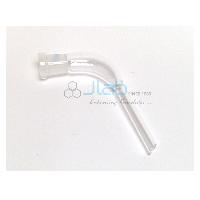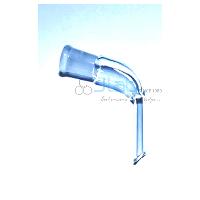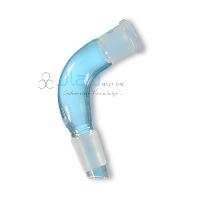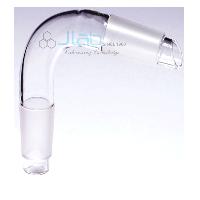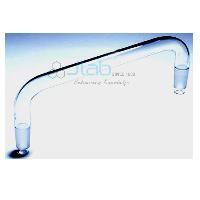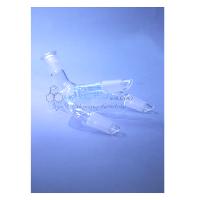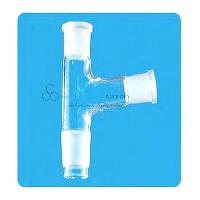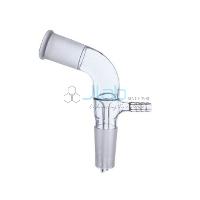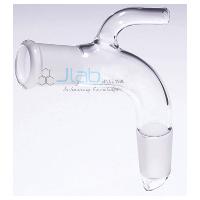

Bends Manufacturer, Suppliers and Exporter in India
Jlabexport is a leading Bends Manufacturer,and suppliers in India
Laboratory glass bends are connecting components used to change the direction of flow between compatible laboratory glassware assemblies. They are selected by bend configuration, socket size, cone size and the connection required between flasks, condensers, receivers, vacuum lines or vented apparatus. This category is intended for schools, universities, TVET institutions, research laboratories and industrial buyers.
Jlab Export is a Manufacturer & Exporter of plain bends, socket-to-cone bends, recovery bends, receiver bends, socket-connected bends, vacuum-connection bends and vented bends from Ambala, India. The category contains nine listed products, with codes from JL-B-1584 to JL-B-1592. Confirmed joint options extend from B10 to B34, depending on the product. Exact bend angles, arm lengths, tubing dimensions, glass material and operating limits are not stated on the individual listings and should be requested before procurement.
Jlab Export states that it exports to markets across Asia, Africa, Europe, North America, South America and Oceania.
What products are included in the Bends category?
The Bends category contains nine laboratory glassware connectors covering plain, socket-to-cone, recovery, receiver, socket, vacuum and vent configurations. Each product has an individual JL-B code and a stated set of B-series socket, cone or flask-to-condenser joint combinations.
The listed products are:
- Bends Plain, Long — JL-B-1584
- Bends, Plain, Short — JL-B-1585
- Bends, Socket to Cone — JL-B-1586
- Bends, Recovery, Sloping — JL-B-1587
- Bends, Recovery, Vertical — JL-B-1588
- Bends, Receiver, Pig, Multiple Connections — JL-B-1589
- Bends with Socket Connection — JL-B-1590
- Bends with Vacuum Connection — JL-B-1591
- Bends with Vent — JL-B-1592
The individual listings do not provide bend angle, tube diameter, wall thickness, arm length or packing quantity. Specifications are available on request.
How do you choose a laboratory glass bend?
Choose a laboratory bend by first identifying the required configuration and then matching every socket and cone connection to the surrounding apparatus. A joint size alone is insufficient because the same socket may be paired with different cone sizes on different models.
Use this selection sequence:
- Select plain, recovery, receiver, vacuum, vent or socket-to-cone construction.
- Confirm the JL-B product code.
- Match the socket size.
- Match the cone size or flask and condenser connections.
- Confirm whether a long, short, sloping or vertical format is required.
- Request the bend angle and physical dimensions.
- Verify material and operating suitability.
Where the bend replaces an existing component, provide the existing joint designation, drawing or approved sample specification.
Which long and short plain bends are available?
Long Plain Bend JL-B-1584 and Short Plain Bend JL-B-1585 are both listed in socket sizes B10, B14, B19, B24 and B29. Their pages do not provide dimensions that define the difference between “long” and “short.”
|
Product |
Listed socket sizes |
|
Bends Plain, Long — JL-B-1584 |
B10, B14, B19, B24, B29 |
|
Bends, Plain, Short — JL-B-1585 |
B10, B14, B19, B24, B29 |
Buyers should request:
- Overall length
- Length of each arm
- Bend angle
- Centre-line bend radius
- Tube outside diameter
- Tube bore
- Opposite-end construction
The same socket range on both pages does not confirm that the two products are otherwise dimensionally interchangeable.
Which socket-to-cone bend combinations are listed?
Socket-to-Cone Bend JL-B-1586 is available in six stated socket-and-cone combinations. Most configurations use matching joint sizes, while one option pairs a B19 socket with a B24 cone.
|
Socket size |
Cone size |
|
B14 |
B14 |
|
B19 |
B19 |
|
B19 |
B24 |
|
B24 |
B24 |
|
B29 |
B29 |
|
B34 |
B34 |
A quotation request should reproduce both joint fields. A request stating only “B19 bend” would be ambiguous because JL-B-1586 includes both B19/B19 and B19/B24 configurations.
The page does not state angle, arm dimensions, material or joint tolerance. These details should be confirmed where the bend must fit an existing modular glassware assembly.
What recovery bend configurations are available?
Jlab Export lists sloping and vertical recovery bends with the same five flask-to-condenser cone combinations. Buyers should select the required orientation and then specify both joint sizes because B24 flask connections are available with either B19 or B24 condenser connections.
|
Cone to fit flask |
Cone to fit condenser |
|
B14 |
B14 |
|
B19 |
B19 |
|
B24 |
B19 |
|
B24 |
B24 |
|
B29 |
B29 |
The applicable products are:
- Recovery, Sloping — JL-B-1587
- Recovery, Vertical — JL-B-1588
The listings do not quantify the sloping angle or define the physical difference between the two models. Buyers should request drawings showing orientation, outlet position, arm length and overall dimensions.
What receiver pig bend connections are listed?
Receiver Pig Bend with Multiple Connections JL-B-1589 is listed in four socket-and-cone combinations. The B10 and B14 versions use matching connections, while the larger B19 and B29 sockets are paired with B14 cones.
|
Socket size |
Cone size |
|
B10 |
B10 |
|
B14 |
B14 |
|
B19 |
B14 |
|
B29 |
B14 |
The product name states “multiple connections,” but the listing does not identify the number, orientation or dimensions of those connections.
Before ordering, request confirmation of:
- Number of outlets or receiver positions
- Joint arrangement
- Connection spacing
- Bend and branch angles
- Overall length and width
- Glass material
- Supply scope
A product drawing is advisable where JL-B-1589 must connect to several receivers.
Which socket-connected bend options are available?
Bend with Socket Connection JL-B-1590 is listed in three socket-and-cone combinations: B10/B14, B19/B19 and B19/B24. Buyers should specify both fields because the B19 socket is paired with two different cone sizes.
|
Socket size |
Cone size |
|
B10 |
B14 |
|
B19 |
B19 |
|
B19 |
B24 |
The product name does not explain how this model differs from JL-B-1586, which is separately described as a socket-to-cone bend.
Buyers comparing JL-B-1590 with JL-B-1586 should request drawings, bend angles, arm dimensions and end-orientation details for both products. The distinction should be confirmed through the manufacturers current technical documentation rather than inferred from the names.
Which vacuum-connection bend sizes are listed?
Bend with Vacuum Connection JL-B-1591 is available in five stated socket-and-cone combinations. Four have matching joints, while one uses a B19 socket with a B24 cone.
|
Socket size |
Cone size |
|
B14 |
B14 |
|
B19 |
B19 |
|
B19 |
B24 |
|
B24 |
B24 |
|
B29 |
B29 |
The page does not state the vacuum-connection design, hose connection, side-arm diameter, pressure limit or tested vacuum level.
Research and industrial buyers should request:
- Vacuum port type and size
- Vacuum connection location
- Tube and side-arm dimensions
- Joint tolerances
- Recommended vacuum range
- Leak-testing information
- Wall thickness
- Compatible seals or tubing
The phrase “vacuum connection” should not be interpreted as a verified vacuum-performance rating.
Which vented bend combinations are available?
Bend with Vent JL-B-1592 is listed in six socket-and-cone configurations. The range extends from B10/B10 to B29/B29 and includes a mixed B19 socket with B24 cone option.
|
Socket size |
Cone size |
|
B10 |
B10 |
|
B14 |
B14 |
|
B19 |
B19 |
|
B19 |
B24 |
|
B24 |
B24 |
|
B29 |
B29 |
The listing does not state the vent-tube diameter, vent position, closure arrangement or whether an accessory is supplied for the vent.
Buyers should identify the intended venting arrangement and request a drawing. Where controlled venting, gas introduction or pressure equalisation is required, the complete operating specification should be confirmed before technical approval.
How should schools, universities and TVET institutions select bends?
Educational institutions should select laboratory bends according to the apparatus schedule, practical procedure and joint sizes already used in the laboratory. The correct product depends on its connection geometry and orientation rather than on the education level of the institution.
An educational enquiry should include:
- Product name and JL-B code
- Required configuration
- Socket size
- Cone size
- Long or short format
- Sloping or vertical orientation
- Quantity per laboratory
- Required drawings or datasheets
- Packing and marking requirements
Where a BOQ states only “glass bend,” request a compliance statement showing the exact product offered and any assumptions or deviations.
What should research and industrial buyers verify?
Research and industrial buyers should verify material, bend geometry, joint tolerances and operating limits. The product pages confirm joint combinations but do not provide enough information to establish chemical, thermal, pressure or vacuum suitability.
Request written confirmation of:
- Glass type and grade
- Tube outside diameter and bore
- Wall thickness
- Bend angle
- Bend radius
- Arm lengths
- Joint dimensions and tolerances
- Thermal limits
- Chemical compatibility
- Pressure or vacuum suitability
- Stress-relief or inspection method
- Included accessories
Any required standard should be supported by documents naming the exact JL-B product rather than a general category claim.
What should institutional and tender buyers include in an enquiry?
Institutional and tender buyers should provide the product code, complete joint combination, required geometry, quantity, destination and documentation requirements. Jlab Export states that tender buyers can receive line-by-line BOQ quotations, technical datasheets, compliance documentation and export-grade packing.
Include:
- Tender or project reference
- Product name and JL-B code
- Socket and cone sizes
- Required bend angle
- Arm lengths and tube dimensions
- Required material
- Quantity
- Inspection requirements
- Packing and carton markings
- Delivery country
- Certificate or declaration requirements
- Submission deadline
Any deviation from the BOQ should be declared in the technical quotation before approval.
Laboratory Bend Product Types
|
Type |
Key listed feature |
Typical use |
|
Plain Bend, Long |
B10–B29 socket sizes |
Assemblies requiring the listed long plain configuration |
|
Plain Bend, Short |
B10–B29 socket sizes |
Assemblies requiring the listed short plain configuration |
|
Socket-to-Cone Bend |
Six B14–B34 joint combinations |
Connecting apparatus with the listed socket and cone sizes |
|
Recovery Bend, Sloping |
Five flask-to-condenser combinations |
Assemblies specifying a sloping recovery configuration |
|
Recovery Bend, Vertical |
Five flask-to-condenser combinations |
Assemblies specifying a vertical recovery configuration |
|
Receiver Pig Bend |
Four socket-and-cone combinations |
Assemblies specifying multiple receiver connections |
|
Bend with Socket Connection |
Three listed connection combinations |
Orders specifying JL-B-1590 |
|
Bend with Vacuum Connection |
Five socket-and-cone combinations |
Assemblies requiring the listed vacuum-connection design |
|
Bend with Vent |
Six socket-and-cone combinations |
Assemblies requiring the listed vented design |
The table reflects only product names, codes and connections stated on the category and individual product pages.
Laboratory Bend Selection Criteria
|
Criterion |
What to check |
|
Bend type |
Plain, socket-to-cone, recovery, receiver, vacuum or vent |
|
Product code |
Confirm JL-B-1584 to JL-B-1592 |
|
Length format |
Long or short where stated |
|
Orientation |
Sloping or vertical for recovery bends |
|
Socket size |
Match the listed B-series socket |
|
Cone size |
Match the listed B-series cone |
|
Flask connection |
Confirm the cone intended to fit the flask |
|
Condenser connection |
Confirm the cone intended to fit the condenser |
|
Bend angle |
Request the angle because it is not listed |
|
Arm dimensions |
Request both arm lengths |
|
Tube dimensions |
Request outside diameter, bore and wall thickness |
|
Material |
Request the glass type and grade |
|
Vacuum or vent connection |
Request port construction and dimensions |
|
Operating requirements |
Confirm chemical, thermal, pressure and vacuum suitability |
|
Documentation |
State drawing, datasheet, inspection and certificate requirements |
Jlab Export Links
- Jlab Export Home
- View Product Categories
- Laboratory Bends Category
- Laboratory and TVET Tender Supply
- About Jlab Export
- Frequently Asked Questions
- Contact Jlab Export
Frequently Asked Questions
How many products are listed in the Bends category?
The category contains nine listed products with codes from JL-B-1584 to JL-B-1592. The range includes long and short plain bends, socket-to-cone bends, recovery bends, receiver bends, socket-connected bends, vacuum-connection bends and vented bends.
What socket sizes are available for long and short plain bends?
Both the long plain JL-B-1584 and short plain JL-B-1585 listings show socket sizes B10, B14, B19, B24 and B29. The pages do not state their lengths, angles or tube dimensions.
What is the largest joint size listed for socket-to-cone bends?
The largest listed configuration for Socket-to-Cone Bend JL-B-1586 is B34 socket with B34 cone. The range also includes B14, B19, B24 and B29 configurations.
Do sloping and vertical recovery bends have the same joint options?
Yes. The current sloping and vertical recovery-bend pages list the same five flask-to-condenser combinations: B14/B14, B19/B19, B24/B19, B24/B24 and B29/B29. Their physical orientations and dimensions require separate confirmation.
Which connections are available for the receiver pig bend?
Receiver Pig Bend JL-B-1589 is listed in B10/B10, B14/B14, B19/B14 and B29/B14 socket-and-cone combinations. The number and orientation of its multiple receiver connections are not stated.
What vacuum-connection bend sizes are listed?
Vacuum-Connection Bend JL-B-1591 is offered in B14/B14, B19/B19, B19/B24, B24/B24 and B29/B29 configurations. The vacuum port design and operating vacuum range are not specified online.
What vented bend sizes are available?
Vented Bend JL-B-1592 is listed in B10/B10, B14/B14, B19/B19, B19/B24, B24/B24 and B29/B29 configurations. Vent dimensions and closure details remain available on request.
Can Jlab Export quote for institutional and tender orders?
Yes. Jlab Export states that applicable buyers can receive line-by-line BOQ quotations, technical datasheets, compliance documentation and export-grade packing for institutional and tender orders.
Request a Quote for Laboratory Glass Bends
Request current drawings, joint combinations, bend angles, tube dimensions, material specifications, quantity-based pricing, documentation and export-packing information.