

Chromatography Columns Manufacturer, Suppliers and Exporter in India
Jlabexport is a leading Chromatography Columns Manufacturer,and suppliers in India, United States, Indonesia, Brazil, Bangladesh, Mexico, Japan, Egypt, Philippines, Democratic Republic of the Congo, Vietnam, Iran, Turkey, Tanzania, United Kingdom, France, South Africa, Italy, Kenya, Colombia, Sudan, Uganda, South Korea, Argentina, Afghanistan, Yemen, Angola, Morocco, Poland, Uzbekistan, Mozambique, Malaysia, Ghana, Saudi Arabia, Peru, Madagascar, Côte d’Ivoire, Cameroon, Niger, Venezuela, Australia, Syria, Mali, Burkina Faso, Sri Lanka, Malawi, Zambia, Chad, Kazakhstan, Somalia, Chile, Senegal, Ecuador, Cambodia, Zimbabwe, Guinea, Benin, Rwanda, Burundi, Bolivia, South Sudan, Tunisia, Haiti, Belgium, Dominican Republic, Jordan, United Arab Emirates, Honduras, Tajikistan, Papua New Guinea, Portugal, Togo, Sierra Leone, Belarus, Laos, Turkmenistan, Libya, Kyrgyzstan, Nicaragua, Paraguay, Bulgaria, Serbia, Republic of the Congo, Lebanon, Liberia, Central African Republic, Palestine, Oman, Mauritania, New Zealand, Costa Rica, Kuwait, Panama, Croatia, Georgia, Eritrea, Mongolia, Uruguay, Qatar, Namibia, Bosnia and Herzegovina, Moldova, Armenia, Gambia, Jamaica, Lithuania, Albania, Gabon, Botswana, Lesotho, Guinea-Bissau, Slovenia, Equatorial Guinea, Latvia, North Macedonia, Bahrain, Trinidad and Tobago, Timor-Leste, Cyprus, Estonia, Eswatini, Mauritius, Djibouti, Fiji, Comoros, Solomon Islands, Guyana, Bhutan, Luxembourg, Suriname, Montenegro, Malta, Maldives, Cabo Verde, Brunei, Belize, Bahamas, Iceland, Vanuatu, Barbados, São Tomé and Príncipe, Samoa, Saint Lucia, Kiribati, Seychelles, Grenada, Saint Vincent and the Grenadines, Antigua and Barbuda.
Last updated: 14 November 2026
What Are Chromatography Columns Used For?
A chromatography column holds a packed bed of adsorbent, such as silica or alumina, through which a solvent carries a mixture so that its parts separate into bands. Chemistry teaching labs and research labs use gravity columns to separate and purify compounds. This range has one item, Chromatography Columns with Sintered Disc, in which a sintered disc at the base holds the packing. It comes in sinter diameters from 10 to 40 mm and lengths from 100 to 500 mm, each with its own socket. JLab (Jain Laboratory Instruments Pvt Ltd), Ambala, India, makes it.
Request a quotation | See the sizes | See the tasks covered
Chromatography Column with Sintered Disc at a Glance
| Feature | Detail |
|---|---|
| Construction | Column with a sintered disc and a ground-glass socket |
| Sinter 10 mm, socket 14/23 | Lengths 100, 200, 300 or 400 mm |
| Sinter 20 mm, socket 19/26 | Lengths 100, 200, 300, 400 or 500 mm |
| Sinter 25 mm, socket 24/29 | Lengths 300, 400 or 500 mm |
| Sinter 30 mm, socket 34/35 | Lengths 400 or 500 mm |
| Sinter 40 mm, socket 40/45 | Lengths 400 or 500 mm |
How to Choose a Chromatography Column
- Diameter by sample size. A wider sinter carries a larger bed for a bigger sample. The 10 mm column suits small teaching separations; the 30 and 40 mm columns suit larger preparative runs.
- Length by separation. A longer column gives close bands more distance to separate. The 20 mm size has the widest choice, from 100 to 500 mm.
- Ready column or loose discs. Choose this column when you want the sinter already in place. The Screwthreads, Discs and Joints range has Economy and Premium sintered discs for a glassblower to fit.
- Adsorption column or distillation column. A chromatography column separates by adsorption at room temperature. The Vigreux columns in the Distillation range separate liquids by boiling point instead.
Tasks Covered by the Chromatography Column
| Task | Column |
|---|---|
| Separating plant pigments, such as those of spinach leaves, on a packed column | Chromatography Columns with Sintered Disc |
| Purifying a reaction product by gravity column chromatography | Chromatography Columns with Sintered Disc |
Who Uses Chromatography Columns?
College and university chemistry and biochemistry labs use them for separation practicals. Research, pharmacy and natural product labs use the wider columns to purify compounds.
Ordering, Minimum Quantity and Dispatch
| Point | Detail |
|---|---|
| Minimum order quantity | 50 units, as shown on the product page |
| Pack quantity | Each column is sold individually |
| Dispatch time | Usually 3–5 working days |
| How to enquire | Use Add To Cart on the product page, or send the sinter diameter, length and quantity through the contact page |
| Tenders and OEM supply | Send the schedule through the tender enquiry page |
| Manufacturer | JLab (Jain Laboratory Instruments Pvt Ltd), Ambala, India |
Related Ranges in Lab Glassware
Chromatography Columns is one of 22 subcategories of the Lab Glassware range. These ranges hold the items used around a column.
| Range | How it relates |
|---|---|
| Screwthreads, Discs and Joints | Economy and Premium sintered discs, single cones and sockets, and plastic joint clips. |
| Funnels Dropping Separating | Cylindrical and pear shaped dropping funnels and pressure equalising funnels for feeding solvent. |
| Beakers and Flasks | Conical flasks and beakers for collecting fractions and preparing the slurry. |
| Distillation | Vigreux columns and distillation heads for separating liquids by boiling point. |
Frequently Asked Questions
Why does a column with a sintered disc need no cotton plug?
The sintered disc is a porous glass plate that holds the adsorbent while the solvent drains through it. A plug of cotton or glass wool does the same job in a plain column, but it can shift, trap air or let fine powder through.
How do I pick the column size for my sample?
Go wider as the sample grows, since a wide sinter holds a larger bed. Go longer when the bands are close together. For a classroom pigment or dye separation, a 10 or 20 mm column is usually enough.
Why must the solvent never drop below the top of the packing?
If the bed runs dry, air enters and the packing cracks or forms channels. The bands then run unevenly and mix. Keep solvent above the bed at all times, and add a thin layer of sand on top to protect it when you pour.
What causes cracks and bubbles in a packed column?
Dry packing that traps air, a sudden change to a much more polar solvent, and heat from mixing solvents all crack the bed. Pack the adsorbent as a slurry, tap the column so it settles evenly, and change the solvent in gradual steps.
Request a Quote
Name the sinter diameter, the length and the number of columns you need, for example 50 Chromatography Columns with Sintered Disc, 20 mm by 300 mm. Then send the request from the contact page.
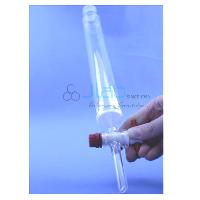
Chromatography Columns with Sintered Disc
Product Code : EL-CC-1595
Chromatography Columns with Sintered Disc are columns whose sintered disc supports the packing, made with 10 to 40 mm sinters in lengths of 100 to 500 mm.
View Details