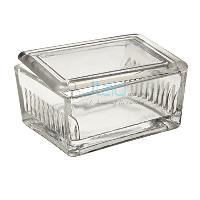

Staining Jars Manufacturer, Suppliers and Exporter in India
Jlabexport is a leading Staining Jars Manufacturer,and suppliers in India
Staining jars are reagent vessels used to immerse microscope slides during histology, cytology and general microscopy staining work. Jlab Export manufactures and exports staining jars from Ambala, India, for school, university, TVET, research and industrial laboratories, and for pathology and diagnostic laboratories.
One staining jar is currently listed in this category, product code JL-SJ-1686, at a stated size of 115 × 115 mm. Capacity, slide capacity, cover or lid arrangement, interior grooving and material of construction are not published for this item and are available on request.
Buyers specifying staining jars should treat the published size as a starting point only. The figures that determine whether a jar suits a given protocol — how many slides it holds, whether slides stand upright or lie flat, whether a lid is supplied, and which reagents the material tolerates — all need to be confirmed by quotation before an order or a tender line is committed.
Jlab Export also lists Coplin jars as a separate category. Buyers comparing slide-staining vessels should look at both.
What is listed in this category?
One product is listed: Staining Jars, product code JL-SJ-1686, with a published size of 115 × 115 mm. No other staining vessel appears in this category at present.
The listing does not state which of the two figures is diameter or height, or whether they describe a length and width. It also does not state capacity in millilitres, the number of slides the jar accepts, the slide orientation, whether a cover is included, or the material.
Because a single size is published, laboratories requiring a range of jar sizes, a matched lid, or a rack should ask Jlab Export what else can be supplied to order. Related slide-staining vessels are listed separately under Coplin Jars.
What should a buyer confirm before ordering a staining jar?
Confirm five things: slide capacity, slide orientation, internal working volume, lid or cover arrangement, and material. None of these are published in this category, and each one changes whether the jar fits a given staining protocol.
Slide capacity and orientation determine throughput and reagent consumption. Internal volume determines how much reagent each change costs across a run. The lid matters where volatile reagents are used, because an uncovered jar loses solvent and exposes the bench. Material determines which reagents the jar tolerates and whether it can be autoclaved.
Ask for these figures in writing on the quotation rather than inferring them from the published size.
How do staining jars and Coplin jars differ?
They are both vessels for immersing microscope slides in reagent, and Jlab Export lists them as two separate categories on this site. This category lists one staining jar; the Coplin Jars category lists one Coplin jar under a different product code.
The site does not publish a specification that distinguishes the two — no slide capacity, orientation or interior arrangement is stated for either. A buyer therefore cannot tell from the published data which item suits a given protocol.
If the choice matters for your workflow, ask Jlab Export to supply both specifications side by side before deciding. Both categories are linked below.
What matters when staining jars are used with volatile reagents?
Ask whether a lid or cover is supplied, and confirm the materials resistance to the specific reagents in the protocol. Neither is stated in this listing. Common histology reagents include solvents that evaporate quickly and attack unsuitable materials.
Because the material of construction is not published, no claim can be made here about chemical resistance, solvent tolerance, autoclavability or temperature range. These need to come from the manufacturer for the exact item quoted.
Laboratories with a defined staining protocol should send the reagent list with the enquiry so that a suitable item can be identified rather than assumed.
How should a school, TVET or research laboratory specify staining jars in a tender?
State the required slide capacity and orientation, internal volume, lid requirement, material and quantity for every line, and attach the staining protocol or reagent list where one exists. Do not rely on the published 115 × 115 mm figure as a complete specification.
For bulk or institutional orders, ask for a line-by-line quotation that repeats each specification back, so the offer can be checked against the tender schedule rather than against a catalogue name.
State the destination, packing and carton-marking requirements, and list any certificates or documents the tender makes mandatory.
Staining jar listing
|
Product |
Product code |
Published specification |
Not published |
|
Staining Jars |
JL-SJ-1686 |
Size 115 × 115 mm |
Capacity, slide capacity, slide orientation, lid or cover, interior grooving, material, pack quantity |
The right-hand column is not a gap in this page — it reflects what the product listing itself omits. Each item there should be requested by quotation.
Selection criteria
|
Criterion |
What to check |
|
Slide capacity |
How many slides the jar holds; not published — confirm by quotation |
|
Slide orientation |
Whether slides stand vertically or lie flat; not published |
|
Internal volume |
Reagent volume per fill, which drives running cost across a staining run |
|
Overall size |
115 × 115 mm is published; confirm which figure is diameter, height, length or width |
|
Lid or cover |
Whether a cover is supplied, and whether it seals — important for volatile reagents |
|
Material |
Not published; request the material specification and its reagent compatibility |
|
Autoclavability |
Not published; confirm if the protocol requires sterilisation |
|
Reagent compatibility |
Send the reagent list with the enquiry rather than assuming tolerance |
|
Rack compatibility |
Confirm whether any slide rack or carrier fits the jar |
|
Pack quantity |
Not published; confirm pieces per pack and total quantity |
|
Alternative vessels |
Compare against the Coplin Jars category before deciding |
Related Jlab Export pages
- Lab Glassware (parent category)
- Staining Jars (product)
- Coplin Jars (related category)
- Specimen Tubes and Vials
- Jlab Export homepage and enquiry form
Frequently asked questions
What is a staining jar used for?
A staining jar holds reagent so that microscope slides can be immersed during staining. It is used in histology, cytology, microbiology and general microscopy work, in teaching laboratories as well as pathology and diagnostic laboratories. The jar is filled with the reagent required at each step of a staining protocol.
What size staining jar does Jlab Export list?
One size is published: 115 × 115 mm, under product code JL-SJ-1686. The listing does not state which figure is the diameter or the height. Other sizes are not published on this page and should be confirmed by enquiry if a different size is required.
How many slides does the jar hold?
Slide capacity is not stated in the product listing, and neither is slide orientation. Because both determine throughput and reagent consumption, they should be confirmed on the quotation before ordering. Laboratories with a fixed protocol should state the required slide capacity in the enquiry.
Is a lid or cover included?
The listing does not say whether a lid or cover is supplied. This matters where volatile reagents are used, since an uncovered jar loses solvent during a staining run. Ask Jlab Export to confirm the cover arrangement for the exact item being quoted.
What material is the staining jar made from?
The material of construction is not stated on the category or product page, and no chemical-resistance, autoclave or temperature rating is published. Request the material specification, together with its compatibility with the reagents in your protocol, before ordering. Specifications are available on request.
Should I choose a staining jar or a Coplin jar?
Both are slide-staining vessels, and Jlab Export lists them as separate categories. The site does not publish specifications that distinguish them, so the choice cannot be made from the listed data alone. Ask for both specifications side by side, stating your slide capacity and reagent requirements.
Request a quote for staining jars
Send the required slide capacity and orientation, internal volume, lid requirement, material and quantity, together with your staining protocol or reagent list where one exists. For institutional and tender orders, attach the complete bill of quantities and state the destination, packing and documentation requirements.