

Voltameter Manufacturer, Suppliers and Exporter in India
Jlabexport is a leading Voltameter Manufacturer,and suppliers in India, United States, Indonesia, Brazil, Bangladesh, Mexico, Japan, Egypt, Philippines, Democratic Republic of the Congo, Vietnam, Iran, Turkey, Tanzania, United Kingdom, France, South Africa, Italy, Kenya, Colombia, Sudan, Uganda, South Korea, Argentina, Afghanistan, Yemen, Angola, Morocco, Poland, Uzbekistan, Mozambique, Malaysia, Ghana, Saudi Arabia, Peru, Madagascar, Côte d’Ivoire, Cameroon, Niger, Venezuela, Australia, Syria, Mali, Burkina Faso, Sri Lanka, Malawi, Zambia, Chad, Kazakhstan, Somalia, Chile, Senegal, Ecuador, Cambodia, Zimbabwe, Guinea, Benin, Rwanda, Burundi, Bolivia, South Sudan, Tunisia, Haiti, Belgium, Dominican Republic, Jordan, United Arab Emirates, Honduras, Tajikistan, Papua New Guinea, Portugal, Togo, Sierra Leone, Belarus, Laos, Turkmenistan, Libya, Kyrgyzstan, Nicaragua, Paraguay, Bulgaria, Serbia, Republic of the Congo, Lebanon, Liberia, Central African Republic, Palestine, Oman, Mauritania, New Zealand, Costa Rica, Kuwait, Panama, Croatia, Georgia, Eritrea, Mongolia, Uruguay, Qatar, Namibia, Bosnia and Herzegovina, Moldova, Armenia, Gambia, Jamaica, Lithuania, Albania, Gabon, Botswana, Lesotho, Guinea-Bissau, Slovenia, Equatorial Guinea, Latvia, North Macedonia, Bahrain, Trinidad and Tobago, Timor-Leste, Cyprus, Estonia, Eswatini, Mauritius, Djibouti, Fiji, Comoros, Solomon Islands, Guyana, Bhutan, Luxembourg, Suriname, Montenegro, Malta, Maldives, Cabo Verde, Brunei, Belize, Bahamas, Iceland, Vanuatu, Barbados, São Tomé and Príncipe, Samoa, Saint Lucia, Kiribati, Seychelles, Grenada, Saint Vincent and the Grenadines, Antigua and Barbuda.
Last updated: 14 November 2026
What Is a Voltameter Used For?
A voltameter of this type is a two-limb glass apparatus for the electrolysis of water. A DC current through acidified water splits it into hydrogen and oxygen, which collect in the two limbs in a volume ratio close to 2:1. Schools and colleges use it to demonstrate the decomposition of water and to test the gases. This range has one item, the Voltameter (With Reservoir), with platinum electrodes, a stopcock on each limb, a reservoir bulb and a metal stand. JLab (Jain Laboratory Instruments Pvt Ltd), Ambala, India, makes it.
Request a quotation | See the voltameter facts | See the practicals covered
Voltameter at a Glance
The table gives the facts stated on the product page of the Voltameter (With Reservoir).
| Feature | Detail |
|---|---|
| Purpose | Demonstrating the decomposition of water |
| Limbs | Two connected limbs, with a stopcock at the top of each |
| Reservoir | Integral reservoir tube with a funnel-shaped bulb |
| Electrodes | Platinum, mounted in rubber stoppers at the lower ends |
| Stand | Metal stand that helps prevent accidental breakage |
| Electrolyte | Water with a little dilute sulfuric acid |
| Gases collected | Hydrogen above the cathode, oxygen above the anode |
How to Choose and Set Up a Voltameter
- Demonstration use: The two limbs stand side by side, so a whole class can see that one gas forms about twice as fast as the other.
- Electrode material: Platinum does not react with the gases or the acid, so side reactions do not change the gas volumes.
- Gas testing: The stopcock at the top of each limb lets each gas be drawn off into a test tube for the splint tests.
- Power supply: Plan for a DC supply with leads to the two electrode terminals; the current direction decides which limb collects hydrogen.
- Stability: The metal stand holds the limbs upright during filling and running, which matters most on a busy demonstration bench.
Practicals Covered by the Voltameter
| Practical | Apparatus |
|---|---|
| Electrolysis of water acidified with dilute sulfuric acid | Voltameter (With Reservoir) |
| Volume ratio of hydrogen to oxygen (about 2:1) | Voltameter (With Reservoir) |
| Test for hydrogen with a lighted splint | Voltameter (With Reservoir) |
| Test for oxygen with a glowing splint | Voltameter (With Reservoir) |
| Products at the cathode and anode, and their half equations | Voltameter (With Reservoir) |
Who Uses a Voltameter?
Chemistry and physics teachers use the voltameter for class demonstrations of electrolysis. Students in secondary and college chemistry use it in practicals on electrolysis and gas tests.
Ordering, Minimum Quantity and Dispatch
| Point | Detail |
|---|---|
| Minimum order quantity | 10 units |
| Dispatch time | Usually 4–6 working days |
| Pack quantity | Each (sold individually) |
| How to enquire | Press Add To Cart on the product page, or send the quantity and the school or laboratory address through the contact page |
| Tenders and OEM supply | See laboratory tenders |
| Manufacturer | Jain Laboratory Instruments Pvt Ltd (JLab), Ambala, India |
Related Ranges in Lab Glassware
Voltameter is part of Lab Glassware. These ranges supply the ware used to prepare the electrolyte and handle the gases.
| Range | How it relates |
|---|---|
| Pipettes, Volumetric Flasks and Measuring Cylinders | Measuring cylinders and pipettes for making up the dilute acid |
| Beakers and Flasks | Borosilicate beakers and flasks for mixing and holding the electrolyte |
| Screw Caps, Stoppers and Stopcocks | Straight-through glass key and PTFE key stopcocks, and stoppers |
| Test Tubes and Thermometer Pockets | Test tubes with joint sockets, from 2 ml to 195 ml |
| Funnels | Filter funnels, including soda glass funnels, for pouring liquids |
Frequently Asked Questions
Which gas collects at each electrode?
Hydrogen collects above the cathode, the electrode joined to the negative terminal. Oxygen collects above the anode, joined to the positive terminal. The hydrogen limb fills about twice as fast, which makes the two easy to tell apart.
What are the half equations at the electrodes?
At the cathode, hydrogen ions gain electrons: 2H+ + 2e- → H2. At the anode, water loses electrons: 2H2O → O2 + 4H+ + 4e-. Four electrons give two hydrogen molecules for every oxygen molecule, so the volumes come out near 2:1.
Why is a little sulfuric acid added to the water?
Pure water conducts poorly, so almost no gas forms. A little dilute sulfuric acid gives ions that carry the current, and it is not used up overall. Common salt is avoided, because chlorine then forms at the anode instead of oxygen.
Why is the oxygen volume often less than half the hydrogen?
Oxygen dissolves in water more than hydrogen does, so some of the first oxygen stays in solution. Run the current for a few minutes, release both gases through the stopcocks, then close them and start measuring.
How do you stop a glass voltameter from breaking?
Keep it in its metal stand while filling, running and emptying, and pour liquid into the reservoir bulb slowly. Turn the stopcocks gently, rinse out the acid after use and store the apparatus upright.
Request a Quote
Name the number of voltameters you need, give the school or laboratory address for delivery, and send them through the contact page or with Add To Cart on the product page.
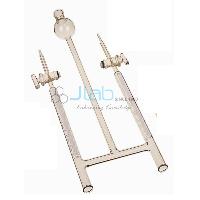
Voltameter (With Reservoir)
Product Code : EL-V-1700
This Voltameter demonstrates the decomposition of water, collecting hydrogen and oxygen in two limbs above platinum electrodes.
View Details