

Voltameter (With Reservoir) Manufacturer,Supplier and Exporter in India
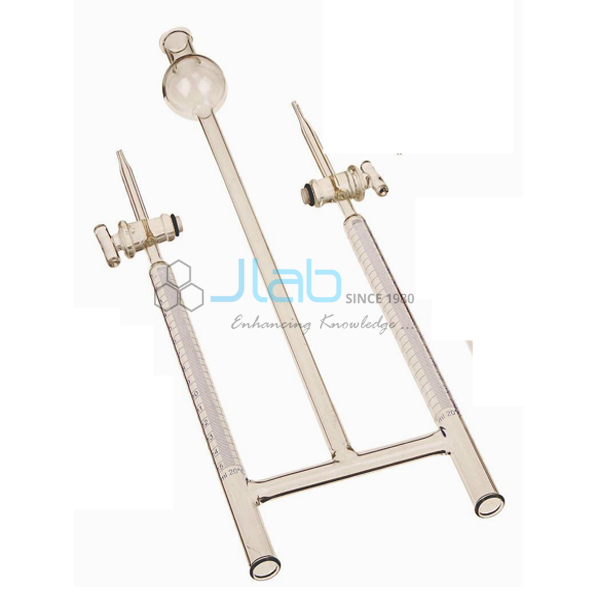
Product Code : EL-V-1700
Jlab Export is a leading Voltameter (With Reservoir) Manufacturer,and suppliers in India
This Hofmann-pattern voltameter shows water being split by an electric current into hydrogen and oxygen, which collect in two separate limbs. Platinum electrodes in rubber stoppers close the lower ends of the limbs. A central reservoir with a funnel-shaped bulb feeds the electrolyte, and a stopcock at the top of each limb lets the gas out for testing.
Construction
| Use | Decomposition of water by electrolysis |
| Limbs | Two connected limbs, with a stopcock at the top of each |
| Reservoir | Central reservoir tube with a funnel-shaped bulb |
| Glass | Borosilicate glass |
| Electrodes | Platinum, mounted in rubber stoppers in the open lower ends of the limbs |
| Mounting | Metal stand |
| Minimum order quantity | 10 units |
| Dispatch time | Usually 4–6 working days |
| Manufacturer | JLab (Jain Laboratory Instruments Pvt Ltd), Ambala, India |
Electrolysis Practicals for Students
In the usual school practical, the voltameter is filled with water made conducting by a little dilute sulfuric acid or sodium sulfate. The electrodes are joined to a Battery Eliminator (0-12 Volts) with Connecting Leads. Gas collects at both electrodes, and the limb on the negative side fills about twice as fast. An Ammeter in the circuit shows that a larger current gives gas more quickly.
Students then test each gas. Hydrogen burns with a squeaky pop at a lighted splint, and oxygen relights a glowing splint. With sodium sulfate and a few drops of universal indicator as the electrolyte, the liquid turns red near the positive electrode. Near the negative one it turns blue or violet, as acid and alkali form.
Frequently Asked Questions
Why does the hydrogen limb fill twice as fast as the oxygen limb?
Water holds two hydrogen atoms for every oxygen atom, so electrolysis releases two volumes of hydrogen for each volume of oxygen. Hydrogen forms at the negative electrode and oxygen at the positive one.
Why is the oxygen often a little less than half the hydrogen?
Oxygen dissolves in water more than hydrogen does, so at first some of it stays in the solution, and a little can react at the electrode. Running the voltameter for a while, then releasing the gas and starting again, brings the ratio closer to two to one.
Why does my hydrogen not give a pop?
Usually too little gas has collected, or it has mixed with too much air. Let a full column build up, hold a test tube mouth down over the stopcock, open it slowly and bring the flame to the tube at once. A weak electrolyte also slows the gas.
How do I fill it without trapping air?
Mix the electrolyte in a beaker first, then pour it into the reservoir bulb with both stopcocks open. The liquid rises in the limbs and pushes the air out at the top. Close each stopcock as soon as liquid reaches it.
Is a voltameter the same as a voltmeter?
No. A voltmeter measures potential difference, while a voltameter collects and measures the products of electrolysis, here the two gases. Voltameters were once used to measure the quantity of electricity passed, from the amount of gas set free.
Other Electrolysis Apparatus
- Hoffman Voltameter (PTFE) with Electrodes
- Electrolysis Kit
- Electrolysis Apparatus
- Hoffman Voltameter Stand incl
For a quote, use Add To Cart or send us a message through the contact page.
Last updated: 19 November 2026