

Chromatography Columns with Sintered Disc Manufacturer,Supplier and Exporter in India
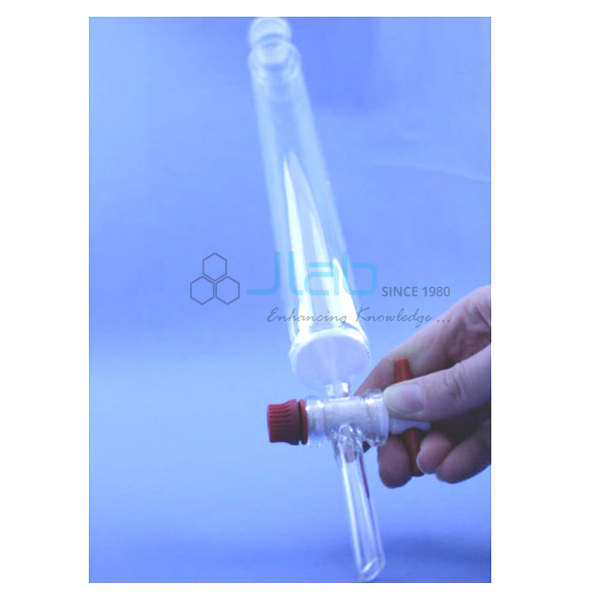
Product Code : EL-CC-1595
Jlab Export is a leading Chromatography Columns with Sintered Disc Manufacturer,and suppliers in India
A sintered glass disc at the foot of this column holds the packing, so no cotton plug is needed. Sinter plate diameters run from 10 to 40 mm and lengths from 100 to 500 mm, and each column has a ground socket at the top.
Column Sizes and Sockets
| Packing support | Sintered glass disc |
| Sinter plate diameter 10 mm | 14/23 socket, lengths 100, 200, 300 and 400 mm |
| Sinter plate diameter 20 mm | 19/26 socket, lengths 100, 200, 300, 400 and 500 mm |
| Sinter plate diameter 25 mm | 24/29 socket, lengths 300, 400 and 500 mm |
| Sinter plate diameter 30 mm | 34/35 socket, lengths 400 and 500 mm |
| Sinter plate diameter 40 mm | 40/45 socket, lengths 400 and 500 mm |
| Minimum order quantity | 50 units |
| Dispatch time | Usually 3–5 working days |
| Manufacturer | JLab (Jain Laboratory Instruments Pvt Ltd), Ambala, India |
Column Chromatography Experiments
A classic college experiment separates the pigments of spinach leaves. Students pack the column with silica gel or alumina as a slurry, load a narrow band of leaf extract and run a non-polar solvent through. The yellow-orange carotene band leaves first, and the green chlorophylls follow when a more polar solvent is added.
Solvent can be fed from one of the Pear Shaped Funnels, Stem with Cone JLab, whose cone fits the 14/23, 19/26 and 24/29 sockets. Fractions go into test tubes and are checked by TLC, spotted with Glass Capillary Tubes for TLC Spotting. A short 10 mm column gives a quick dye demonstration, and a longer one shows how bed length improves separation.
Frequently Asked Questions
Do I need cotton wool or sand above the sintered disc?
No cotton plug is needed, because the disc holds the packing. Add a thin layer of clean sand on the disc and another on top of the bed. The sand keeps the surface level when solvent is poured in.
Will silica gel wash through the sinter?
Silica and alumina sold for columns normally stay above a sintered disc. Very fine powders, such as the grade used to coat TLC plates, can creep into the pores and slow the flow, so use packing made for columns.
Which column size should I choose?
Match the column to the sample. A narrow 10 mm column suits a few drops of extract, while the 30 and 40 mm columns take larger beds for bigger samples. Longer columns help when bands run close together.
How do I stop air bubbles and cracks in the packing?
Pour the slurry in one go and tap the column gently as it settles, so trapped air rises out. Never let the solvent fall below the top of the bed. A bed that runs dry cracks, and the bands then run unevenly.
How do I clean the column after use?
Tip out the old packing and rinse the disc from below with solvent, then water, until it runs clear. Do not scrape the sinter or use strong alkali, which attacks sintered glass.
Why do the pigments separate on the column?
Each compound is held on the surface of the silica or alumina to a different degree. Less polar ones are held weakly and move down quickly with the solvent, while polar ones stay longer. This is adsorption chromatography.
Other Sinters, Funnels and Chromatography Kits
- Economy Range Sintered Discs
- Pressure Equalising Funnels, Pear Shaped JLab
- Chromatography Set (paper chromatography kit)
For a quote, use Add To Cart or send us a message through the contact page.
Last updated: 19 November 2026