Flow Through Helical Coil Manufacturer,Supplier and Exporter in India
Product Code : EL-TWL-9121
Jlab Export is a leading Flow Through Helical Coil Manufacturer,and suppliers in India
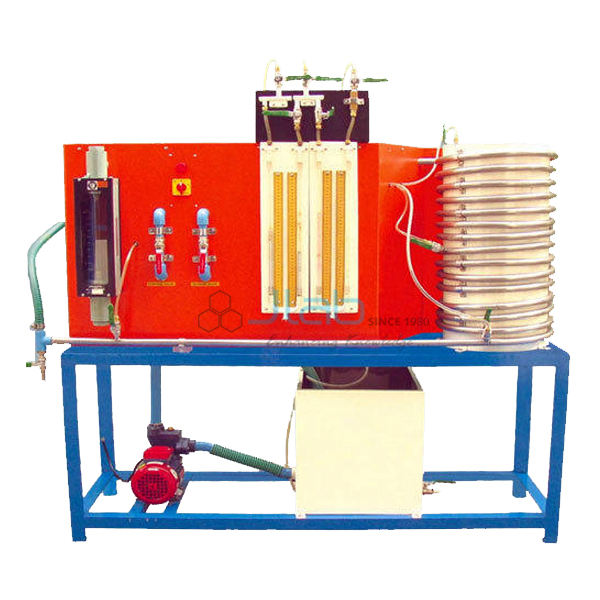
Water pumped round a stainless steel coil of 15 turns shows how flow behaves in a curved tube, where the bends set up secondary currents that raise friction. A rotameter shows the flow and manometers read the pressures, so students can work out a friction factor for each flow and plot it against the Reynolds number.
Specifications
| Helical coil | Stainless steel, 12 in coil diameter, 15 turns |
| Coil tube | 21 mm OD, 17 mm ID (approx.) |
| Sump tank | Stainless steel or PVC, 50 litres |
| Water circulation | FHP pump |
| Flow measurement | Rotameter |
| Manometers | 2 |
| Piping | GI and PVC |
| Control panel | On/off switch and mains indicator |
| Minimum order quantity | 1 unit |
| Dispatch time | Usually 14–18 working days |
| Manufacturer | JLab (Jain Laboratory Instruments Pvt Ltd), Ambala, India |
Experiments on Flow in a Coiled Tube
For each rotameter setting, students read the manometer and work out the velocity, the Reynolds number and the friction factor from the pressure drop over the coil length. Before the main run they check the rotameter by timing water into a Measuring Cylinder, since the friction factor depends on the square of the velocity.
Tests over the same Reynolds numbers on a straight pipe of the Friction in Pipe Lines Apparatus put the coiled and straight friction curves side by side. The Dean number, De = Re √(d/D), with d the tube bore and D the coil diameter, measures how strongly the curvature drives the secondary flow.
Frequently Asked Questions
Why is the pressure drop higher in a coil than in a straight tube?
In a bend, the faster fluid at the centre is thrown outward. This sets up a pair of swirling secondary currents, called Dean vortices, which steepen the velocity gradient at the wall and add to the friction.
Does flow stay laminar to a higher Reynolds number in a coil?
Yes. The secondary currents steady the flow, so laminar flow lasts to a higher Reynolds number than in a straight pipe. The tighter the coil, meaning the larger the ratio of tube bore to coil diameter, the higher that critical value.
How is the friction factor worked out from the readings?
Convert the manometer reading to head loss h in metres of water. Take the mean velocity v from the flow, the tube bore d and the coil length L. The Darcy friction factor is then f = 2 g d h / (L v²).
How is the coil length found?
The tube length in the coil is close to the number of turns times π times the coil diameter. For a more exact value, use the diameter measured to the centre line of the tube and add any straight lengths between the pressure tappings.
Other Pipe Flow and Friction Apparatus
For a quote, use Add To Cart or send us a message through the contact page.
Last updated: 6 November 2026