Reynolds Apparatus Manufacturer,Supplier and Exporter in India
Product Code : EL-TWL-9127
Jlab Export is a leading Reynolds Apparatus Manufacturer,and suppliers in India
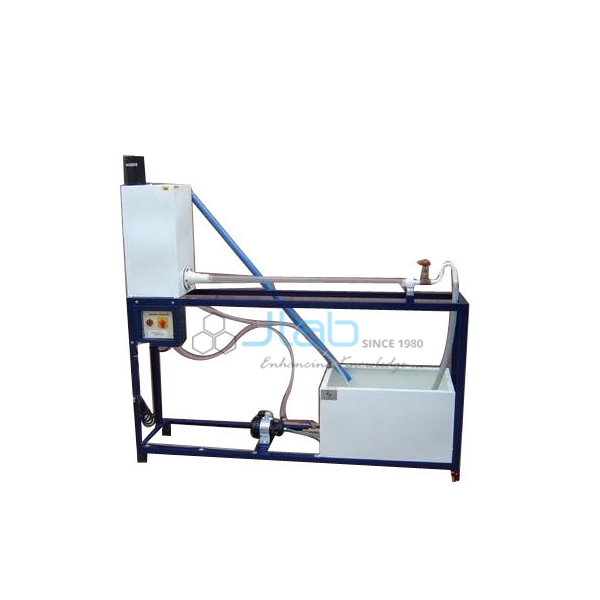
Dye fed through a fine capillary at the bell-mouth entry of a glass tube marks the flow. Students watch it change from a straight thread to full mixing as the outlet cock is opened. Timing the outflow into the measuring cylinder gives the velocity, and from it the Reynolds number for each flow pattern.
Specifications
| Test tube | Borosilicate glass, bell-mouth entrance from the water tank |
| Flow control | Cock at the outlet end |
| Dye injection | Copper or stainless steel capillary at the centre of the bell mouth |
| Dye vessel | Stainless steel, on top of the constant head tank, polythene feed tubing |
| Constant head tank | 40 litres |
| Sump tank | 60 litres |
| Water circulation | FHP pump |
| Flow measurement | Measuring cylinder and electronic stop watch, supplied |
| Control panel | On/off switch and mains indicator |
| Minimum order quantity | 1 unit |
| Dispatch time | Usually 14–18 working days |
| Manufacturer | JLab (Jain Laboratory Instruments Pvt Ltd), Ambala, India |
Classroom Demonstrations and Practicals
Students open the cock in small steps and note, at each setting, whether the dye line is straight, wavy or fully mixed. For each they collect outflow over a timed interval, find the velocity v = Q/A and work out Re = ρ v D / μ. Water viscosity changes with temperature, so they read the tank water with a Digital Stem Thermometer before each run.
The critical values found here explain the head loss results on the Friction in Pipe Lines Apparatus. There, head loss rises in proportion to velocity in laminar flow and close to the square of velocity in turbulent flow.
Frequently Asked Questions
At what Reynolds number does the flow turn turbulent?
In a straight pipe the flow is usually laminar below a Reynolds number of about 2000 and turbulent above about 4000, with a transition band between. The exact value depends on how calm the inlet is, which is why the tube has a bell-mouth entry from a constant head tank.
Why does the tube have a bell-mouth entrance?
A sharp-edged entry throws off eddies that can start turbulence early. The rounded bell mouth lets water enter smoothly, so laminar flow holds to a higher Reynolds number and the dye thread stays clear.
What dye should be used?
Use a dilute, water-soluble ink or food colour with a density close to that of water, so the trace neither sinks nor rises. Feed it slowly, as a strong jet from the capillary disturbs the flow it is meant to show.
How is the velocity worked out?
Collect the outflow in the measuring cylinder for a timed period to get the discharge Q. Divide Q by the bore area, π D²/4, to get the mean velocity. Repeat each reading and take the mean.
Other Laminar and Turbulent Flow Apparatus
- Reynolds Apparatus (vertical glass pipe with heater module)
- Flow Through Helical Coil
- Pipe Friction Apparatus
For a quote, use Add To Cart or send us a message through the contact page.
Last updated: 6 November 2026