Differential Voltage Sensor Manufacturer,Supplier and Exporter in India
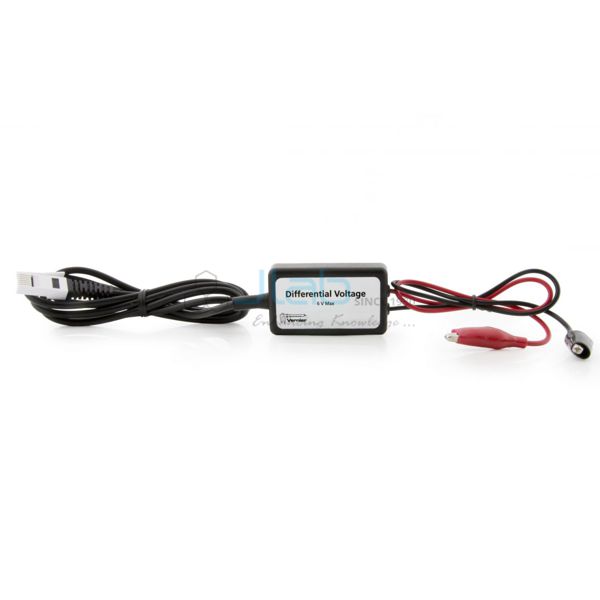
Product Code : EL-TWL-9197
Jlab Export is a leading Differential Voltage Sensor Manufacturer,and suppliers in India
This differential voltage sensor reports the potential difference between its red and black leads over ±6.0 V, with a resolution of 3.1 mV. Neither lead is tied to a shared ground, so several sensors can measure different parts of one circuit at the same time. It suits low-voltage AC and DC work such as battery and bulb circuits.
Specifications
| Input voltage range | ±6.0 V |
| Maximum voltage on any input | ±10 V |
| Resolution | 3.1 mV |
| Differential impedance | >20 MΩ |
| Input impedance (to ground) | 10 MΩ |
| Linearity | 0.01% |
| Supply voltage | 5 V DC |
| Leads | Red and black, reading the potential difference between them |
| Minimum order quantity | 5 units |
| Dispatch time | Usually 7–10 working days |
| Manufacturer | JLab (Jain Laboratory Instruments Pvt Ltd), Ambala, India |
Circuit Experiments for Physics Students
A series circuit is the usual start. Students wire two torch bulbs in Bulb Holder units to AA cells in Single Battery Holder units and clip one sensor across each bulb and one across the cells. The bulb voltages add up to the cell voltage, which is Kirchhoff’s voltage law.
Rewired in parallel, every branch shows the same voltage. Adding a Low Current Sensor in the main lead lets the class plot voltage against current for a bulb and see that its resistance rises as the filament heats. In a low-voltage AC circuit, a logger records the changing voltage as a waveform.
Frequently Asked Questions
Why use a differential sensor instead of a plain voltage sensor?
A plain sensor measures against a ground it shares with the interface. With two or more in one circuit, those grounds can short parts of the circuit together. A differential sensor reads only between its own two leads, so several can sit anywhere in the circuit.
What voltage can it measure?
Up to ±6.0 V between the red and black leads. Neither lead should go beyond ±10 V from ground. That covers circuits run from a few cells or a low-voltage supply.
Will the sensor change the current in my circuit?
Very little. The differential impedance is above 20 MΩ, so the sensor draws a tiny current compared with the bulbs and resistors used in school circuits.
How small a change can it show?
The resolution is 3.1 mV, the smallest step between two readings. That is fine enough to see the small drop across a connecting lead or a switch contact.
What power does the sensor need?
It runs on a 5 V DC supply. The voltage being measured does not power it, so the sensor reads correctly even across a bulb that has gone out.
Other Sensors and Meters for Electricity Practicals
For a quote, use Add To Cart or send us a message through the contact page.
Last updated: 6 November 2026