Emulsion Polymerization Reactor Manufacturer,Supplier and Exporter in India
Product Code : EL-TWL-9153
Jlab Export is a leading Emulsion Polymerization Reactor Manufacturer,and suppliers in India
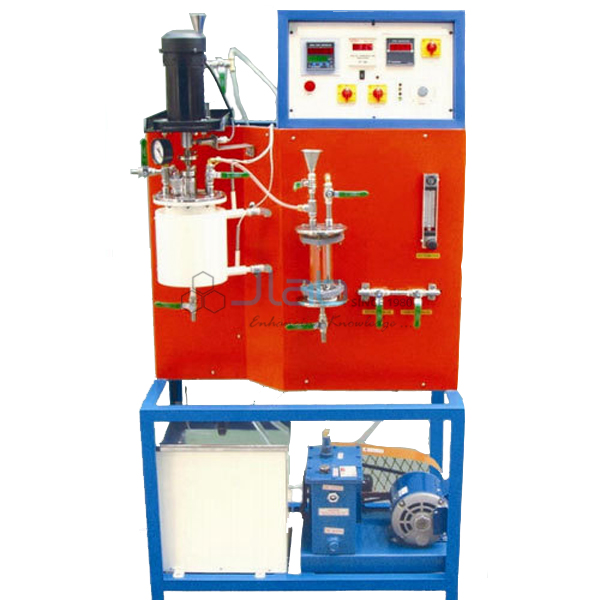
Styrene and similar unsaturated monomers are polymerised here as an oil-in-water emulsion, under air-free nitrogen. The jacketed stainless steel reactor has a variable speed agitator and baffles, and hot water from a digitally controlled bath is pumped through its jacket. Initiator comes from a reservoir under pressure, and sampling ports give kinetic data as conditions are changed.
Specifications
| Reactor | Jacketed stainless steel, with variable speed agitator and baffles |
| Heating | Hot water from a digitally controlled water bath, pumped through the jacket |
| Initiator feed | From a reservoir, under pressure |
| Inert gas | Metered nitrogen through a de-oxygenation column |
| Air removal | Evacuation to 30 mm Hg before nitrogen is passed |
| Sampling | Sampling ports |
| Electricity | 1.5 kW, single phase |
| Services needed | Water supply, floor drain, vacuum pump, high purity nitrogen |
| Minimum order quantity | 1 unit |
| Dispatch time | Usually 14–18 working days |
| Manufacturer | JLab (Jain Laboratory Instruments Pvt Ltd), Ambala, India |
Polymerisation Experiments for Students
Before each run a Vacuum Pump draws the air out of the reactor, and nitrogen from the de-oxygenation column takes its place. Students charge water, emulsifier and monomer, bring the jacket to temperature and add the initiator. Samples from the ports go into weighed dishes with a trace of inhibitor and are dried to constant weight in a Hot Air Oven.
Weighing the dry solids on an Electronic Analytical Balance gives the polymer formed and so the conversion at each time. Separate runs change one factor at a time: agitator speed, emulsifier, initiator or monomer concentration. Smith-Ewart theory predicts that more emulsifier and more initiator both give more particles and a faster rate, which the conversion curves can test.
Frequently Asked Questions
Why must air be removed before the run?
Oxygen reacts with the free radicals that start and grow polymer chains, so it delays or stops the reaction. The reactor is evacuated to 30 mm Hg, then filled and kept under nitrogen that has passed through the de-oxygenation column.
What does each ingredient do?
Water is the continuous phase and carries away heat. The emulsifier forms micelles and keeps monomer droplets and polymer particles stable. The water-soluble initiator makes radicals in the water, and these enter the micelles, where the oil-soluble monomer polymerises.
How is conversion measured?
A sample from a port is weighed, a trace of inhibitor stops the reaction, and the sample is dried to constant weight. The solids left, less the emulsifier and initiator, give the polymer formed. Dividing by the monomer in that sample gives the conversion.
Which factors can students vary?
The set-up is planned for the effect of agitator speed, emulsifier concentration, initiator concentration and monomer concentration on conversion. Temperature can be changed too, through the water bath that heats the jacket.
Why is the monomer washed before a run?
Monomers such as styrene are sold with a little inhibitor that stops them polymerising in storage. Left in, it uses up the first radicals and delays the start of conversion. Washing the monomer with dilute sodium hydroxide solution and then water removes it.
Other Reactors for Kinetics Work
For a quote, use Add To Cart or send us a message through the contact page.
Last updated: 6 November 2026