Condensation Polymerization Reactor Manufacturer,Supplier and Exporter in India

Product Code : EL-TWL-9155
Jlab Export is a leading Condensation Polymerization Reactor Manufacturer,and suppliers in India
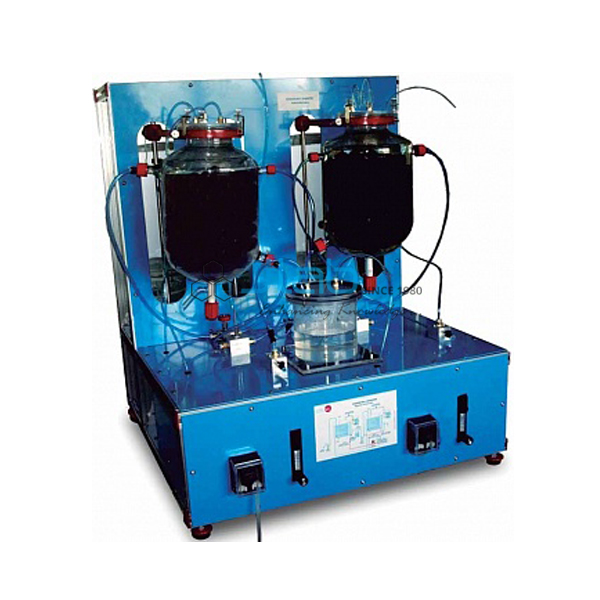
Condensation polymers such as polyesters grow by joining monomers and splitting off a small molecule, usually water. This batch reactor carries out that reaction under nitrogen in a jacketed 1 litre stainless steel vessel with stirring and baffles. Vapour leaves through a concentric tube condenser to a Perkin triangle, and samples give the extent of reaction and the rate constant.
Specifications
| Reactor | Stainless steel, jacketed, about 1 litre, with baffles |
| Stirrers | Two, stainless steel impeller and shaft with motor, variable speed |
| Heating | Nichrome wire heaters, digital temperature controller |
| Water bath | Stainless steel, double wall, ceramic wool insulation |
| Feed | Top funnel with SS ball valve |
| Condenser | Concentric tube type, with Perkin triangle for the condensate |
| Nitrogen | Metered from a cylinder, regulator end connection 1/4 in BSP female |
| Timer | Electronic stopwatch |
| Electricity | Single phase, 220 V AC, 50 Hz, 5–15 A socket with earth |
| Floor area | 1.5 m x 1 m |
| Minimum order quantity | 1 unit |
| Dispatch time | Usually 14–18 working days |
| Manufacturer | JLab (Jain Laboratory Instruments Pvt Ltd), Ambala, India |
Polycondensation Experiments
A common practical is the polyesterification of a dicarboxylic acid with a diol, run once on its own and once with a little acid catalyst. Nitrogen sweeps the vessel as the charge is heated, and the water formed condenses and collects in the Perkin triangle. Samples taken at fixed times are dissolved and titrated with alcoholic Potassium Hydroxide (Pellets) solution from a Burette. A Measuring Cylinder gives the volume of water collected.
The extent of reaction p is the fraction of acid groups used up. With no added catalyst the acid catalyses its own reaction, and 1/(1 - p)² rises in a straight line with time. With a strong acid catalyst the reaction is second order and 1/(1 - p) is linear in time. The slopes give the two rate constants, and 1/(1 - p) is also the number-average degree of polymerization.
Frequently Asked Questions
How do acid-catalysed and self-catalysed runs differ?
In a self-catalysed polyesterification a second acid group acts as the catalyst, so the rate depends on acid concentration squared and slows sharply as acid is used up. A strong acid catalyst stays at a constant level, so the rate becomes second order and the reaction runs faster.
Why is nitrogen passed into the reactor?
Nitrogen keeps air away from the hot reaction mass, which limits oxidation and discolouring of the polymer. It also helps carry the water vapour formed by the reaction out to the condenser.
Why must the water be removed?
Polycondensation is an equilibrium. Taking away the water formed drives the reaction forward, so the chains keep growing. The condensate collected also gives a running check on how far the reaction has gone.
How is the extent of reaction measured?
Samples are titrated for the acid groups left, and p = (C0 - C)/C0, with C0 the starting acid concentration. The volume of water collected gives a second estimate, since one water molecule forms with each ester link.
How is the reactor cleaned between runs?
The top cover comes off, so the vessel, stirrers and baffles can be reached. Remove the polymer while it is still warm and soft, because many polyesters set hard as they cool.
Other Batch Reaction Units
For a quote, use Add To Cart or send us a message through the contact page.
Last updated: 6 November 2026