Isothermal Batch Reactor Manufacturer,Supplier and Exporter in India

Product Code : EL-TWL-9135
Jlab Export is a leading Isothermal Batch Reactor Manufacturer,and suppliers in India
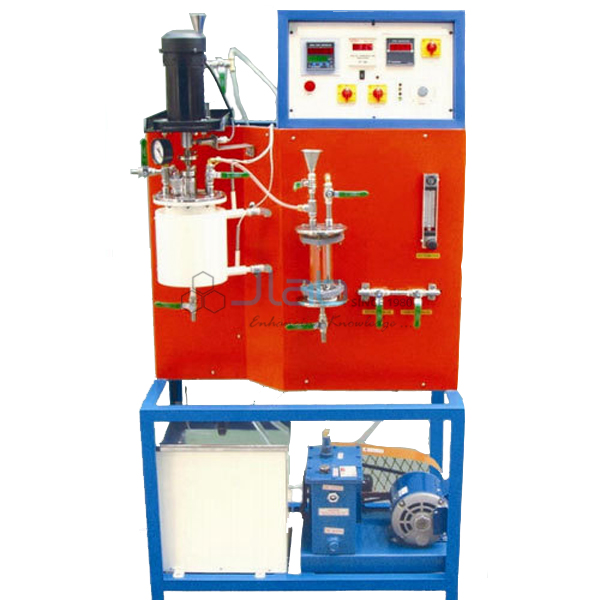
Rate data for a homogeneous liquid reaction are gathered here in a closed, stirred vessel held at one temperature. The 2 litre stainless steel reactor sits in a constant temperature water bath, set from ambient to 90 °C by a digital controller. One stirrer mixes the reaction mass and another keeps the bath even, while samples are drawn with a pipette.
Technical Details
| Reactor | Stainless steel, about 2 litres |
| Water bath | Stainless steel, double wall, ceramic wool insulation |
| Bath temperature | Ambient to 90 °C |
| Temperature control | Digital PID controller, 0–199.9 °C, RTD PT-100 sensor |
| Heater | Nichrome wire |
| Stirrers | Two, stainless steel impeller and shaft on FHP motor |
| Sampling | Sampling pipette |
| Electricity | Single phase, 220 V AC, 50 Hz, 5–15 A socket with earth |
| Floor area | 1.0 m x 0.5 m |
| Minimum order quantity | 1 unit |
| Dispatch time | Usually 14–18 working days |
| Manufacturer | JLab (Jain Laboratory Instruments Pvt Ltd), Ambala, India |
Batch Kinetics Experiments
Students charge the reactor with ethyl acetate solution, let it reach bath temperature, then pour in sodium hydroxide of the same strength and start a Digital Stop Watch. Samples taken at fixed times are run into excess standard acid, which stops the reaction. A back titration then gives the alkali left at each time.
With equal starting concentrations, 1/C_A against time gives a straight line of slope k for this second-order reaction. Repeating the run at two or three bath settings gives k at each temperature, and the slope of ln k against 1/T gives the activation energy. Instead of titrating, students can dip the probe of a Digital Conductivity Meter into each sample and read conversion from a calibration line made with standards.
Frequently Asked Questions
How does the water bath keep the run isothermal?
The reactor sits inside the bath, so heat from the reaction passes into the water. A PID controller reads the RTD PT-100 sensor and switches the nichrome heater, and a second stirrer keeps the bath uniform. The reaction mass stays at the set point, so k does not drift during a run.
How do I find the order of the reaction?
Use the integral method. Plot ln C_A and then 1/C_A against time. If ln C_A gives the straight line the reaction is first order, and if 1/C_A does it is second order. The slope of the straight plot is the rate constant.
Why is a batch reactor called a closed system?
Once the reactants are charged, no stream enters or leaves apart from the small samples. The volume stays constant and the composition changes only with time, so the mole balance reduces to the rate of change of concentration.
What services must the lab provide?
A single phase 220 V AC, 50 Hz supply on a 5–15 A socket with earth, and an earth voltage below 5 V. The unit also needs a water supply, a floor drain and a floor area of 1.0 m x 0.5 m.
How does it differ from the semi-batch version?
Here both reactants are in the vessel from the start. The Isothermal Semi Batch Reactor starts with one reactant and receives the other from a feed tank during the run. That feed is metered on a rotameter, so the concentrations change by feed as well as by reaction.
Other Batch and Continuous Reactors
- Adiabatic Batch Reactor (insulated Dewar flask with a stirrer)
- Isothermal Continuous Stirred Tank Reactor
- Batch Enzyme Reactor
For a quote, use Add To Cart or send us a message through the contact page.
Last updated: 6 November 2026