Isothermal Continuous Stirred Tank Reactor Manufacturer,Supplier and Exporter in India

Product Code : EL-TWL-9131
Jlab Export is a leading Isothermal Continuous Stirred Tank Reactor Manufacturer,and suppliers in India
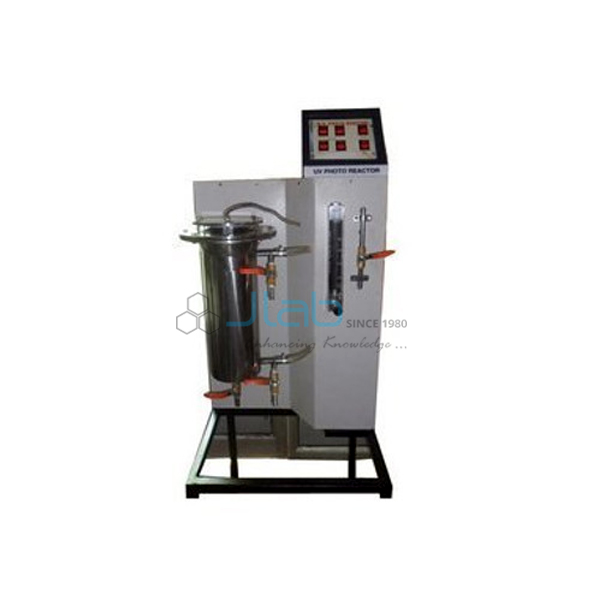
A constant temperature water bath around this continuous stirred tank reactor lets the same reaction be run at several fixed temperatures. A magnetic drive pump delivers the two reactants from their feed tanks through rotameters, and a stirrer keeps the contents uniform. Samples from the top outlet show the steady-state conversion at each temperature.
Specifications
| Reactor type | Continuous stirred tank, isothermal |
| Temperature control | Constant temperature water bath arrangement |
| Feed | Two feed tanks |
| Feed circulation | Magnetic drive pump |
| Flow measurement | Rotameters with needle valves |
| Mixing | Stirrer |
| Sampling | Top outlet |
| Services | Single phase 220 VAC, 1.5 kW, water supply and drain |
| Minimum order quantity | 1 unit |
| Dispatch time | Usually 14–18 working days |
| Manufacturer | JLab (Jain Laboratory Instruments Pvt Ltd), Ambala, India |
Practicals on Rate and Temperature
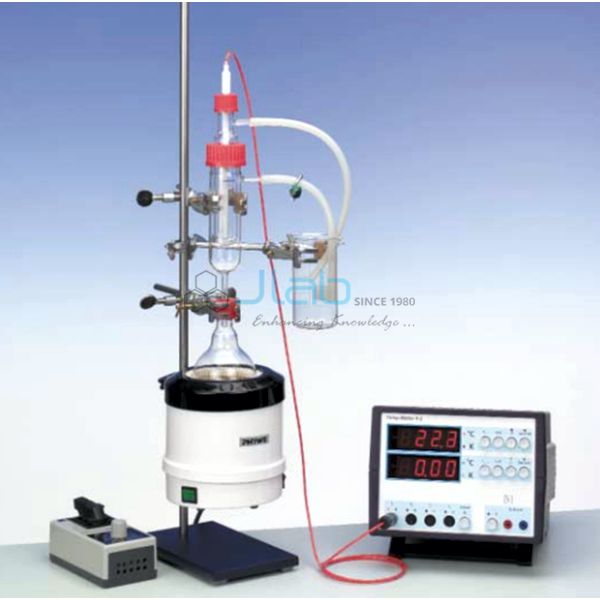
Saponification of ethyl acetate with sodium hydroxide is run at three or four bath temperatures. At each, students check the reactor temperature with a Digital Stem Thermometer, wait for steady state and titrate the alkali left in outlet samples with a Burette. From the conversion X and the space time τ, k = X / (τ C_A0 (1 - X)²).
A plot of ln k against 1/T gives a straight line of slope -E/R, and so the activation energy. Students can then predict the conversion at a new temperature and test the prediction on the next run.
Frequently Asked Questions
What does isothermal mean for this reactor?
The water bath holds the reactor at one temperature for the whole run. The rate constant is then fixed during the run, and results from runs at different bath temperatures can be compared.
How is the activation energy found?
Find k at three or more temperatures. By the Arrhenius law, k = A exp(-E/RT), so ln k plotted against 1/T, with T in kelvin, gives a line of slope -E/R. Multiply the slope by -R to get E.
How does it differ from the plain CSTR?
The Continuous Stirred Tank Reactor pushes its feed with compressed air and runs at room temperature. This reactor uses a magnetic drive pump for the feed and sits in a constant temperature water bath, so the effect of temperature can be studied.
Why is a magnetic drive pump used for the feed?
Its impeller is turned through a magnetic coupling, so there is no shaft seal for the alkali to leak through or wear. Flow is set on the rotameter needle valves.
Why is it also called a back-mix reactor?
Fresh feed is mixed back into the whole contents straight away, instead of moving through as a plug. The names vat, back-mix and mixed flow reactor all describe this ideal of perfect mixing, on which the design calculations are based.
Other Isothermal Reactors
For a quote, use Add To Cart or send us a message through the contact page.
Last updated: 6 November 2026