RTD Studies in Plug Flow Reactor Manufacturer,Supplier and Exporter in India

Product Code : EL-TWL-9137
Jlab Export is a leading RTD Studies in Plug Flow Reactor Manufacturer,and suppliers in India
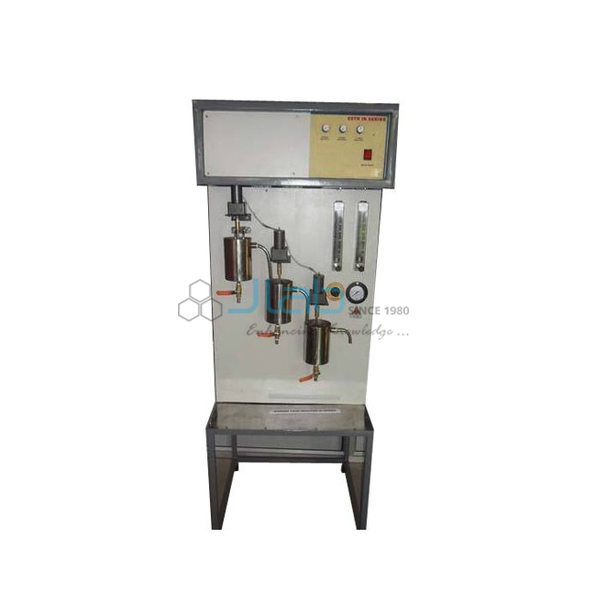
A syringe port at the bottom of a stainless steel coil lets students inject a tracer pulse into steady water flow. They then see how far it has spread by the time it reaches the top. Water comes from one feed tank by a magnetic drive pump, set on a rotameter with a needle valve. The outlet samples give the residence time distribution of the coil.
Specifications
| Reactor | Helical coil tube plug flow reactor, stainless steel pipe |
| Feed tank | One, for water |
| Feed circulation | Magnetic drive pump |
| Flow measurement | Rotameter with needle valve |
| Tracer injection | By syringe at the lower end of the coil |
| Sampling | At the top outlet of the coil |
| Objective | To plot the RTD curve of a plug flow reactor |
| Minimum order quantity | 1 unit |
| Dispatch time | Usually 14–18 working days |
| Manufacturer | JLab (Jain Laboratory Instruments Pvt Ltd), Ambala, India |
Tracer Experiments on the Coil
Students set a steady flow, inject a small pulse of dilute Potassium Permanganate solution and start timing. Outlet samples are collected at short intervals and read on a Digital Photo Colorimeter. In dilute solution the absorbance rises in step with tracer concentration, so the readings trace the outlet curve.
Dividing each reading by the area under the curve gives E(t). The mean residence time t_m is the first moment of E(t), and the variance σ² is the spread about it. When the spread is small, D/uL is close to half of σ²/t_m², and t_m²/σ² gives N for the tanks-in-series model. The result helps explain conversion data from the Plug Flow Reactor (Coiled Tube Type), which also uses a helical coil.
Frequently Asked Questions
What is a stimulus-response test?
The flow is disturbed with a known input of tracer, and the outlet is watched to see how the vessel responds. Here the input is a pulse from the syringe at the lower end of the coil. The shape of the outlet curve shows how long fluid elements stay inside.
What makes a real coil depart from plug flow?
Liquid near the wall moves slower than liquid at the centre, and diffusion spreads the tracer along the tube. In vessels generally, channelling, recycling and stagnant pockets widen the curve too. The secondary flow at each turn of a coil mixes liquid across the tube and narrows the spread.
Can a step input be used instead of a pulse?
A step input means switching the whole feed to tracer solution at one moment. The outlet then traces an S-shaped F(t) curve, and E(t) is its slope. With one feed tank and a syringe port, this unit is set up for pulses.
How do I check the mean residence time?
Compare t_m from the E(t) curve with the coil volume divided by the flow rate. The two should agree. If t_m comes out smaller, part of the coil is not being swept by the flow. A long tail shows liquid trading slowly with stagnant pockets.
Other RTD and Flow Reactor Units
- RTD Studies in CSTR JLab (stirred tank version of the tracer study)
- RTD Packed Bed Reactor Apparatus
- Plug Flow Reactor
For a quote, use Add To Cart or send us a message through the contact page.
Last updated: 6 November 2026