Liquid Chromatography Digital System Manufacturer,Supplier and Exporter in India
Product Code : EL-TWL-9106
Jlab Export is a leading Liquid Chromatography Digital System Manufacturer,and suppliers in India
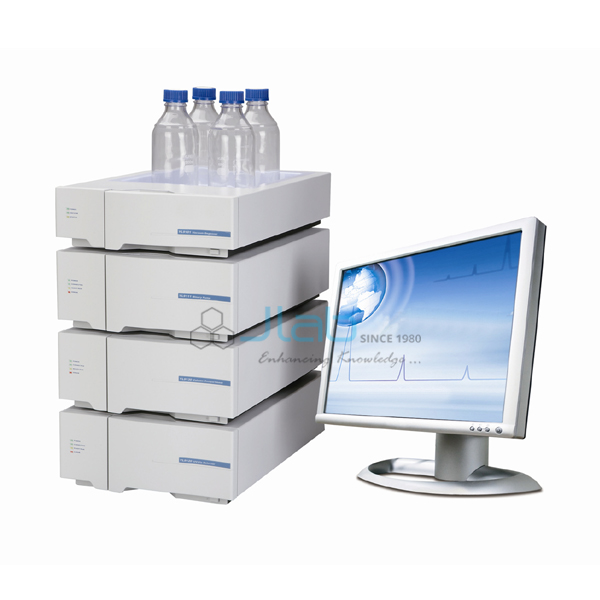
This liquid chromatography system is a modular HPLC for teaching and analysis labs. It can be set up with a quaternary low-pressure gradient pump or a binary high-pressure gradient pump. It also has a four-channel vacuum degasser and a column compartment from 4 to 90 °C. Detection is by UV/Vis, photodiode array or refractive index detector.
Specifications
| Quaternary pump | Parallel dual-plunger, low-pressure gradient, up to 4 solvents through a 4-channel mixing valve, composition precision < 0.1%, accuracy < 0.5% |
| Binary pump | Double parallel dual-plunger, high-pressure gradient |
| Vacuum degasser | 4 channels, up to 10 ml/min per channel, 70% gas removed from methanol at 0–2.0 ml/min, 925 µl internal volume per channel |
| Degasser wetted parts | Amorphous fluoropolymer, PEEK, glass-filled PTFE |
| Column compartment | 4 °C (cooling) to 90 °C, stability ±0.05 °C, accuracy ±0.5 °C, up to 3 analytical or 2 semi-prep 30 cm columns |
| UV/Vis detector | 190–900 nm, dual wavelength, data rate up to 50 Hz, noise < ±0.5 × 10⁻⁵ AU, drift < 1 × 10⁻⁴ AU/h, linearity > 99.5% to 2.5 AU |
| PDA detector | 1024 channels, 190–950 nm, noise 2 × 10⁻⁵ AU, drift 2 × 10⁻⁴ AU/h, wavelength accuracy 1 nm |
| RI detector | 1.00–1.75 RIU, noise ≤ 5 × 10⁻⁹ RIU (analytical) or ≤ 10 × 10⁻⁸ RIU (semi-prep), flow cell 9 µl or 7 µl |
| Minimum order quantity | 1 unit |
| Dispatch time | Usually 7–10 working days |
| Manufacturer | JLab (Jain Laboratory Instruments Pvt Ltd), Ambala, India |
HPLC Practicals in the Teaching Lab
A common first practical is caffeine in tea or a soft drink on a reversed-phase column with UV detection. Students weigh caffeine standards on an Electronic Analytical Balance, make them up in a Volumetric Flask and inject them to build a line of peak area against concentration. The sample is then run and its caffeine read from the line.
A second practical changes the methanol and water ratio of the mobile phase on the quaternary pump and records how retention time and peak spacing shift. With the PDA detector, students compare spectra across a peak to check that it holds one compound. Sugars, which absorb little UV, are run on the RI detector. Samples can be dissolved in an Ultrasonic Water Bath before filtering.
Frequently Asked Questions
Should I choose the quaternary or the binary pump?
The quaternary pump mixes up to 4 solvents on the low-pressure side through a 4-channel valve, which suits method development and teaching. The binary pump forms the gradient at high pressure, which gives a smaller delay volume for fast gradients. Choose by the methods the lab will run.
Why does an HPLC need a degasser?
Dissolved air comes out of the mobile phase as bubbles in the pump heads and the detector cell, which upsets the flow and the baseline. The vacuum degasser removes gas from each of its 4 solvent lines before they reach the pump.
Which detector suits which samples?
The UV/Vis detector suits compounds that absorb light between 190 and 900 nm. The PDA detector records full spectra from 190 to 950 nm, which helps identify peaks and check purity. The RI detector responds to almost any compound, such as sugars, but is used for isocratic runs only.
Why control the column temperature?
Retention times shift as the column warms or cools, so a steady temperature keeps runs comparable from day to day. The compartment holds from 4 °C with cooling up to 90 °C, stable to ±0.05 °C, and takes up to three 30 cm analytical columns.
Other Analytical Instruments
For a quote, use Add To Cart or send us a message through the contact page.
Last updated: 6 November 2026