RTD Packed Bed Reactor Apparatus Manufacturer,Supplier and Exporter in India
Product Code : EL-TWL-9148
Jlab Export is a leading RTD Packed Bed Reactor Apparatus Manufacturer,and suppliers in India
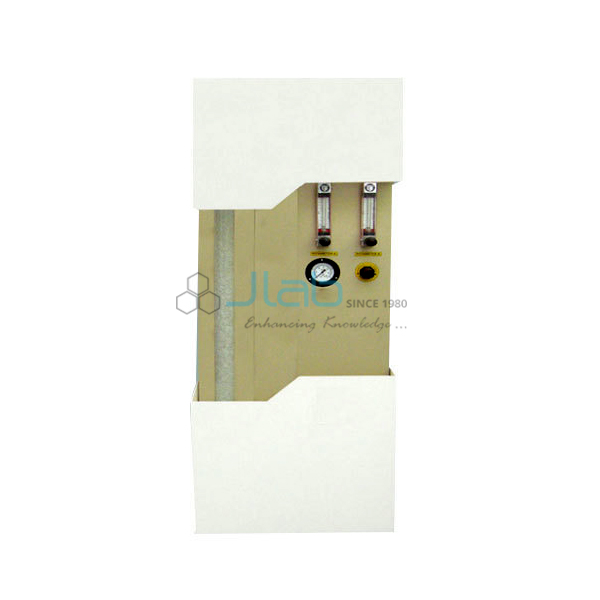
Axial dispersion decides how far a packed bed falls short of plug flow, and this apparatus measures it with a pulse of tracer. Water from a 20 litre stainless steel tank, pushed by compressed air, enters a borosilicate glass column of Raschig rings through a bottom distributor. Tracer goes in by syringe at the lower end and is sampled at the top outlet.
Specifications
| Reactor column | Borosilicate glass |
| Packing | Raschig rings, borosilicate glass, about 8–10 mm |
| Feed tank | Stainless steel, 20 litres |
| Feed circulation | Compressed air, with pressure regulator and pressure gauge |
| Flow measurement | Rotameter with needle valve |
| Liquid inlet | Distributor at the bottom of the column |
| Tracer injection | Syringe at the lower end, pulse input |
| Sampling | Top outlet of the column |
| Control panel | On/off switch and mains indicator |
| Utilities | Compressed air at 2 bar and 0.25 CFM, water supply, drain |
| Minimum order quantity | 1 unit |
| Dispatch time | Usually 14–18 working days |
| Manufacturer | JLab (Jain Laboratory Instruments Pvt Ltd), Ambala, India |
Dispersion Experiments for Students
With the water flow steady on the rotameter, students inject a small pulse of dilute Potassium Chloride solution and draw samples from the top at regular intervals. Each sample is read on a Digital Conductivity Meter, and a short calibration with known solutions turns conductivity into concentration. Normalising the curve to unit area gives E(t), its mean time and its variance.
Dividing the variance by the square of the mean time gives the dimensionless variance σθ². For a closed vessel, σθ² = 2(D/uL) - 2(D/uL)²(1 - e^(-uL/D)), which is solved for D/uL by trial. When dispersion is small this reduces to σθ² ≈ 2 D/uL. Students then plot D/uL against the flow set on the rotameter to find the trend for this packing.
Frequently Asked Questions
Why does axial dispersion matter in design?
Back-mixing along a packed column lowers the driving force in separation equipment and the conversion in a reactor. A measured D/uL lets engineers correct a plug flow calculation for the real spread of residence times in the bed.
How is the water feed driven?
Compressed air at 2 bar and 0.25 CFM presses on the 20 litre feed tank. The pressure regulator and gauge in the air line hold that pressure steady, and the needle valve on the rotameter sets the flow to the column.
Why does water enter at the bottom of the column?
Upward flow through the distributor fills the bed completely and pushes air out of the packing. The bed then holds one continuous liquid phase, so the tracer curve reflects the packing and not trapped gas.
What does the dispersion number tell me?
D/uL compares spreading along the bed with transport by the flow. As it tends to zero, the tracer leaves as a narrow, nearly symmetric peak. As it grows, the peak widens, arrives earlier and trails a long tail, the pattern of a well-mixed vessel.
How does it differ from the other packed bed RTD unit?
Both use a glass column of Raschig rings with a tracer port at the lower end. This apparatus adds a 20 litre stainless steel feed tank driven by compressed air. The RTD Studies in Packed Bed JLab has a port that also takes a gas tracer.
Other Packed Column Units
- Absorption in Packed Column
- Hydrodynamics of Trickle Bed Reactor Apparatus
- RTD Studies in Plug Flow Reactor
For a quote, use Add To Cart or send us a message through the contact page.
Last updated: 6 November 2026