RTD Studies in Packed Bed JLab Manufacturer,Supplier and Exporter in India
Product Code : EL-TWL-6641
Jlab Export is a leading RTD Studies in Packed Bed JLab Manufacturer,and suppliers in India
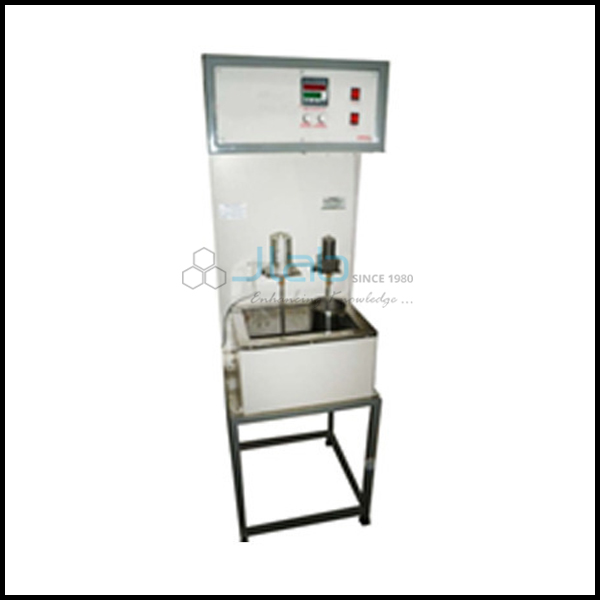
This set-up measures how long liquid stays in a packed bed. Water flows up through a glass column packed with Raschig rings, entering by a distributor at the bottom and leaving at the top. A tracer is injected at the lower end of the bed, and samples drawn from the top outlet give its residence time distribution, or RTD.
Specifications
| Column | Glass, packed with Raschig rings |
| Liquid feed | Through a distributor at the bottom of the column |
| Flow measurement | Rotameter with needle valve |
| Tracer injection | At the lower end of the column, for a liquid or gas tracer |
| Sampling | From the top outlet, at set intervals |
| Experiments | RTD curve for plug flow, dispersion number |
| Utilities | Water supply and drain |
| Minimum order quantity | 1 unit |
| Dispatch time | Usually 14–18 working days |
| Manufacturer | JLab (Jain Laboratory Instruments Pvt Ltd), Ambala, India |
RTD Experiments on the Packed Bed
Students set a steady water flow on the rotameter and inject a short pulse of tracer, such as a dilute salt solution, at the bottom of the bed. Samples are taken from the top outlet at fixed intervals timed with a Digital Stop Watch. The tracer in each one is read on a Digital Conductivity Meter. Concentration against time gives the E(t) curve, from which they work out the mean residence time and the variance.
For a bed close to plug flow, the variance divided by the square of the mean time is about twice the dispersion number, D/uL. A small value means near plug flow, and a large one means strong back-mixing. Repeating the run at two or three flow rates shows how dispersion in the packing changes with liquid velocity.
Frequently Asked Questions
What does an RTD curve show?
It shows how long different parts of the liquid stay in the bed. In ideal plug flow every element leaves after the same time and the curve is a single spike. In a real packed bed some liquid channels through faster and some lingers, which spreads the curve.
Which tracer should be used?
Use a tracer that does not react, does not stick to the packing and is easy to measure. A dilute salt solution read by conductivity is the usual choice, and a dye read on a colorimeter also works. The injection point takes a liquid or a gas tracer.
Why are Raschig rings used?
Raschig rings are short open tubes that pack loosely with a lot of free space between them. Liquid paths split and rejoin around the rings, so the bed shows clear axial dispersion that students can measure.
What else is needed to run it?
The rig needs only a water supply and a drain. Tracer analysis needs its own instruments, glassware and chemicals, chosen to suit the method, for example a conductivity meter for a salt tracer.
Other RTD and Reactor Set-Ups
For a quote, use Add To Cart or send us a message through the contact page.
Last updated: 6 November 2026