Boiling Point Elevation Manufacturer,Supplier and Exporter in India
Product Code : EL-TWL-9185
Jlab Export is a leading Boiling Point Elevation Manufacturer,and suppliers in India
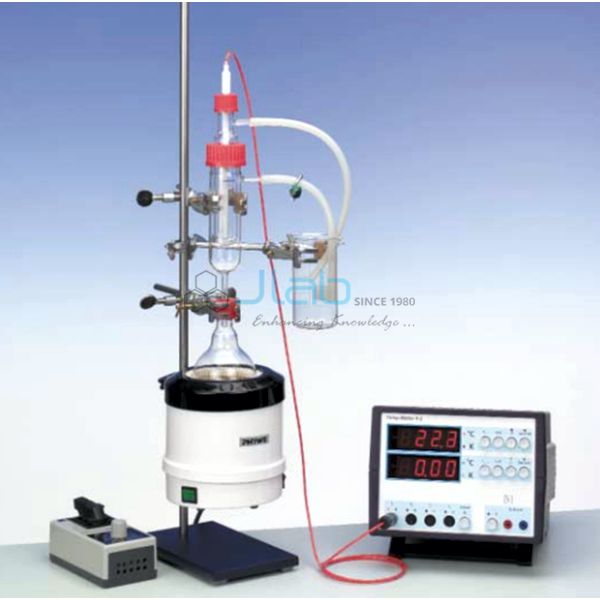
This apparatus measures how much a dissolved substance raises the boiling point of water. Students add the solute in steps, as pellets, and record the rise in boiling point each time. Plotted against concentration, the rise gives the molar mass of the solute. The experiments use table salt, urea and hydroquinone.
Specifications
| Principle | The boiling point of a solution is higher than that of the pure solvent |
| Solvent | Water |
| Solutes studied | Table salt, urea, hydroquinone |
| Measurements | Rise in boiling point against number of pellets and concentration |
| Result | Molar mass of the solute |
| Minimum order quantity | 10 units |
| Dispatch time | Usually 4–6 working days |
| Manufacturer | JLab (Jain Laboratory Instruments Pvt Ltd), Ambala, India |
Colligative Property Experiments for Students
Boiling point elevation is a colligative property: it depends on the number of dissolved particles, not on what they are. The rise is ΔTb = Kb m, where m is the molality and Kb is the ebullioscopic constant of water. Students weigh the water and each pellet on a Digital Balance, boil the water and note its temperature on a Digital Stem Thermometer. They then add pellets one at a time.
A graph of ΔTb against the number of pellets is a straight line. Its slope, with Kb and the masses used, gives the molar mass M of the solute. Table salt gives about twice the rise expected from its formula mass, because each unit splits into two ions in water. A pure grade such as Sodium Chloride analytical reagent avoids the additives in kitchen salt. Urea and hydroquinone do not ionise, so they give their true molar mass.
Frequently Asked Questions
Why does a solute raise the boiling point?
Dissolved particles lower the vapour pressure of the water. The solution must be heated further before its vapour pressure reaches the air pressure above it, so it boils at a higher temperature than pure water.
Why does table salt give a larger rise than urea?
Each formula unit of sodium chloride splits into two ions, so the same number of moles gives about twice as many particles as urea. Boiling point elevation counts particles, so salt raises the boiling point roughly twice as much.
How is the molar mass worked out?
Molality is m = (mass of solute / M) / mass of water in kg. Putting this into ΔTb = Kb m with the measured rise gives M = Kb × mass of solute / (ΔTb × mass of water in kg).
What affects the result besides concentration?
Air pressure changes the boiling point of water itself, so measure the pure water on the same day before adding any solute. Steady heating and a thermometer kept clear of the vessel wall also matter.
Is any safety care needed?
Yes. Hot water and steam can scald, so keep the apparatus stable on the bench. Hydroquinone is harmful if swallowed and irritates skin and eyes, so wear gloves and goggles when weighing it.
Other Items for Heat Practicals
- Calibrateable Digital Thermometer (stainless steel probe, can be field calibrated)
- Heating Mantle (for flasks of various capacities)
- Thermal Expansion in Solids and Liquids
For a quote, use Add To Cart or send us a message through the contact page.
Last updated: 6 November 2026