Coulomb Meter Manufacturer,Supplier and Exporter in India

Product Code : EL-TWL-9162
Jlab Export is a leading Coulomb Meter Manufacturer,and suppliers in India
This coulomb meter works like a digital electroscope. Charge delivered to its input appears on the display as a number of coulombs, up to 199 nC, where an electroscope would only deflect its vane. The charge can come from a current through a resistance, from a capacitor, or from a static source such as a charged plastic rod.
Specifications
| Measures | Electric charge, shown digitally in coulombs |
| Range | Up to 199 nC |
| Accuracy | ±10 nC |
| Works as | A digital electroscope |
| Charge sources | Current through a resistance, a capacitor, or a static source such as a charged plastic rod |
| Minimum order quantity | 1 unit |
| Dispatch time | Usually 7–10 working days |
| Manufacturer | JLab (Jain Laboratory Instruments Pvt Ltd), Ambala, India |
Electrostatics Experiments with the Meter
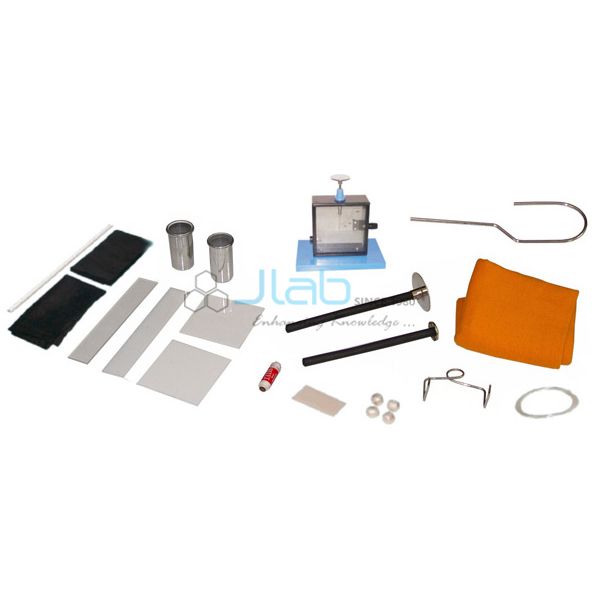
Students rub a Polythene Rod with a dry cloth, touch it to the input and note the reading. Rubbing for longer, or with a different cloth, shows how the charge picked up changes. The same rod brought to a Gold Leaf Electroscope gives only a leaf deflection on its scale. The class can then see what a number adds to the picture.
Teachers charge a Parallel Plate Capacitor to a set voltage and discharge it into the meter. Repeating at several plate spacings shows the charge, and so the capacitance C = Q/V, falling as the plates move apart. This links the reading to C = ε0 A/d.
Frequently Asked Questions
How is it different from an electroscope?
An electroscope shows charge only as a leaf or vane deflection, which gives a rough comparison. This meter shows the charge on a display in coulombs, up to 199 nC, so readings can be written down and compared as numbers.
What range and accuracy does it have?
It reads up to 199 nanocoulombs, and the stated accuracy is ±10 nanocoulombs. Charges from rubbed rods, small capacitors and charged plates in simple electrostatics work are of this size.
How do I measure the charge stored on a capacitor?
Charge the capacitor to a known voltage, then connect it across the meter input so the charge flows into the instrument. The reading is Q, and the capacitance is C = Q/V. Choose the voltage so that Q stays within 199 nC.
Can it be used for Faraday’s law electrolysis experiments?
Not directly. Depositing a weighable mass of metal by m = Q M / (n F) needs several coulombs or more, far beyond the 199 nC range. Electrolysis work uses an ammeter and a timer instead, with charge found from Q = I t.
How can a current be turned into a charge reading?
Charge is current multiplied by time, Q = I t. A very small current passed through a resistance into the meter for a known time gives a reading. Students compare it with the product of current and time.
Other Electrostatics Apparatus
- Charge Sensor (three ranges and a zeroing switch)
- Van de Graaff Generator
- Ebonite Rod
For a quote, use Add To Cart or send us a message through the contact page.
Last updated: 6 November 2026