Van de Graaff Generator Manufacturer,Supplier and Exporter in India

Product Code : EL-TWL-9187
Jlab Export is a leading Van de Graaff Generator Manufacturer,and suppliers in India
A Van de Graaff generator builds up a large static charge on a metal dome. This one reaches potentials of up to 350,000 volts on its polished, anodized dome, which charges negative. An electronic motor controller runs the belt drive, and the unit comes assembled with a spare transport belt.
Specifications
| Maximum potential | Up to 350,000 V on the dome |
| Dome | Polished, anodized, negative polarity |
| Maximum continuous current | About 10 microamperes |
| Spark length | Usually about 8 in (20 cm), up to 12–15 in (30–38 cm) |
| Belt drive | Electric motor with an electronic motor controller |
| Supplied | Assembled, with an extra transport belt |
| Minimum order quantity | 1 unit |
| Dispatch time | Usually 7–10 working days |
| Manufacturer | JLab (Jain Laboratory Instruments Pvt Ltd), Ambala, India |
Classroom Demonstrations with the Generator
Teachers use the generator for effects that a rubbed rod is too weak to show well. Paper strips fixed to the dome stand on end and fly off, since every strip carries the same charge. The Electrostatic Equipment Set adds a tissue-paper bundle, chimes and a pointed electrode, joined to the dome by its connection chains. Students watch the strips spread, the bells ring and the point leak charge into the air.
An electroscope a short way from the dome opens by induction. Put it inside the Demonstration Faraday Cage and it stays closed, which shows electrostatic shielding. Sparks jump from the dome to a nearby earthed conductor, and their length gives a rough idea of the potential. After each run the Discharger brings the dome back to zero before anyone touches it.
Frequently Asked Questions
How does a Van de Graaff generator build up its charge?
The motor drives an insulating belt between two rollers. Charge passes to the belt at the bottom, rides up inside the column and is taken off by a comb inside the dome. It spreads over the outer surface, and the potential rises until charge leaks away or a spark jumps.
Why are the sparks shorter on humid days?
In humid weather a thin layer of water forms on the column and belt, and charge drains along it instead of collecting on the dome. Wipe the dome and column clean and dry, keep the room as dry as you can and avoid dusty or greasy hands on the column.
What spark length can I expect?
Sparks of about 8 inches are usual with this model, and on a dry day they may reach 12 to 15 inches. Shorter sparks most often point to damp air, a dirty column or a worn belt.
How can students show that the dome is negative?
Carry a little charge from the dome to an electroscope with a proof plane. Then bring a rubbed polythene strip, which is also negative, near the cap. The leaf opens further, so the two charges have the same sign.
What is the extra belt for?
The generator is shipped assembled with a spare transport belt. The belt is the part that stretches and wears with use, so the spare lets the lab replace it without waiting for a part.
Other Apparatus for Electrostatics Lessons
- Electroscope (aluminium needle on an axle)
- Pith Ball Electroscope
- Electrostatic Kit (with electrophorus and proof plane)
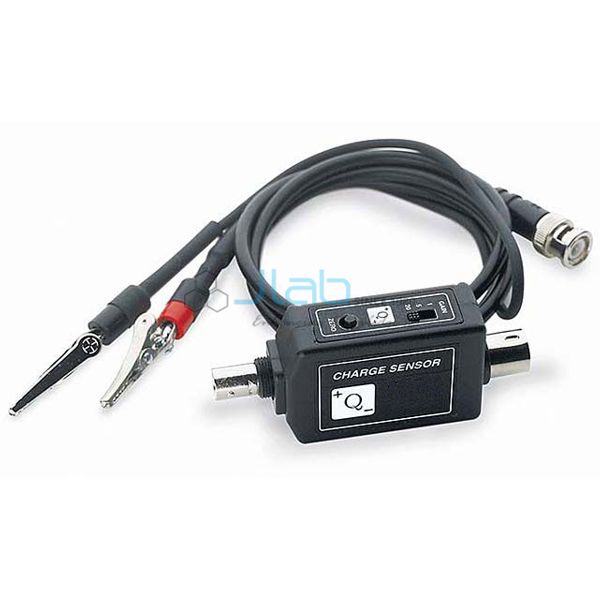
- Charge Sensor (measures charge and its sign)
For a quote, use Add To Cart or send us a message through the contact page.
Last updated: 6 November 2026