

Charge Sensor Manufacturer,Supplier and Exporter in India
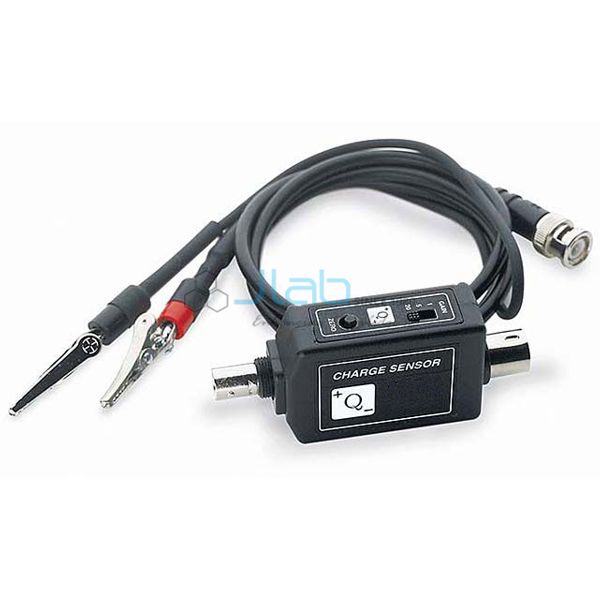
Product Code : EL-TWL-9195
Jlab Export is a leading Charge Sensor Manufacturer,and suppliers in India
The charge sensor puts numbers on electrostatics. It is a very high-impedance voltage sensor with a 0.01 μF input capacitor, so the voltage it reads gives the charge, along with its sign. It has three ranges, from ±5 nC to ±100 nC, and a zeroing switch that discharges the input capacitor between readings.
Specifications
| Ranges | ±0.5 V (±5 nC), ±2 V (±20 nC), ±10 V (±100 nC) |
| Input capacitance | 0.01 μF |
| Maximum input | ±150 V |
| Typical bias input current | 0.005 pA |
| Instrument time constant | 0.1 s |
| Zeroing | Switch to discharge the input capacitor |
| Measures | Amount of charge and its polarity |
| Minimum order quantity | 5 units |
| Dispatch time | Usually 7–10 working days |
| Manufacturer | JLab (Jain Laboratory Instruments Pvt Ltd), Ambala, India |
Electrostatics Practicals with Measured Charge
Charging by friction becomes a measurement. Students rub an Ebonite Rod with a cloth and lower the rod, then the cloth, into an aluminium can connected to the sensor. The two readings come out about equal in size and opposite in sign. The cans and proof plane of the Electrostatic Kit suit this ice-pail method.
For charging by induction and by contact, students compare a charged object held inside the can with one touched to it. With a proof plane they carry small samples from the dome of the Van de Graaff Generator to the can. The readings come out negative, as expected for this dome.
Frequently Asked Questions
Which range should I start on?
Begin on ±10 V, which covers up to ±100 nC, when the charge is unknown. If the reading is small, move to ±2 V (±20 nC) or ±0.5 V (±5 nC) for finer steps.
What does the zeroing switch do?
It discharges the input capacitor so the sensor starts from zero. Press it before each measurement, and again whenever the lead or can has been touched. Charge from hands, clothing or a nearby rod can otherwise add to the reading.
How does a voltage reading become a charge?
The sensor uses Q = CV with its input capacitance of 0.01 μF. On the ±2 V range, a full reading of 2 V corresponds to 20 nC. In the same way, 1 V on any range means 10 nC.
Does it show whether a charge is positive or negative?
Yes. The sign of the reading gives the polarity. Rubbed ebonite or polythene, for example, gives a negative reading, which students can compare with the charge left on the cloth.
Can the sensor lead touch a Van de Graaff dome?
No. The maximum input is ±150 V and a dome runs far higher. Take small samples to the can with a proof plane instead, and keep the generator well away from the sensor.
Electroscopes and Charge Sources
- Gold Leaf Electroscope
- Electroscope (aluminium needle on an axle)
- Electrostatic Equipment Set
- Datalogger
For a quote, use Add To Cart or send us a message through the contact page.
Last updated: 6 November 2026





