Isothermal Semi Batch Reactor Manufacturer,Supplier and Exporter in India
Product Code : EL-TWL-9136
Jlab Export is a leading Isothermal Semi Batch Reactor Manufacturer,and suppliers in India
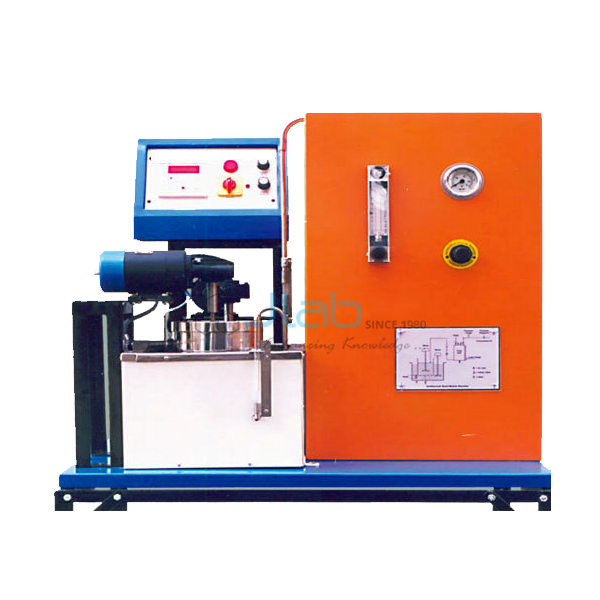
In this semi-batch reactor one reactant is charged into the vessel first, and the second is fed in steadily while the reaction runs. The 3 litre stainless steel reactor stands in a stirred water bath held between ambient and 70 °C. Compressed air pushes the feed from a 20 litre tank through a rotameter, and samples are drawn by pipette at fixed intervals.
Specifications
| Reactor | Stainless steel, about 3 litres |
| Feed tank | Stainless steel, 20 litres |
| Feed circulation | Compressed air, with pressure regulator, pressure gauge and safety valve |
| Pressure regulator and gauge | 0–2 kg/cm², Bourdon type gauge |
| Flow measurement | Rotameter |
| Water bath | Stainless steel, double wall, ceramic wool insulation, ambient to 70 °C |
| Temperature control | Digital controller, 0–199.9 °C, nichrome wire heater |
| Stirrers | Two, stainless steel impeller and shaft on FHP motor |
| Piping | Stainless steel and PVC |
| Utilities | 1.5 kW single phase, compressed air at 2 bar and 0.25 CFM |
| Minimum order quantity | 1 unit |
| Dispatch time | Usually 14–18 working days |
| Manufacturer | JLab (Jain Laboratory Instruments Pvt Ltd), Ambala, India |
Semi-Batch Experiments for Students
A typical run starts with a measured volume of ethyl acetate solution in the reactor, while sodium hydroxide flows in from the tank at a set rotameter reading. Students check the bath with a Digital Stem Thermometer before the feed starts. Samples timed on the electronic stop watch are quenched in excess acid and back-titrated from a Burette into a Conical Flask.
Because feed keeps entering, the liquid volume grows as V = V0 + v0 t, and the mole balance has to carry that change. Students solve the balances for both reactants step by step in a spreadsheet, try values of k and keep the one that matches the measured concentrations. Running the same reaction on the Isothermal Batch Reactor, with both reactants charged at the start, shows by contrast how slow feeding keeps one reactant dilute.
Frequently Asked Questions
When is a semi-batch reactor used?
It suits reactions where one reactant should stay dilute, such as a strongly exothermic reaction or one with an unwanted side reaction. Feeding that reactant slowly limits how fast heat is released and can improve selectivity. In teaching, it shows how a growing volume changes the mole balance.
What does the compressed air line need?
It needs air at 2 bar and 0.25 CFM. The regulator, reading 0–2 kg/cm², sets the pressure on the feed tank, the Bourdon gauge shows it and the safety valve relieves any excess. Flow into the reactor is then set on the rotameter.
How often should samples be taken?
Take them at fixed intervals, closer together early in the run when the concentration changes fastest. Note the feed volume added by each sample time, since it gives the liquid volume in the vessel at that moment.
Why are there two stirrers?
One stirrer mixes the feed into the reaction mass at once, so the vessel stays perfectly mixed. The other circulates the bath water, which keeps its temperature even around the reactor wall.
Can the unit also be run as a plain batch reactor?
Yes. Charge both solutions into the vessel at the start and keep the feed shut, and it works as a batch reactor at bath temperature. Running one reaction both ways on the same unit shows how slow feeding changes the concentration curves.
Other Reactors in the Series
- Adiabatic Batch Reactor
- Isothermal Plug Flow Reactor (compressed air feed and water bath)
- Continuous Stirred Tank Reactor
For a quote, use Add To Cart or send us a message through the contact page.
Last updated: 6 November 2026