Continuous Stirred Tank Reactor Manufacturer,Supplier and Exporter in India
Product Code : EL-TWL-9130
Jlab Export is a leading Continuous Stirred Tank Reactor Manufacturer,and suppliers in India
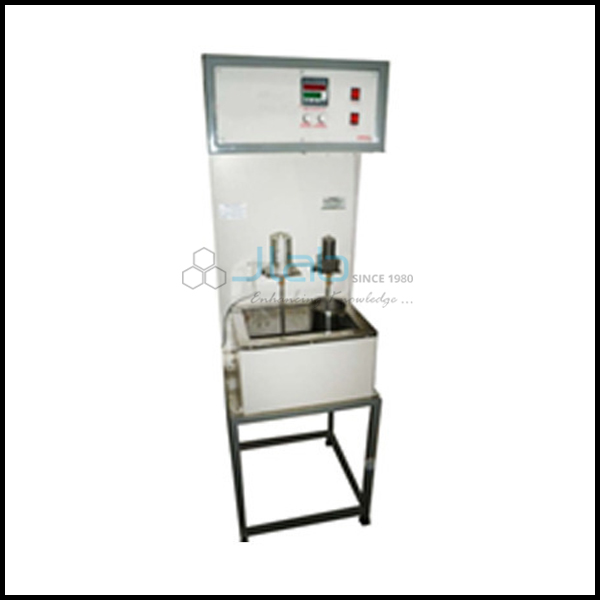
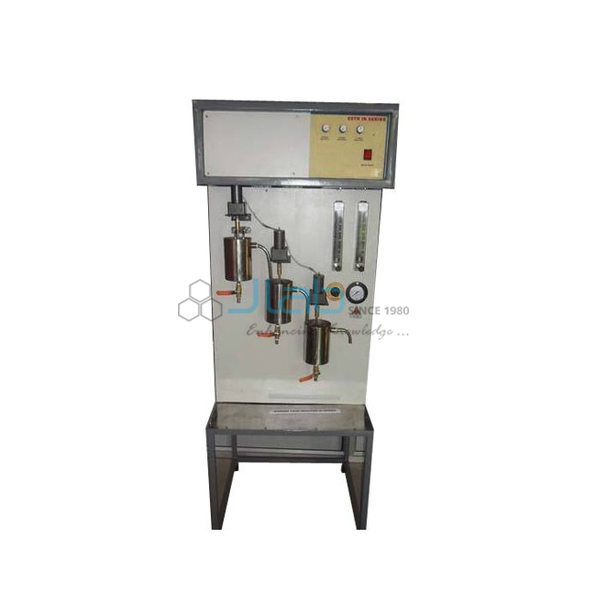
Two reactants are pushed from stainless steel feed tanks by compressed air and metered on rotameters into a stirred 2 litre reactor. Its outflow has the same composition as its contents. At steady state, a sample from the top outlet gives the conversion, and from that the rate constant of a second order liquid phase reaction at room temperature.
Specifications
| Reactor | Stainless steel, capacity about 2 litres |
| Stirrer | Stainless steel impeller and shaft on an FHP motor |
| Feed tanks | Two, stainless steel, 20 litres |
| Feed circulation | Compressed air |
| Flow measurement | Two rotameters with needle valves |
| Air line | Pressure regulator 0–2 kg/cm², Bourdon gauge 0–2 kg/cm², safety valve |
| Piping | Stainless steel and PVC |
| Timer | Electronic stop watch |
| Services | Compressed air 1 HP, 2 CFM, single phase 220 VAC 0.5 kW, water, drain |
| Minimum order quantity | 1 unit |
| Dispatch time | Usually 14–18 working days |
| Manufacturer | JLab (Jain Laboratory Instruments Pvt Ltd), Ambala, India |
Experiments in Reaction Engineering
The usual reaction is the saponification of ethyl acetate with sodium hydroxide, fed at equal concentrations. Students set both rotameters, wait three or four residence times, then take an outlet sample and add it to a known excess of standard acid. Back titration with a Burette into a Conical Flask, Erlenmeyer gives the alkali left, and so the conversion X.
The CSTR design equation, τ = C_A0 X / (-r_A), with -r_A = k C_A0² (1 - X)², gives k for each run. Here τ is the reactor volume divided by the total feed flow. Repeating at several flow rates checks that k stays the same. A Digital Conductivity Meter on the outlet samples gives a faster reading of conversion, since conductivity falls as hydroxide is used up.
Frequently Asked Questions
How is the rate constant calculated?
For equal feeds of a second order reaction, k = X / (τ C_A0 (1 - X)²). Take C_A0 as the concentration after the two streams mix at the inlet, which is half the tank strength when the two flows are equal.
How long should I wait before sampling?
A stirred tank approaches steady state gradually, so allow three to five residence times after any change in flow. One residence time is the 2 litre volume divided by the total flow. Take two samples a few minutes apart and check they agree.
Why does the outlet match the reactor contents?
In an ideal stirred tank the feed is mixed through the whole volume at once, so the outflow is a sample of the contents. The reaction therefore runs at the low outlet concentration, which is why a CSTR needs more volume than a plug flow reactor for the same conversion.
Does it matter if the tank starts with water instead of reactants?
No. The steady outlet conversion is set by the feed strengths, the total flow and the temperature. Whatever the tank holds at the start is washed out as feed replaces it. Starting with water only means a longer wait before the first sample worth titrating.
Other Chemical Reactors for the Lab
- Isothermal Continuous Stirred Tank Reactor
- Cascade Continuous Stirred Tank Reactor JLab
- Plug Flow Reactor
- Isothermal Batch Reactor
For a quote, use Add To Cart or send us a message through the contact page.
Last updated: 6 November 2026