Atwood Machine Manufacturer,Supplier and Exporter in India
Product Code : EL-TWL-9164
Jlab Export is a leading Atwood Machine Manufacturer,and suppliers in India
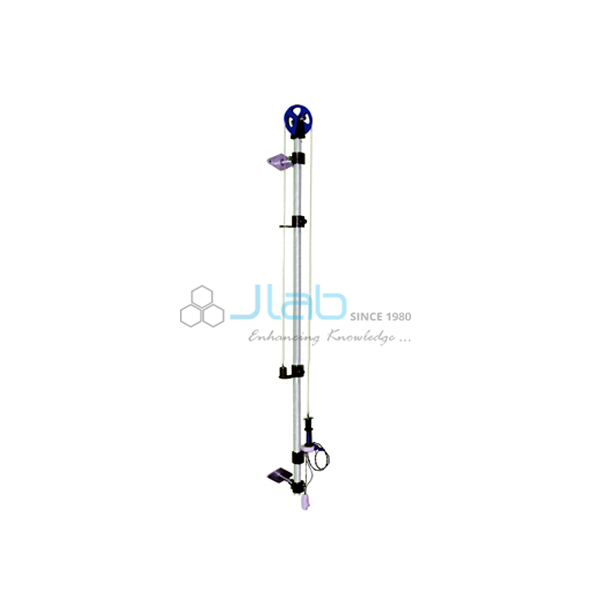
This Atwood machine hangs two masses from a light cord over a pulley, so their motion under gravity is slow enough to time by hand. Two metal rods join end to end to give a 245 cm working length, with a scale in 1 cm steps. An electromagnet holds and releases the masses, and the 10 cm pulley turns on near-frictionless bearings.
Specifications
| Working length | 245 cm, two metal rods joined by a thread |
| Scale | 0–245 cm, 1 cm divisions |
| Pulley | 10 cm, well balanced, on near-frictionless bearings |
| Release | Electromagnetic |
| Masses | Two pairs, plus 1 g and 2 g loading masses |
| Mounting | Table/ring brackets and wall-mounting clamps |
| Cord | Lightweight |
| Minimum order quantity | 10 units |
| Dispatch time | Usually 4–6 working days |
| Manufacturer | JLab (Jain Laboratory Instruments Pvt Ltd), Ambala, India |
Practicals with the Atwood Machine
The usual practical tests Newton’s second law. With masses m1 and m2 on the two sides of a light pulley, the acceleration is a = (m1 - m2) g / (m1 + m2). Students let the heavier mass fall from rest, read the drop on the scale and time it with a Digital Stopwatch. They work out a from s = ½ a t² and compare it with the formula.
Moving a loading mass from one side to the other keeps the total mass fixed and changes only the difference. A graph of a against (m1 - m2) is then a straight line of slope g / (m1 + m2), which gives a value for g. For shorter drops, the two gates of a Timer with Two Photogates can stand beside the path to time the mass between two scale marks.
Setting Up the 245 cm Column
The rod that carries the pulley has a thread at its other end, which screws into the second rod. The joined column is fixed to a wall with the clamps, or held in the table and ring brackets. Hang it plumb so the masses fall clear of the rods and the cord leaves the pulley straight.
Frequently Asked Questions
Why should the pulley be light and free-running?
The simple formula treats the cord and pulley as having no mass and no friction. Both effects make the measured acceleration smaller. This 10 cm pulley is balanced and runs on near-frictionless bearings. Students can still find the friction by adding the small mass that just keeps the system moving at a steady speed.
What length of fall can be measured?
The scale runs from 0 to 245 cm in 1 cm divisions along the two joined rods. A long drop takes longer, so a hand-timing error of a fraction of a second becomes a smaller part of the result.
What does the electromagnetic release do?
It holds the mass at the start mark and lets go the moment its current is switched off. The system starts from rest with no push from a hand, so the start of the timing and the start of the motion match.
Which masses come with the set?
The set has two pairs of masses and loading masses of 1 g and 2 g, with a lightweight cord. Equal masses on both sides balance each other, and the loading masses add the small difference that drives the motion.
More Items for Dynamics Practicals
- Atwood’s Machine (pulley on a vertical base, with photogate and timer)
- Stop Clock (spring-wound, with start, stop and reset levers)
- Hangers with Slotted Weights
For a quote, use Add To Cart or send us a message through the contact page.
Last updated: 6 November 2026