Adiabatic Batch Reactor Manufacturer,Supplier and Exporter in India

Product Code : EL-TWL-9146
Jlab Export is a leading Adiabatic Batch Reactor Manufacturer,and suppliers in India
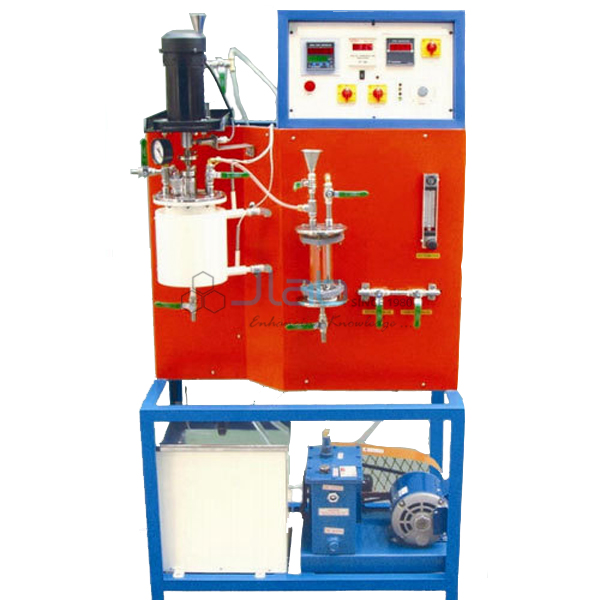
Nothing is heated or cooled in this batch reactor. The reaction mass is left to change temperature on its own, and that rise is the measurement. A 1 litre Dewar flask with a stirrer is double insulated with ceramic wool and read by a digital temperature indicator. It is used for a catalytic homogeneous reaction, such as hydrogen peroxide breaking down with an iodide catalyst.
Specifications
| Reactor | Dewar flask, 1 litre, with stirrer |
| Insulation | Double insulated with ceramic wool |
| Temperature measurement | Digital temperature indicator |
| Operating conditions | Adiabatic, perfectly mixed, constant volume |
| Mounting | Rigid MS frame |
| Reaction studied | Catalytic homogeneous reaction, such as hydrogen peroxide decomposition with an iodide catalyst |
| Minimum order quantity | 1 unit |
| Dispatch time | Usually 14–18 working days |
| Manufacturer | JLab (Jain Laboratory Instruments Pvt Ltd), Ambala, India |
Experiments on Adiabatic Temperature Rise
Students fill the flask with dilute Hydrogen Peroxide, start the stirrer and note the steady starting temperature. A measured amount of Potassium Iodide solution is then added. The temperature is read at fixed times on a Digital Stop Watch until it stops rising.
With no heat loss, the temperature rise is proportional to conversion, so X = (T - T0)/(Tf - T0). The slope of the temperature curve at any point, divided by (Tf - T), gives the first-order rate constant at that temperature. Plotting ln k against 1/T from a single run gives the activation energy. The total rise and the starting concentration also give an estimate of the heat of reaction.
Frequently Asked Questions
Why is a Dewar flask used?
The vacuum wall of a Dewar flask, with ceramic wool around it, stops heat escaping during the run. Nearly all the heat of reaction stays in the liquid, so the temperature rise follows the conversion closely.
How is conversion found from temperature?
In an adiabatic batch the heat released is proportional to the amount reacted. With T0 the starting temperature and Tf the final one when the reaction stops, the conversion at any moment is X = (T - T0)/(Tf - T0).
Why does the reaction speed up during the run?
Heat from the reaction stays in the flask, so the temperature climbs and the rate constant rises with it. Later the falling peroxide concentration takes over, the rate drops and the temperature levels off.
Is the flask closed during the peroxide run?
No. The decomposition gives off oxygen gas, so the flask must stay vented. Keep the peroxide dilute, add the iodide in small measured amounts and wear eye protection.
How does it differ from the isothermal batch unit?
The Isothermal Batch Reactor sits in a controlled water bath and holds one temperature. This reactor has no bath, and its temperature moves freely, so one run gives rate data over a span of temperatures.
Other Batch Reactor Set-Ups
For a quote, use Add To Cart or send us a message through the contact page.
Last updated: 6 November 2026