RTD Studies in CSTR JLab Manufacturer,Supplier and Exporter in India
Product Code : EL-TWL-6657
Jlab Export is a leading RTD Studies in CSTR JLab Manufacturer,and suppliers in India
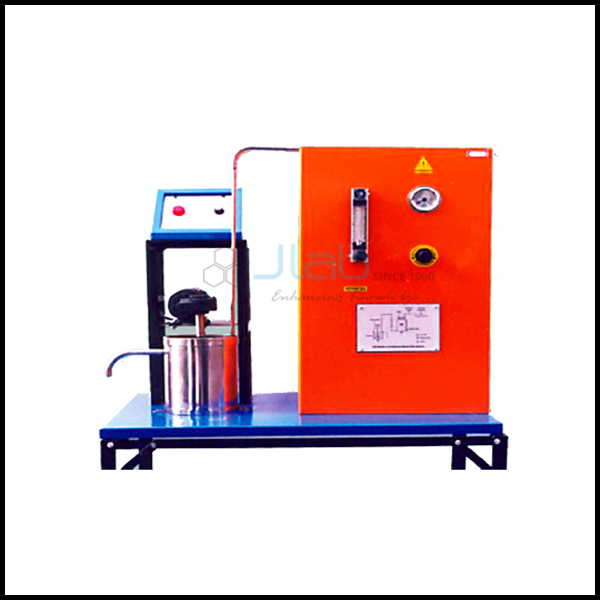
Real reactors never mix perfectly, and this stirred-tank set-up lets students measure by how much. Water from a feed tank is circulated by a magnetic drive pump and fed through a rotameter to a stainless steel CSTR. A pulse of tracer is dosed by syringe, and the outlet concentration over time gives the residence time distribution.
Specifications
| Reactor | Continuous stirred tank, stainless steel |
| Feed | Feed tank with magnetic drive pump |
| Flow control | Needle valve and rotameter |
| Tracer dosing | Syringe, pulse input |
| Experiments | RTD curve for a CSTR with pulse tracer, dispersion number |
| Electricity | 1 phase, 220 V AC, 0.5 kW |
| Other utilities | Water supply and drain |
| Minimum order quantity | 1 unit |
| Dispatch time | Usually 14–18 working days |
| Manufacturer | JLab (Jain Laboratory Instruments Pvt Ltd), Ambala, India |
Pulse Tracer Experiments in the CSTR
With the stirrer running and a steady flow set on the needle valve, students dose a small pulse of tracer by syringe and start a Stopwatch. Outlet samples are taken at short, regular intervals and read on a Conductivity Meter. The readings, scaled so that the area under the curve equals one, form the E(t) curve.
For an ideal CSTR the curve falls away as an exponential, E(t) = (1/τ) e^(−t/τ), where τ is the tank volume divided by the flow rate. Students compare their measured mean residence time with τ. A shorter measured time points to a dead zone, and an early spike points to short-circuiting from inlet to outlet. A tanks-in-series fit with N close to 1 confirms near-ideal mixing.
Frequently Asked Questions
Why use a pulse rather than a step input?
A pulse gives the E(t) curve directly, because the outlet trace follows the age spread of one small batch of fluid. A step input gives the cumulative F(t) curve instead. Dosing a pulse by syringe uses only a little tracer.
What does the dispersion number mean for a stirred tank?
It gives a figure for where the flow sits between plug flow and full mixing. A very large value means the tank is close to an ideal CSTR, while a small one would mean the flow is closer to plug flow.
What supplies does the set-up need?
Electricity at 1 phase, 220 V AC, with a load of 0.5 kW, plus a water supply and a drain. The instruments, glassware and chemicals for tracer analysis are picked to match the method in use.
Why does a real CSTR depart from ideal mixing?
Fluid can channel from inlet to outlet, recirculate inside the vessel or sit in stagnant pockets. Each fault leaves its own mark on the tracer curve, which is why an RTD test is a standard step before a reactor is used for kinetics work.
Other Stirred Tank and RTD Set-Ups
- Continuous Stirred Tank Reactor
- Isothermal Continuous Stirred Tank Reactor
- RTD Studies in Packed Bed JLab
For a quote, use Add To Cart or send us a message through the contact page.
Last updated: 6 November 2026