Plug Flow Reactor (Coiled Tube Type) Manufacturer,Supplier and Exporter in India

Product Code : EL-TWL-9134
Jlab Export is a leading Plug Flow Reactor (Coiled Tube Type) Manufacturer,and suppliers in India
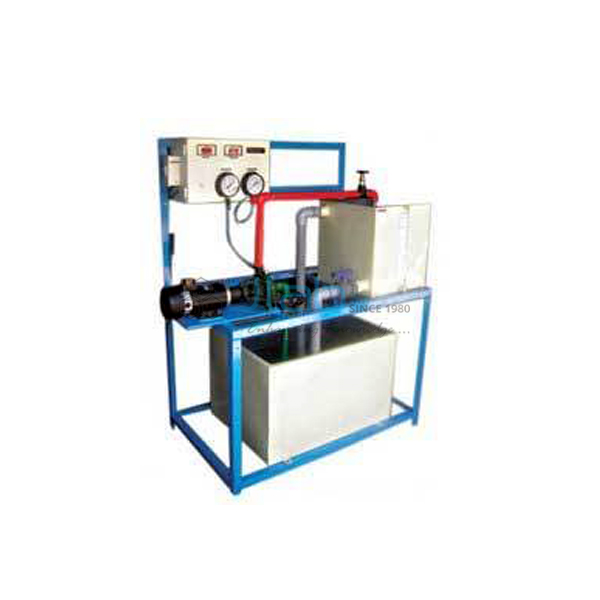
This plug flow reactor is a tube wound into a helical coil, so the reacting liquid keeps changing direction as it climbs. Two reactants come from separate feed tanks, driven by a magnetic drive pump and metered on rotameters with needle valves. They enter at the bottom of the coil and are sampled where they leave at the top. It serves for a non-catalytic homogeneous reaction under isothermal conditions.
Specifications
| Reactor type | Helical coil tube plug flow reactor |
| Feed tanks | Two, one for each reactant |
| Feed circulation | Magnetic drive pump |
| Flow measurement | Rotameter on each reactant line, with needle valve |
| Flow path | In at the lower end, out at the top of the coil |
| Sampling | At the coil outlet |
| Reaction studied | Non-catalytic homogeneous reaction, isothermal |
| Minimum order quantity | 1 unit |
| Dispatch time | Usually 14–18 working days |
| Manufacturer | JLab (Jain Laboratory Instruments Pvt Ltd), Ambala, India |
Rate Constant Practicals in the Coil
Ethyl acetate and sodium hydroxide of equal strength are the usual teaching pair for this coil. With the two rotameters at one flow, the class waits for the outlet to settle and then draws a sample at the top. Each sample goes into a known excess of standard acid. The acid left is then titrated with Sodium Hydroxide from a Burette, Borosilicate Glass, with PTFE Stopcock, using Phenolphthalein as the indicator.
Space time here is the coil volume over the total flow rate. Four or five flow rates give the same number of points of X / (1 - X) against τ. With equal feeds of this second-order pair they lie on a line through the origin, and the slope of that line equals k C_A0. Repeating the reaction on the Plug Flow Reactor, Straight Tube Type JLab at the same temperature lets the class compare a coil with a straight tube.
Frequently Asked Questions
Why is the reactor tube coiled instead of straight?
The flow changes direction all the way round the coil. This adds turbulence and drives a secondary circulation over the tube cross-section. Radial mixing improves, so the rate constant calculated from coil data is expected to be higher than for a straight tube.
How is conversion worked out from the titration?
The acid used up by the sample equals the sodium hydroxide still unreacted at the outlet. Divide that by the sodium hydroxide fed after the two streams mix, and subtract the result from one. That figure is the conversion X.
When can I take the first outlet sample?
Wait two or three space times after setting or changing the flows. Then take samples a few minutes apart. When two in a row give the same titre, the outlet composition has stopped changing and the run is at steady state.
How does it differ from the RTD Studies in Plug Flow Reactor?
Both are helical coils fed by a magnetic drive pump through a rotameter. This unit has two feed tanks for a reacting pair. The RTD Studies in Plug Flow Reactor has one water tank and a syringe port for tracer, so it measures flow behaviour instead of reaction rate.
Other Tubular and Stirred Reactors
- Isothermal Plug Flow Reactor (stainless steel reactor with a water bath)
- Combined Flow Reactor (coil tube PFR studied with a mixed flow reactor)
- Continuous Stirred Tank Reactor
For a quote, use Add To Cart or send us a message through the contact page.
Last updated: 6 November 2026