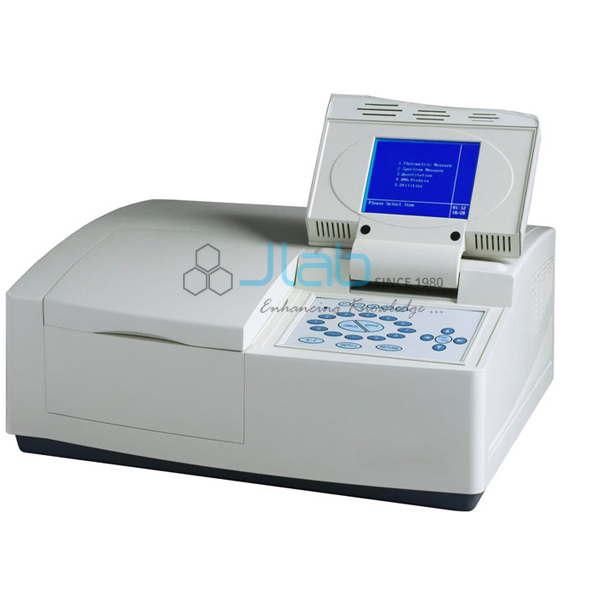
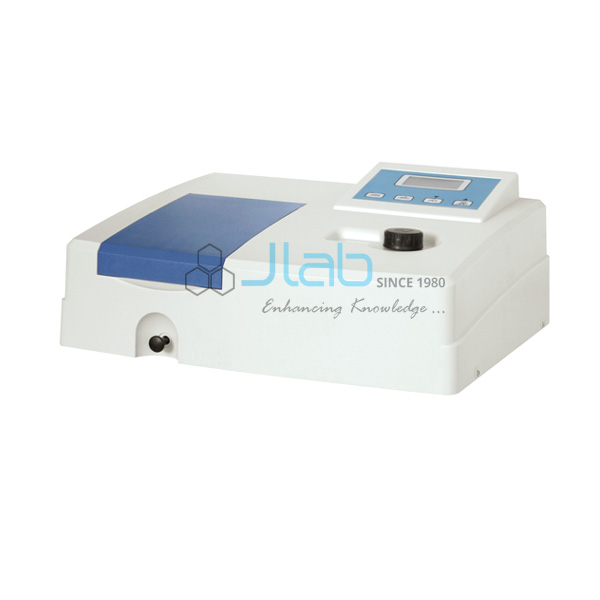
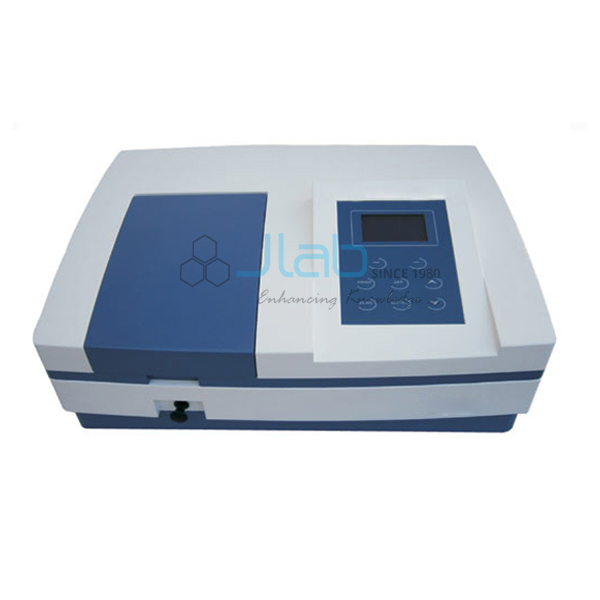
Double Beam UV-VIS Spectrophotometer Manufacturer,Supplier and Exporter in India
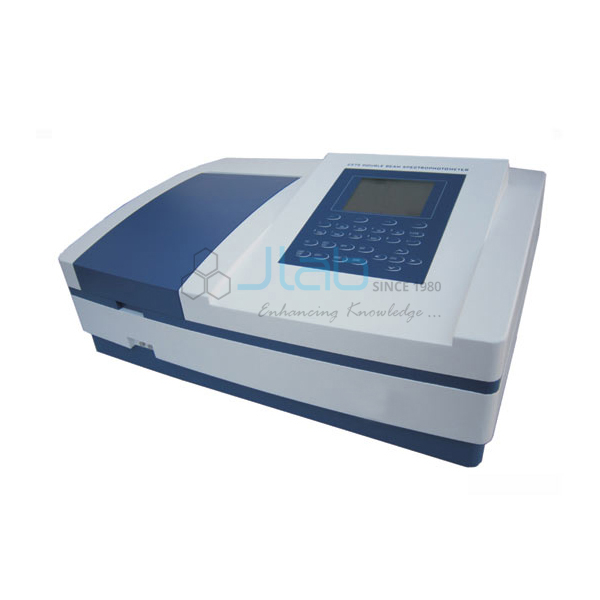
Product Code : EL-S-2160
Jlab Export is a leading Double Beam UV-VIS Spectrophotometer Manufacturer,and suppliers in India
This scanning UV-VIS spectrophotometer splits its light into a sample beam and a reference beam, so lamp drift cancels out while a spectrum is recorded from 190 to 1100 nm. A deuterium lamp covers 190 to 380 nm and a tungsten halogen lamp takes over up to 1100 nm. Results show on a 24 x 2 line backlit LCD as %T, absorbance or concentration.
Specifications
| Optics | Double beam, Czerny-Turner monochromator, 1200 lines/mm grating |
| Wavelength range | 190–1100 nm |
| Spectral bandwidth | 2 nm |
| Wavelength accuracy | ±0.5 nm, readability 0.1 nm |
| Photometric range | %T 0–100.0, Abs 0–3.000 |
| Lamps | Deuterium 190–380 nm, tungsten halogen 380–1100 nm, programmable change-over |
| Measuring modes | Scan (%T, Abs), multi-wavelength and serial-wavelength photometry, concentration, time scan (kinetics) |
| Sample holder | Automatic 6-position, for 10 mm cuvettes |
| Memory and outputs | 1000 samples, dot matrix printer interface, RS-232C optional |
| Supplied with | 2 quartz and 5 polystyrene 10 mm cuvettes, mains lead, manual, dust cover |
| Minimum order quantity | 1 unit |
| Dispatch time | Usually 7–10 working days |
| Manufacturer | JLab (Jain Laboratory Instruments Pvt Ltd), Ambala, India |
Scanning and Kinetics Experiments for Students
Pharmacy and chemistry students can record the UV spectrum of a drug standard and read its absorbance maximum straight off the scan. They weigh the standard on an Electronic Balance Analytical, make it up in Volumetric Flasks, Class A Borosilicate Glass Plastic Stopper JLab and dilute it for a calibration line. The blank and five standards sit in the 6-position holder and are read in one run.
In biochemistry, the time scan follows an enzyme reaction as the absorbance changes over a few minutes. Students add the enzyme with a Single Channel Micro Pipette, start the scan at once and take the initial rate from the first straight part of the curve.
What the Second Beam Does
A single-beam instrument reads the blank first and the sample after it, so any change in lamp output between the two readings becomes an error. Here the light passes through the sample and the reference at the same time, and the instrument works from the ratio of the two. Slow drift in the lamp or detector therefore cancels, which matters during long scans and kinetic runs.
Frequently Asked Questions
Why does a double-beam instrument still need a blank?
The reference beam cancels lamp drift, but the solvent and the cuvette walls also absorb light. Run the automatic baseline correction with the blank solvent first, so their absorbance is taken off every later reading.
Which cuvettes should I use below 380 nm?
Use the quartz cuvettes. Glass and polystyrene absorb ultraviolet light and hide the sample absorbance in the UV region. The polystyrene cuvettes supplied are for visible work, where they save the quartz cells from wear.
Which scan speed should I choose?
Use the slow speed when peaks are sharp or close together, because a fast scan can flatten and shift them. The fast speed suits a quick survey to find where a sample absorbs. In time scan, the reading interval can be set from 5 to 99 seconds.
What is the lamp change-over wavelength for?
It is the point where the instrument switches from the deuterium lamp to the tungsten halogen lamp. A small step can appear in a scan at that point. Because it is programmable, you can move it away from a peak you want to measure.
Can it measure two compounds in one solution?
Yes, if their absorbance maxima are far enough apart. The multi-wavelength mode reads the mixture at each maximum, and the two concentrations come from simultaneous equations built on the absorbance of each pure standard.
Other UV-VIS and Double-Beam Models
- Double Beam Spectrophotometer (graphical LCD, 8-position cell changer)
- Visible/UV Spectrophotometer (true double beam, fixed bandwidth)
- Microprocessor UV-VIS Spectrophotometer (single beam with K factor)
- UV-VIS Spectrophotometer
For a quote, use Add To Cart or send us a message through the contact page.
Last updated: 6 November 2026