Digital UV-VIS Spectrophotometer Manufacturer,Supplier and Exporter in India

Product Code : EL-S-2165
Jlab Export is a leading Digital UV-VIS Spectrophotometer Manufacturer,and suppliers in India
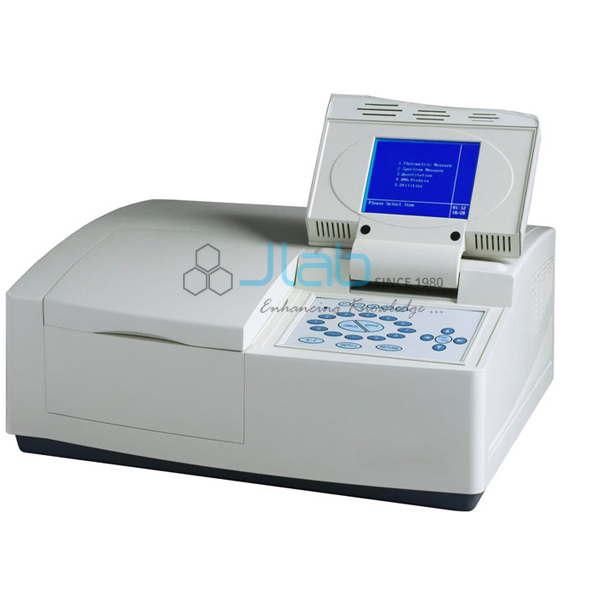
Wavelength on this single-beam UV-VIS spectrophotometer is set by a microprocessor-controlled stepper motor, in 0.1 nm steps from 190.0 to 1000.0 nm. Two red LED displays sit side by side: a 4-digit one for the wavelength and a 3½-digit one for %T, absorbance or concentration. Deuterium and tungsten halogen lamps cover the UV and visible regions with a 2 nm bandwidth.
Specifications
| Optics | Single beam, Czerny-Turner mirror optics, 1200 grooves/mm grating |
| Wavelength range | 190.0–1000.0 nm, 0.1 nm steps by stepper motor |
| Spectral bandwidth | 2 nm |
| Wavelength accuracy | ±0.5 nm, repeatability ±0.3 nm |
| Photometric range | %T 0–100, Abs 0–1.999, Conc 0–1999 |
| Photometric repeatability | ±0.002 Abs at 1.0 Abs |
| Displays | 4-digit red LED for wavelength, 3½-digit red LED for results |
| Lamps and detector | Deuterium and tungsten halogen lamps, silicon photodiode |
| Sample holder | 4-position adjustable |
| Supplied with | 2 quartz and 4 polystyrene 10 mm cuvettes, opaque cuvette, mains lead, manual, dust cover |
| Minimum order quantity | 1 unit |
| Dispatch time | Usually 7–10 working days |
| Manufacturer | JLab (Jain Laboratory Instruments Pvt Ltd), Ambala, India |
Lambda Max and Calibration Experiments
Finding lambda max is often the first spectrophotometry experiment. Students make a dilute solution of Potassium Permanganate, step the wavelength across the visible region and note the absorbance at each setting, zeroing with water every time. A plot of absorbance against wavelength shows the peak, and that wavelength is used for the calibration line that follows.
For the calibration, the solid is weighed on an Electronic Balance Analytical and the standards are diluted with Graduated Pipettes, Class B Soda Glass JLab. Students can note %T and absorbance for each standard and check that A = 2 - log10(%T) holds for every pair.
Frequently Asked Questions
What is the opaque cuvette for?
It blocks the beam completely. With it in the holder, the display should read 0 %T, which checks the dark reading of the detector. Then put the blank in and set 100 %T before you measure samples.
How are %T and absorbance related?
Transmittance is %T = 100 x I/I0, where I0 is the light through the blank and I the light through the sample. Absorbance is A = 2 - log10(%T). So 100 %T is 0 A, 10 %T is 1 A and 1 %T is 2 A.
Do I need to zero again after changing the wavelength?
Yes. Lamp brightness and detector response change with wavelength, and a single-beam instrument has no reference beam to follow them. Put the blank back in and set zero absorbance at every new wavelength before reading the sample.
Can the polystyrene cuvettes be used in the UV?
No. Polystyrene absorbs strongly in the ultraviolet, so the reading would come mostly from the cuvette. Keep the polystyrene cells for coloured solutions in the visible region and use the quartz pair for UV work.
Why do my readings drift from one session to the next?
Let the lamps warm up before you start, and handle cuvettes only by their frosted sides. Wipe the clear faces, remove air bubbles, and put each cuvette in the same way round every time.
Close Models in the Spectrophotometer Range
- Microprocessor UV-VIS Spectrophotometer (LCD readout, K factor, sample memory)
- Digital Spectrophotometer (visible range, test tube holder)
- Visible Spectrophotometer
- UV Spectrophotometer
For a quote, use Add To Cart or send us a message through the contact page.
Last updated: 6 November 2026