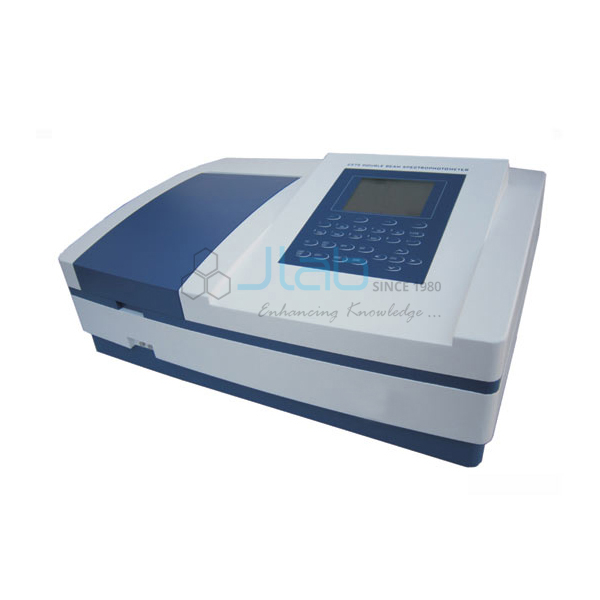
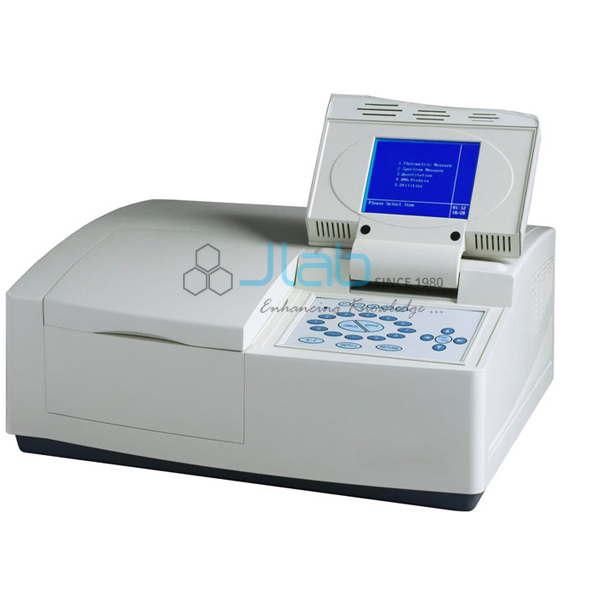
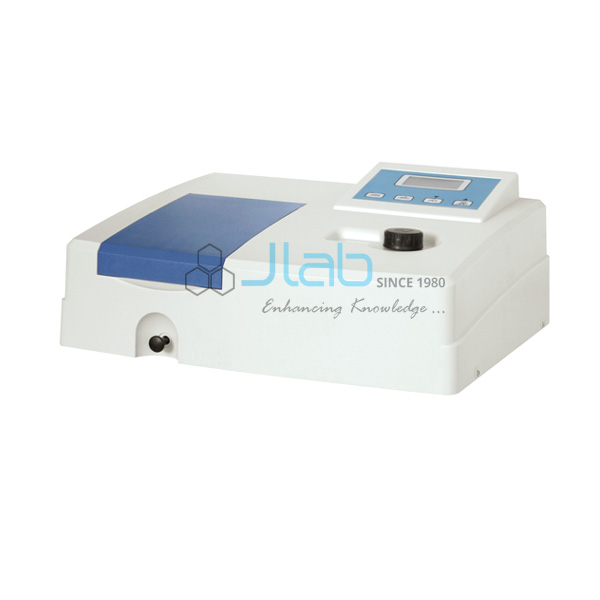
Microprocessor UV-VIS Spectrophotometer Manufacturer,Supplier and Exporter in India
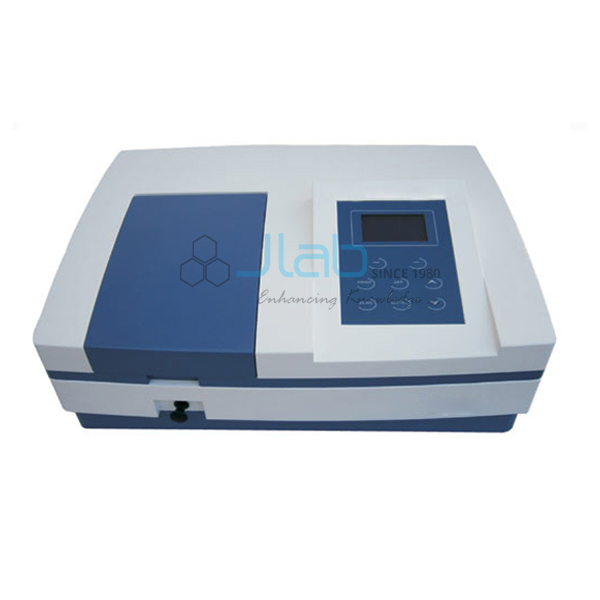
Product Code : EL-S-2164
Jlab Export is a leading Microprocessor UV-VIS Spectrophotometer Manufacturer,and suppliers in India
Read one standard on this single-beam UV-VIS spectrophotometer and its K factor mode turns every later absorbance straight into concentration. It works from 190 to 1000 nm, with a deuterium lamp below 350 nm and a tungsten halogen lamp above. Results show on a 16 x 2 line backlit LCD, the wavelength on a separate 4-digit LED, and up to 100 results stay in memory.
Specifications
| Optics | Single beam, Czerny-Turner mirror optics, 1200 grooves/mm grating |
| Wavelength range | 190–1000 nm |
| Spectral bandwidth | 2 nm |
| Wavelength accuracy | ±0.5 nm, repeatability ±0.3 nm |
| Photometric range | %T 0–100, Abs 0–1.999, Conc 0–1999, K factor 0–1999 |
| Lamps | Deuterium 190–350 nm, tungsten halogen 350–1000 nm |
| Displays | 16 x 2 line backlit LCD for data, 4-digit red LED for wavelength (0.1 nm) |
| Sample holder | 4-position adjustable, 10 mm cuvettes |
| Memory and interfaces | 100 samples, Centronics printer interface, RS-232C optional |
| Supplied with | 2 quartz and 4 plastic cuvettes, mains lead, manual, dust cover |
| Minimum order quantity | 1 unit |
| Dispatch time | Usually 7–10 working days |
| Manufacturer | JLab (Jain Laboratory Instruments Pvt Ltd), Ambala, India |
UV Assay Practicals for Pharmacy Students
A common pharmaceutical analysis practical is the UV assay of a tablet against a reference standard. Students dissolve the standard and the powdered tablet, then dilute both with Bulb Pipettes, Class B Soda Glass, One Mark JLab into Volumetric Flasks Class B Soda Glass Plastic Stopper JLab. They read both at the absorbance maximum, and the K factor from the standard gives the drug content of the tablet.
In a chemistry class, the visible range serves for a Beer-Lambert line of Potassium Permanganate. The 4-position holder takes the blank and three standards at a time. Students plot absorbance against concentration, check that the line passes close to the origin and read an unknown from it.
How the K Factor Works
The Beer-Lambert law says A = εlc, so at one wavelength and one path length the absorbance is proportional to concentration. The instrument divides the known concentration of the standard by its absorbance to get K. It then multiplies each sample absorbance by K and shows the concentration.
Frequently Asked Questions
Why read the blank before every sample?
A single-beam instrument has no reference beam, so it cannot follow small changes in lamp output by itself. Put the blank in the beam and set zero absorbance before each reading, and again whenever you change the wavelength.
When can I trust a K factor result?
Only while the samples stay in the straight part of the calibration line. Check the factor with a second standard of a different strength. Work out a new factor whenever you change the wavelength, the solvent or the type of cuvette.
What does the automatic shutter do?
It closes the light path when no reading is being taken. The photodiode detector then sits in the dark between readings, which makes it last much longer in daily class use.
How can I check that the wavelength setting is right?
Read a reference with sharp peaks at known wavelengths, such as a holmium oxide filter, and compare where each peak falls. The wavelength accuracy of this model is 0.5 nm either way, so a larger shift means the instrument needs a service check before assay work.
How are stored results printed or sent to a PC?
The memory holds 100 results, numbered 0 to 99. Print them on any Centronics dot matrix printer, or fit the optional RS-232C interface to pass them to a computer.
Other Single-Beam UV-VIS Models
- Digital UV-VIS Spectrophotometer (LED data display, opaque cuvette included)
- UV Spectrophotometer (graphical LCD, large sample compartment)
- Microprocessor Spectrophotometer (tungsten halogen lamp, stored standard curves)
- Double Beam UV-VIS Spectrophotometer
For a quote, use Add To Cart or send us a message through the contact page.
Last updated: 6 November 2026