Digital Spectrophotometer Manufacturer,Supplier and Exporter in India

Product Code : EL-S-2171
Jlab Export is a leading Digital Spectrophotometer Manufacturer,and suppliers in India
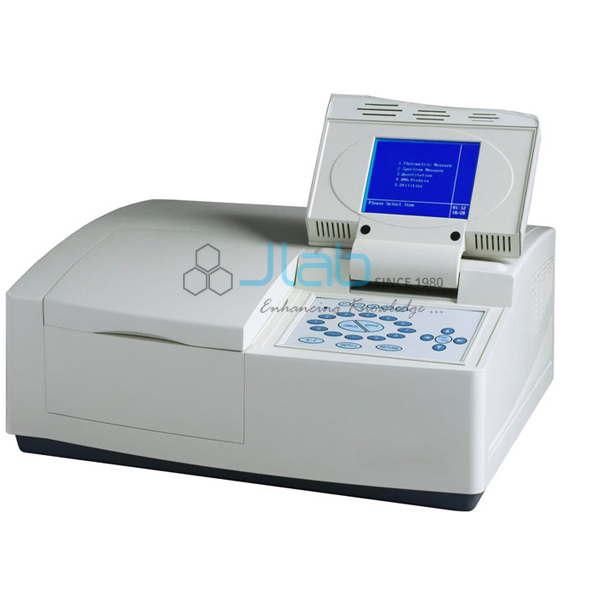
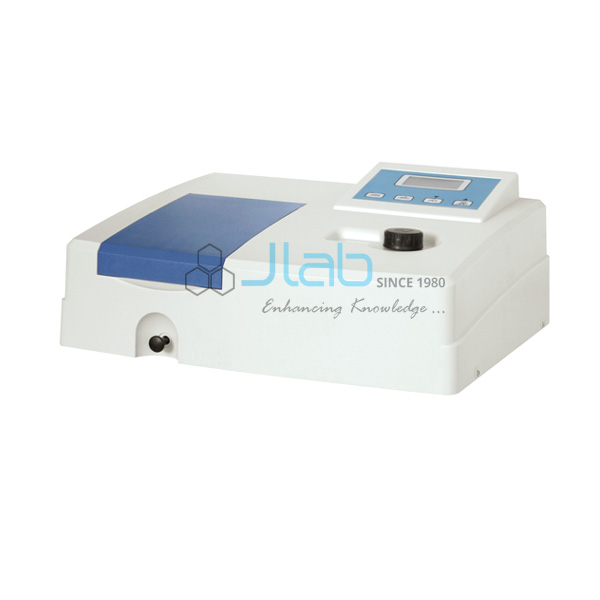
Built around a 600 line/mm holographic grating and a 6 V, 10 W tungsten halogen lamp, this digital spectrophotometer covers 340 to 960 nm in 1 nm steps. A red LED display gives the result as %T, absorbance or a direct concentration. Samples are read in 10 mm test tubes, with provision for 50 mm tubes.
Specifications
| Wavelength range | 340–960 nm, 1 nm resolution |
| Spectral bandwidth | 5 nm |
| Wavelength accuracy | Within 2.5 nm, repeatability within 2 nm |
| Monochromator | 600 line/mm holographic grating |
| Lamp and detector | 6 V, 10 W tungsten halogen lamp, silicon photodiode |
| Readout | 3½-digit red LED: %T 0–100 (0.1), Abs 0–1.99 (0.001), Conc 0–1999 (1) |
| Sample holder | 10 mm test tube, provision for 50 mm test tube |
| Outputs | Recorder output |
| Operating conditions | 5–45 °C, 230 V AC, 50 Hz |
| Supplied with | 2 quartz cuvettes (10 mm), operation manual, dust cover |
| Minimum order quantity | 1 unit |
| Dispatch time | Usually 7–10 working days |
| Manufacturer | JLab (Jain Laboratory Instruments Pvt Ltd), Ambala, India |
Copper Sulphate and Colour Experiments
A Beer-Lambert experiment with Copper Sulphate suits this instrument well. The blue solution absorbs at the red end of the spectrum, which lies inside its range. Students weigh the salt on an Electronic Balance Analytical and prepare standards with Bulb Pipettes, Class B Soda Glass, One Mark JLab. They read each one in a 10 mm tube and plot absorbance against concentration.
The same solutions show why a solution looks the colour it does. Copper sulphate absorbs orange and red light and passes blue, so its absorbance peak sits at the long-wavelength end. A pale solution that reads too low in a 10 mm tube gives five times the absorbance in a 50 mm tube.
Frequently Asked Questions
Do test tubes give the same results as square cuvettes?
For teaching and routine work they do, as long as the blank and samples go in matched tubes. The curved wall bends the beam slightly, so a scratch or a change in position can move the reading. Mark each tube and keep it facing the same way.
What is the recorder output for?
It sends the reading to a chart recorder or data logger. This lets students record how the absorbance of a reacting mixture changes with time, instead of writing down figures every few seconds.
How does the direct concentration reading work?
Put a standard of known strength in the holder and set the display to read its concentration. Because absorbance follows the Beer-Lambert law, later samples at the same wavelength then read in the same units, up to 1999 on the display.
Why are quartz cuvettes supplied with a visible-range model?
The range starts at 340 nm, close to where ordinary glass begins to absorb. The two 10 mm quartz cuvettes pass light well across the whole range, so readings near the short-wavelength end are not distorted by the cell.
Can it work in a warm lab?
It is rated for 5 to 45 °C and runs on 230 V AC, 50 Hz. Keep it out of direct sun and away from heaters, and let the lamp warm up before readings.
Other Visible Spectrophotometers and Colorimeters
- Visible Spectrophotometer
- Microprocessor Spectrophotometer (stores standard curves)
- Digital Photo Colorimeter
- Microprocessor Photo Colorimeter
For a quote, use Add To Cart or send us a message through the contact page.
Last updated: 20 November 2026