Microprocessor Photo Colorimeter Manufacturer,Supplier and Exporter in India

Product Code : EL-BTI-2151
Jlab Export is a leading Microprocessor Photo Colorimeter Manufacturer,and suppliers in India
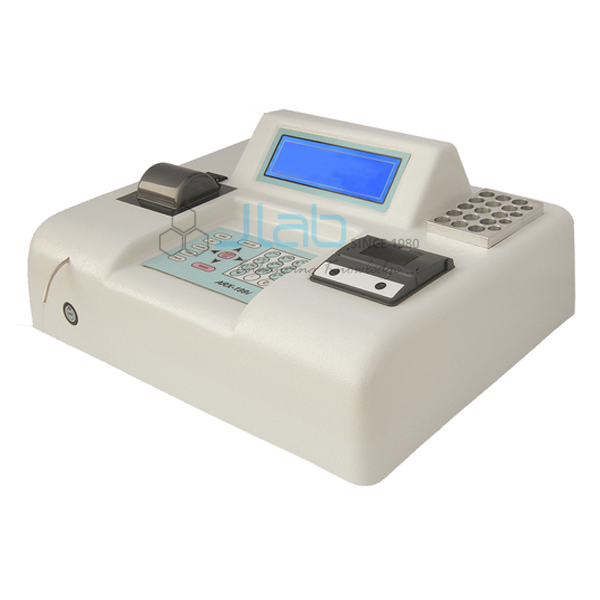
This photo colorimeter measures how much light a coloured solution absorbs, and its microprocessor turns the reading into a concentration. It shows %T, absorbance, concentration or K factor on a backlit LCD, keeps up to 100 results and prints them on a dot matrix printer. Eight glass filters on a rotating disc cover 400 to 700 nm.
Specifications
| Filters (400–700 nm) | 8 glass filters on a rotating disc: 400, 450, 490, 520, 540, 570, 620, 680 nm |
| Photometric range | %T 0–100, Abs 0–1.99, Conc. 0–1999, K factor 0–1999 |
| Resolution | %T 1, Abs 0.01, Conc. 0.01, K factor 0.01 |
| Display and keys | 16 x 2 line backlit alphanumeric LCD, soft-touch membrane keys |
| Memory | Up to 100 samples (0–99) |
| Sample system | 10 mm path length matched glass test tubes |
| Lamp and detector | 6.8 V, 0.3 A tungsten lamp; wide-range silicon photodiode/photocell |
| Interfaces | Centronics parallel port for a dot matrix printer; RS-232C on request |
| Power, size and weight | 230 V ±10% AC, 50 Hz; 240 x 254 x 90 mm; about 2.5 kg |
| Supplied with | Set of 5 matched test tubes, spare lamp, mains lead, operation manual, dust cover |
| Minimum order quantity | 1 unit |
| Dispatch time | Usually 7–10 working days |
| Manufacturer | JLab (Jain Laboratory Instruments Pvt Ltd), Ambala, India |
Practicals for Chemistry and Biochemistry Students
The usual first practical is a Beer-Lambert calibration line. Students dissolve Potassium Permanganate in distilled water and make up five standards in Volumetric Flasks, Class A Borosilicate Glass Plastic Stopper JLab. Each standard is read against a water blank with the 520 or 540 nm filter, and absorbance is plotted against concentration. The unknown is then read off the straight line.
Biochemistry classes estimate protein with Biuret Reagent (Protein Test), which turns violet with protein. Students measure sample and reagent with Graduated Pipettes, Class B Soda Glass JLab, read one protein standard in concentration mode and let the colorimeter store its K factor. Each later tube then reads straight out as a concentration.
Frequently Asked Questions
How do I set the blank before reading samples?
Fill one 10 mm matched tube with the blank your method names, often reagent mixed with distilled water. Place it in the holder, select the filter and set the reading to zero absorbance. Read standards and samples on the same filter, and set the blank again after any filter change.
Which filter suits my solution?
Pick the filter whose colour is complementary to the solution. Purple and violet solutions absorb green, so try 520 or 540 nm. Blue solutions absorb orange-red light, so try 620 or 680 nm, and yellow ones need 400 or 450 nm. When unsure, read one standard on all eight filters and keep the highest absorbance.
What does the K factor do?
Concentration equals K times absorbance. The colorimeter works K out from a standard of known strength and keeps the last K factor and standard value in memory. If your test method already gives a factor, key it in and skip running the standards again.
Why do the matched test tubes matter?
In A = εlc the path length l must be the same for blank, standards and samples, and the tubes in the set are matched for that. Scratches, fingerprints and air bubbles change how much light gets through. Wipe each tube and fill it above the light path.
Why do my strongest standards fall below the line?
The Beer-Lambert law fits most closely at low and middle absorbance, and the line often bends as readings climb towards the 1.99 Abs limit. Dilute strong samples so they fall inside your standards, then multiply the result by the dilution factor.
Other Colorimeters and Spectrophotometers
- Balanced Cell Photo Colorimeter (three filters, LED readout)
- Digital Photo Colorimeter (optical density readout, small sample)
- Auto Colorimeter Analyzer (memory for three standards)
- Visible/UV Spectrophotometer
For a quote, use Add To Cart or send us a message through the contact page.
Last updated: 6 November 2026