Semi Auto Analyzer Manufacturer,Supplier and Exporter in India
Product Code : EL-BTI-2157
Jlab Export is a leading Semi Auto Analyzer Manufacturer,and suppliers in India
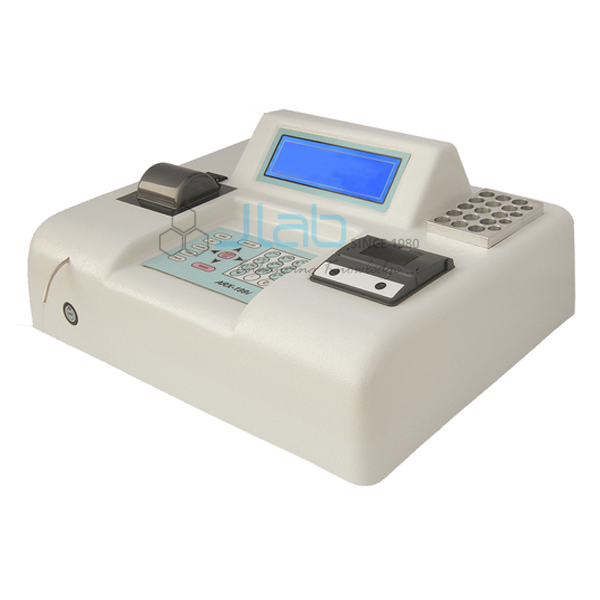
A semi-automatic analyser reads the colour reactions of clinical biochemistry tests and works out results from programmed methods. In this one a peristaltic pump draws each reacted sample into an 18 µl flow cell. A Peltier cell holds it at 25, 30 or 37 °C, and seven interference filters cover 340 to 670 nm. It stores 100 open test programs and has a built-in thermal printer.
Specifications
| Measuring modes | Absorbance, end point, differential, kinetic, fixed time, multi-standard (mono or bichromatic), coagulation |
| Filters | 340, 405, 505, 546, 578, 630, 670 nm on a stepper-motor wheel, plus a slot for a user-defined filter |
| Spectral field, lamp and detector | 340–690 nm; 6 V, 10 W halogen lamp; silicon photodiode |
| Measuring range | 0–2.500 Abs, zero set automatically |
| Flow cell | 18 µl flow-through cell; typical working volume 500 µl, minimum 350 µl |
| Intake and cuvettes | Peristaltic pump with programmable intake and wash volume; micro and macro cuvettes can be used |
| Temperature | 25, 30 and 37 °C selectable, Peltier cell for heating and cooling |
| Programs and memory | 100 open test programs; 100 samples with name and ID; quality control for 100 samples |
| Display, keys and printer | 40 x 4 character backlit LCD; 57 membrane keys incl. 28 quick test keys; built-in 2 inch graphics thermal printer |
| Interfaces, power and size | Centronics parallel and RS232C; 230 V ±10% AC, 50/60 Hz; 470 x 365 x 85 mm; about 11 kg |
| Minimum order quantity | 1 unit |
| Dispatch time | Usually 7–10 working days |
| Manufacturer | JLab (Jain Laboratory Instruments Pvt Ltd), Ambala, India |
Clinical Biochemistry Practicals for MLT Students
In an MLT or biochemistry lab, students first separate serum from clotted blood in a Centrifuge. Sample and reagent are measured with a Micropipette, and end-point tests such as glucose or cholesterol are incubated in a Serological Water Bath. The analyser then aspirates the blank, the standard and each sample in turn and prints the results.
A second exercise compares the modes. Students run an enzyme such as ALT in kinetic mode at 340 nm and 37 °C and study the printed absorbance-time plot. They then run creatinine in fixed-time mode, which uses the change between two set times. Teachers can also show how multi-standard mode builds a calibration curve from several standards.
Frequently Asked Questions
What is the difference between end point, fixed time and kinetic modes?
End point reads once, after the colour reaction has finished. Fixed time reads at two set times and uses the change between them. Kinetic reads again and again over a set period and uses the rate of change per minute, which is how enzyme activity is measured.
How much reaction mixture does each reading use?
The flow cell holds 18 µl, but the pump draws more to flush it. A typical working volume is 500 µl and the minimum is 350 µl. The intake volume is programmable, and micro or macro cuvettes can be used in the second compartment instead.
How do I keep carry-over between samples low?
Use the programmable wash with distilled water between samples, and keep each intake at or above the minimum working volume so the old liquid is pushed out. Programmable air gap aspiration puts air between one liquid and the next. Where the method allows, run low samples before high ones.
Why does the cell temperature matter?
Enzyme reaction rates change with temperature, so kinetic results compare only at the temperature the method names. The Peltier cell heats or cools the sample compartment to 25, 30 or 37 °C. Let it settle at the set value before the first reading.
Can I add my own test methods?
Yes. All 100 test programs are open and every parameter can be changed by the user. The 28 most common tests sit on quick access keys, and the filter wheel has room for a user-defined filter beside the seven fitted. At start-up the analyser checks its optics, filter wheel, printer and memory.
Other Analysers, Colorimeters and Pipettes
- Bio-Chemistry Analyzer
- Biochemistry Analyser Automatic (touch screen, built-in flow cell)
- Microprocessor Photo Colorimeter
- Variable Volume Micropipette
- Micropipette Tips
For a quote, use Add To Cart or send us a message through the contact page.
Last updated: 6 November 2026