Differential Blood Cell Counter Manufacturer,Supplier and Exporter in India
Product Code : EL-BTI-2159
Jlab Export is a leading Differential Blood Cell Counter Manufacturer,and suppliers in India
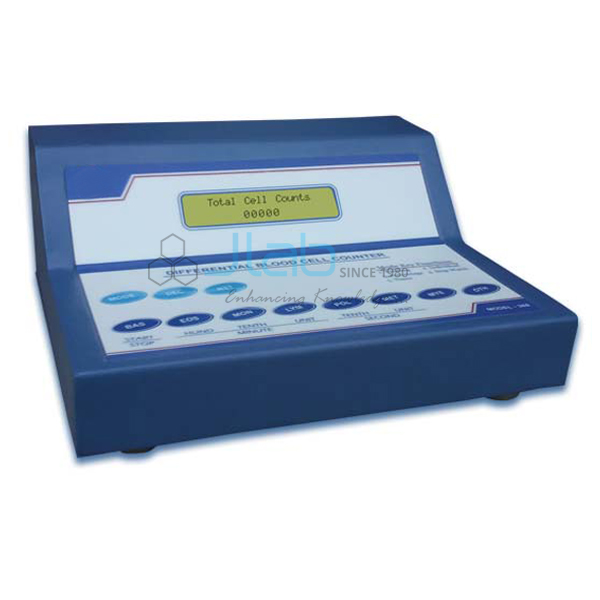
A differential cell counter keeps the tally while you identify white cells on a stained blood film. This one has eight cell keys and three function keys and shows the counts on a 16 x 2 line LCD. It works out the percentage of each cell type automatically. It also has a built-in stopwatch and timer and an audible beep, all in a metal body.
Specifications
| Cell counting keys | 8 |
| Total keys | 11 (8 cell keys and 3 function keys) |
| Display | 16 x 2 line LCD |
| Calculation | Automatic percentage of each cell type |
| Counting | Individual count for each cell type |
| Other functions | Built-in stopwatch and timer, audible beep |
| Control | Microprocessor |
| Body | Metal |
| Mains input | 230 V ±10% AC, 50 Hz |
| Size and weight | 250 x 230 x 150 mm; about 1.5 kg |
| Minimum order quantity | 1 unit |
| Dispatch time | Usually 7–10 working days |
| Manufacturer | JLab (Jain Laboratory Instruments Pvt Ltd), Ambala, India |
Differential Count Practicals for Students
In a haematology practical, students spread a thin blood film on Microscope Slides, stain it and scan it under the microscope. Each white cell is identified and its key pressed: neutrophils, lymphocytes, monocytes, eosinophils and basophils. The spare keys take band forms or other cells the method names.
Counting goes on to the total the method sets, and the counter shows each type as a percentage. Students then count total white cells on a Haemocytometer. Multiplying each percentage, as a fraction, by that total gives the absolute count of each cell type.
Frequently Asked Questions
How many cell types can it count at once?
Eight. Each cell key keeps its own count, and the three function keys run the counter. Most labs give five keys to the main white cells and keep the others for band forms, abnormal cells or nucleated red cells.
Does it work out the percentages?
Yes. The counter divides each cell count by the total counted and shows the percentage on its display. There is no hand arithmetic at the end of the count.
What mistakes do students make in a differential count?
Counting in the thick part of the film, where cells overlap, or only along the edges, where large cells gather. Going over the same field twice inflates some types. Move across the thin area in a steady zigzag and identify each cell before you press its key.
What are the stopwatch and timer for?
They time steps in the practical, such as how long a stain or buffer stays on the film, so no separate clock is needed on the bench.
What power does it need?
It runs on 230 V ±10% AC, 50 Hz mains. The metal body weighs about 1.5 kg and measures 250 x 230 x 150 mm, so it sits beside the microscope on a normal bench.
Other Cell Counters and Microscopes
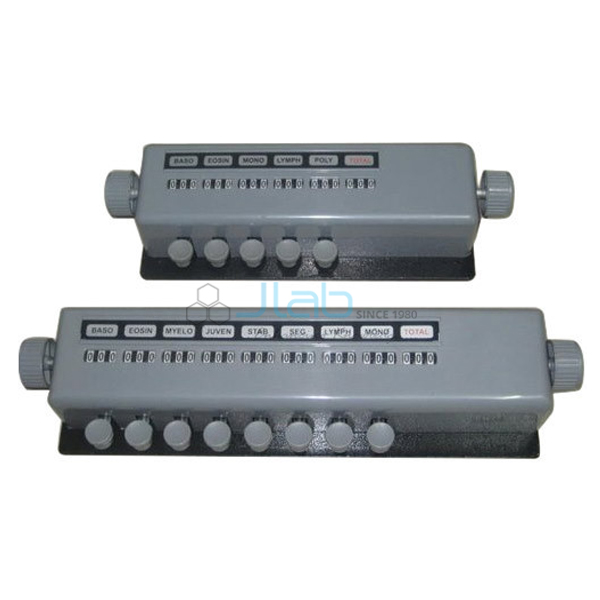
- Blood Cell Counter (key counter with totalizer)
- Blood Cell Counter Digital
- Hand Tally Counter
- Binocular Laboratory Microscope
For a quote, use Add To Cart or send us a message through the contact page.
Last updated: 6 November 2026