Double Beam Spectrophotometer Manufacturer,Supplier and Exporter in India

Product Code : EL-S-2161
Jlab Export is a leading Double Beam Spectrophotometer Manufacturer,and suppliers in India
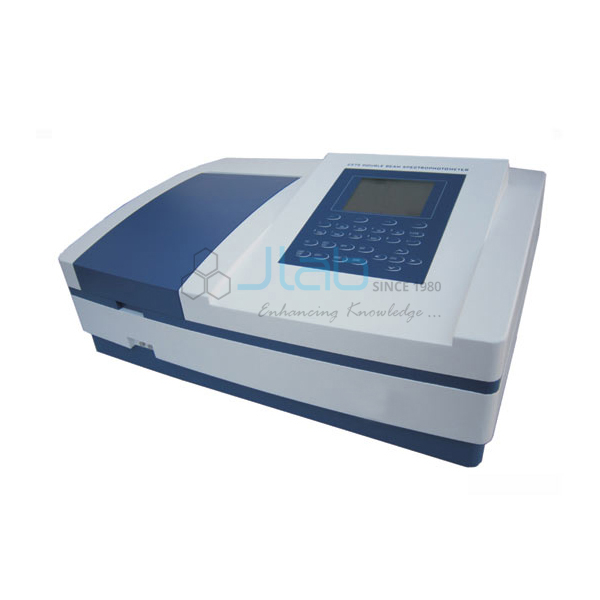
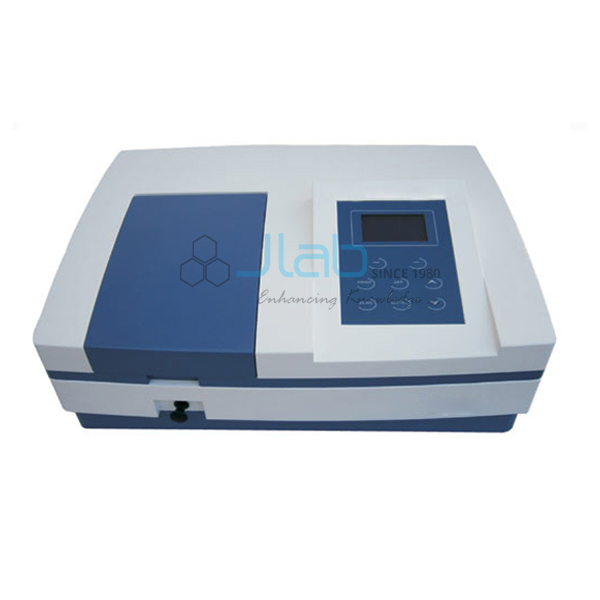
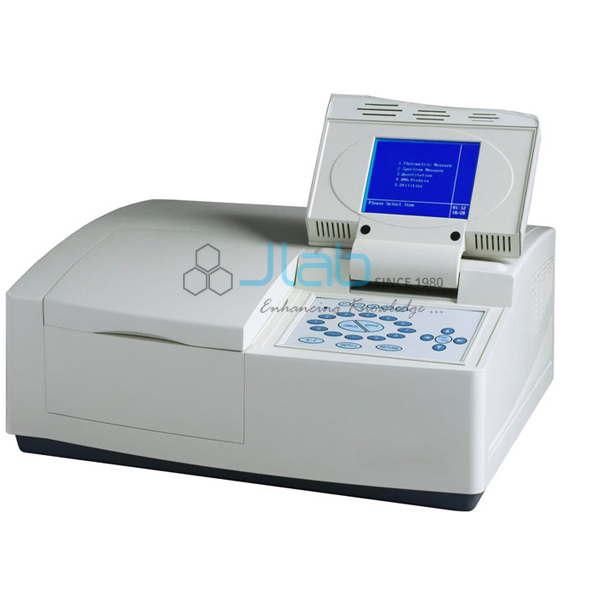
Eight cuvettes load into the automatic cell changer of this double-beam spectrophotometer, so a blank, standards and samples are read in one sequence. It covers 190 to 1100 nm with a 2 nm bandwidth. A 5-inch, 320 x 240 graphical LCD draws the test curves as you work, and results pass to a PC over USB.
Specifications
| Optics | Double beam, 1200 lines/mm grating, deuterium and tungsten lamps, silicon photovoltaic detector |
| Wavelength range | 190–1100 nm |
| Spectral bandwidth | 2 nm |
| Wavelength accuracy | ±0.3 nm over the full range (±0.1 nm at 656.1 nm) |
| Photometric range | -0.4 to 4 A, accuracy ±0.3 %T |
| Stability | ±0.001 A/h, drift ±0.0004 Abs/h |
| Display | 5 in, 320 x 240 graphical LCD with curve display |
| Cell changer | 8-position automatic, 10 mm cuvettes |
| Modes | Quantitative, kinetics, wavelength scan, multi-wavelength, DNA/protein |
| Data and power | USB export and PC link, printer port; AC 220 V 50 Hz or 110 V 60 Hz |
| Minimum order quantity | 1 unit |
| Dispatch time | Usually 7–10 working days |
| Manufacturer | JLab (Jain Laboratory Instruments Pvt Ltd), Ambala, India |
Biochemistry Practicals on the Double Beam
Protein estimation by the biuret method is a standard biochemistry practical. The biuret reagent is made with Copper Sulphate, and protein turns it violet, with a depth of colour that rises with the protein content. Students measure out standards with Graduated Pipettes, Class B Soda Glass JLab and load the blank and seven tubes into the changer. The calibration line then builds up on the screen.
Molecular biology classes use the DNA/protein mode to judge the purity of a nucleic acid extract from its UV absorbance. In a kinetics practical, the screen plots absorbance against time at a fixed wavelength. Buffers and stock solutions for both are made up in Volumetric Flasks Class B Soda Glass Plastic Stopper JLab.
Frequently Asked Questions
How does the 8-position cell changer help in a class?
The blank and up to seven standards or samples go in together, and the changer moves each one into the beam in turn. Cuvettes are handled less, so fewer fingerprints and spills reach the optical faces, and every reading is taken under the same conditions.
What does the DNA/protein mode measure?
It reads the sample at the absorbance peak of nucleic acids and at the peak of protein in the UV, then reports their ratio. A low ratio points to protein left in a DNA extract. Use quartz cuvettes, since glass and plastic absorb at these wavelengths.
Should I dilute a sample that reads above the top standard?
Yes. The range goes up to 4 A, but at 3 A only a thousandth of the light reaches the detector, so readings get noisy. Dilute the sample until it falls inside the calibration line, then multiply the result by the dilution factor.
How do I get results onto a computer?
Connect the instrument to a PC with a USB cable and export the data. A dot matrix printer can also be attached to the printer port for a paper record of each run.
How is it different from the Double Beam UV-VIS Spectrophotometer?
This model has the graphical LCD, an 8-position changer, USB output and a DNA/protein mode. The Double Beam UV-VIS Spectrophotometer has a two-line character LCD, a 6-position holder, a programmable lamp change-over and an optional serial port for a PC.
Other Double-Beam and UV-VIS Models
- Double Beam Spectrophotometer Wavelength Range 190-1100nm (large sample compartment)
- Visible/UV Spectrophotometer
- UV-VIS Spectrophotometer (double-beam and split-beam versions)
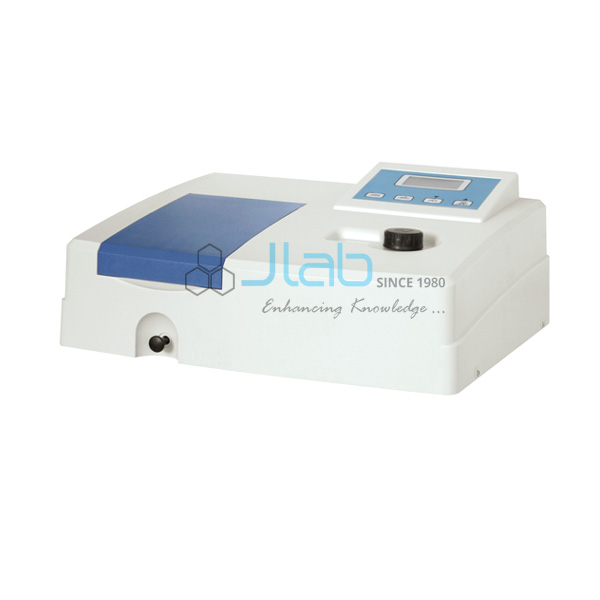
- Digital UV-VIS Spectrophotometer (single beam, LED readout)
For a quote, use Add To Cart or send us a message through the contact page.
Last updated: 6 November 2026