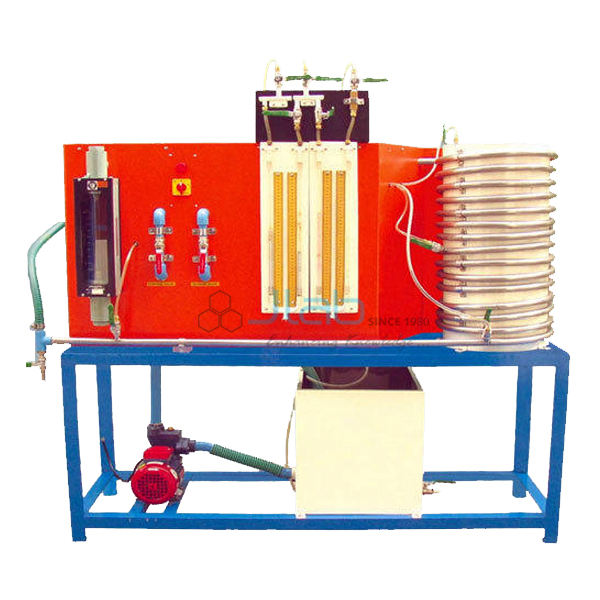
Vapor Liquid Equilibrium Apparatus Manufacturer,Supplier and Exporter in India
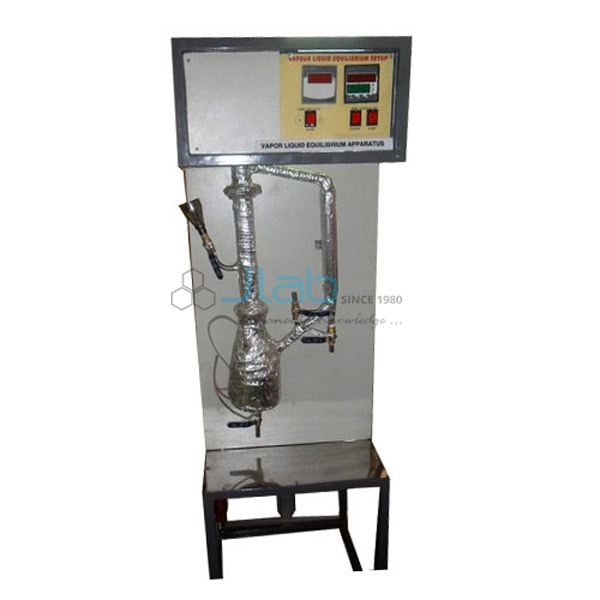
Product Code : EL-TWL-9140
Jlab Export is a leading Vapor Liquid Equilibrium Apparatus Manufacturer,and suppliers in India
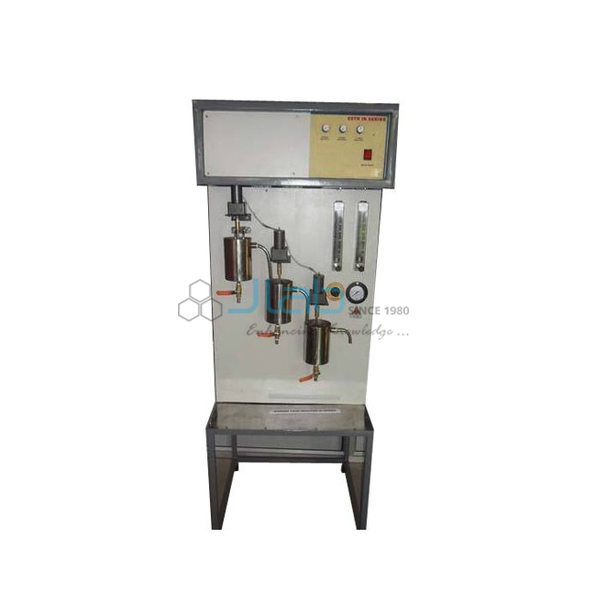
Vapour-liquid equilibrium is reached when a liquid and its vapour stay in contact and the rate of evaporation equals the rate of condensation. Both phases are then saturated. This apparatus is used to bring a liquid mixture to that state. Students can then compare the composition of the vapour with that of the liquid at the boiling point.
Specifications
| Study | Vapour-liquid equilibrium of a liquid mixture |
| Equilibrium condition | Rate of evaporation equals rate of condensation |
| State at equilibrium | Saturated liquid in contact with saturated vapour |
| Minimum order quantity | 1 unit |
| Dispatch time | Usually 14–18 working days |
| Manufacturer | JLab (Jain Laboratory Instruments Pvt Ltd), Ambala, India |
VLE Experiments for Students
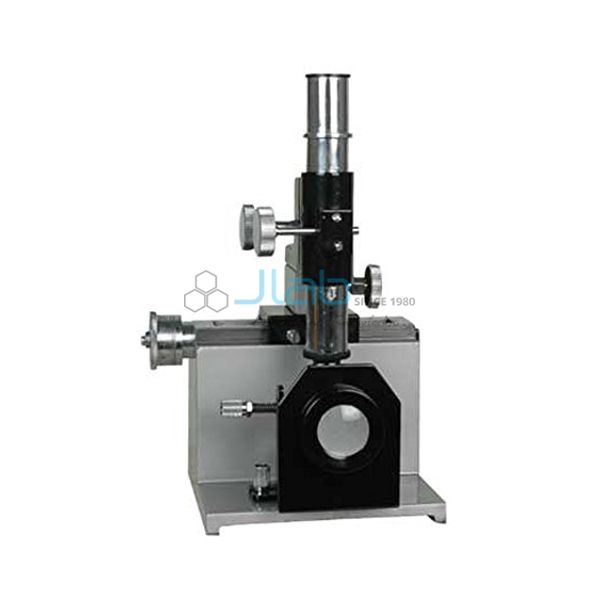
In a typical practical a binary mixture, such as methanol and water, is boiled until its temperature and composition stop changing. Students note the boiling temperature, then take a sample of the liquid and one of the condensed vapour. Both are read on an ABBE Refractometer against a calibration curve made from mixtures weighed on an Electronic Analytical Balance.
Repeating the run at several starting compositions gives pairs of liquid and vapour mole fractions, x and y, at each boiling point. Students draw the T-x-y diagram and the x-y curve against the diagonal and work out the relative volatility at each point. The x-y curve is then used for McCabe-Thiele stage counts on a column such as the Packed Distillation Column.
Frequently Asked Questions
What does vapour-liquid equilibrium mean?
A liquid and its vapour are at equilibrium when there is no net change between them, because molecules evaporate and condense at the same rate. At a given pressure, each phase then has a fixed composition and both sit at the same temperature.
What is relative volatility?
It compares how readily two components pass into the vapour. For components A and B it is (y_A/x_A) divided by (y_B/x_B). A value close to one means distillation separates them poorly, and a larger value means fewer stages are needed.
How are the liquid and vapour compositions found?
Refractive index is the usual method. Mixtures of known composition are weighed out and read to give a calibration curve, and each equilibrium sample is read against it. Cool the samples and keep them closed, so that the lighter component does not evaporate first.
Which mixtures are used in teaching labs?
Labs choose pairs that boil at moderate temperatures and differ clearly in refractive index, such as methanol and water or ethanol and water. Ethanol and water also form an azeotrope, a point where the vapour and liquid compositions become equal.
What do the T-x-y and x-y diagrams show?
The T-x-y diagram gives the bubble point and dew point curves of the mixture at one pressure. The x-y diagram plots vapour against liquid composition. The gap between that curve and the diagonal shows how much one equilibrium stage enriches the vapour.
Other Mass Transfer Units
For a quote, use Add To Cart or send us a message through the contact page.
Last updated: 6 November 2026