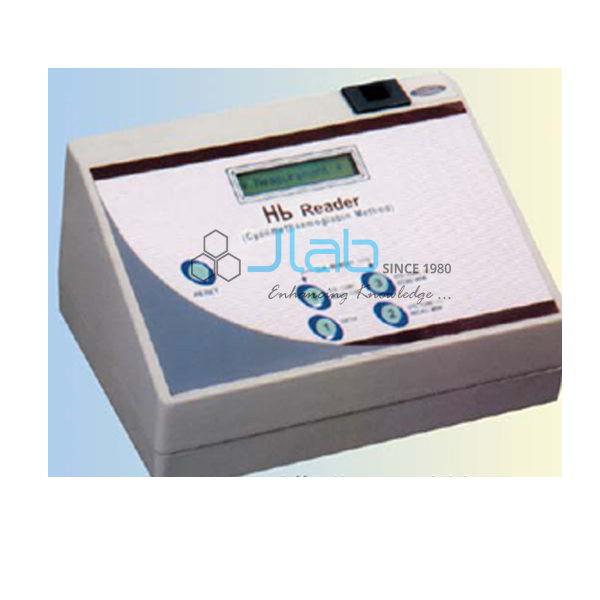
Biochemistry Analyser Automatic Manufacturer,Supplier and Exporter in India
Product Code : EL-PALE-9841
Jlab Export is a leading Biochemistry Analyser Automatic Manufacturer,and suppliers in India
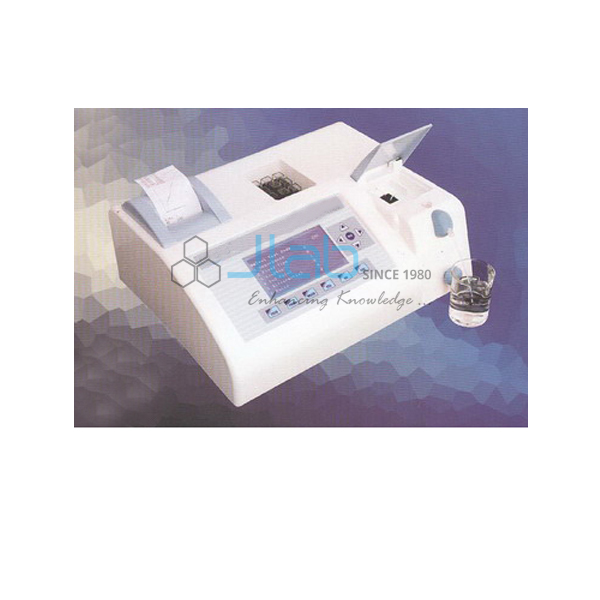
This analyser is a filter photometer built for clinical chemistry methods. A peristaltic pump sips each reacted sample into an 18 µl flow cell held at a set temperature by a Peltier block. Readings can also be taken in a 500 µl cuvette. Six interference filters from 340 to 630 nm are changed by a stepper motor, and results are shown on a touch-screen graphics display and printed.
Specifications
| Interface | Touch panel and keypad, graphics LCD |
| Measuring range | 0.000 to 3.000 A (linearity 2.2 A), drift 0.007 A per hour |
| Filters | Interference filters at 340, 405, 510, 546, 578 and 630 nm, two optional; half bandwidth 10 ± 2 nm; selected by stepper motor |
| Flow cell | 18 µl, sample sipped by peristaltic pump, 100 to 300 µl per aspiration |
| Cuvette mode | 500 µl cuvettes; dry block incubator for 12 cuvettes at 37 °C |
| Cell block temperature | 25, 30 and 37 °C, Peltier controlled |
| Light source and detector | Xenon gas filled or tungsten halogen lamp; photodiode; warm-up 90 s |
| Analysis modes | Absorbance, end point, fixed time, kinetic, differential, ratio; result by factor or by standard |
| Storage | 250 open tests with 30 QC results each, 2000 patient results with ID, 64 KB battery-backed memory |
| Printer and supply | Built-in 20-column thermal printer; built-in stabiliser |
| Minimum order quantity | 1 unit |
| Dispatch time | Usually 7–10 working days |
| Manufacturer | JLab (Jain Laboratory Instruments Pvt Ltd), Ambala, India |
Clinical Chemistry Practicals on the Analyser
Glucose by the glucose oxidase-peroxidase method is a typical first test. Students pipette reagent, standard and sample with Micropipettes Single Channel, using new Micropipette Tips for each liquid, and warm the tubes in the dry block at 37 °C. The pink colour is read in end point mode at the 510 nm filter, and the analyser works out the result from the standard.
For enzyme work, the class runs a kinetic test at 405 nm and watches the absorbance change on the graph minute by minute. Comparing a fixed time and a kinetic run of the same sample shows why enzymes are measured as a rate. Serum for these tests is separated beforehand in a Centrifuge.
Frequently Asked Questions
Why do air bubbles in the flow cell spoil readings, and how are they cleared?
A bubble in the light path scatters light, so the absorbance jumps or wanders. Bubbles come from a sample tip lifted out too early or from worn pump tubing. Keep the sipper below the liquid until the pump stops, and flush the cell with water if readings are unsteady.
How long does it need to warm up?
The lamp warm-up time is 90 seconds. Let the cell block also reach its set temperature of 25, 30 or 37 °C before running a blank. A reaction read in a cold cell gives a lower rate.
What happens with a sample that is too high for the method?
In kinetic tests the software plots the reaction and uses a delta calculation on the straight part of the curve. A sample that runs out of substrate quickly can then often be worked out from the graph without diluting it and running it again.
What do the Levey-Jennings charts show?
They plot the control results for each test day by day against the mean and standard deviation lines. A run of points on one side of the mean, or a point beyond the outer lines, tells the lab to check reagent, standard or instrument before reporting.
How should the pump tubing and flow cell be looked after?
Flush the cell with distilled water after each batch and at the end of the day, so reagent does not dry inside it. Check the peristaltic tubing for flattening or cracks. Worn tubing draws less liquid and lets bubbles in, so replace it when uptake falls.
Other Analysers and Colorimeters
For a quote, use Add To Cart or send us a message through the contact page.
Last updated: 12 November 2026