Atomic Absorption Spectrophotometer Manufacturer,Supplier and Exporter in India
Product Code : EL-PALE-9842
Jlab Export is a leading Atomic Absorption Spectrophotometer Manufacturer,and suppliers in India
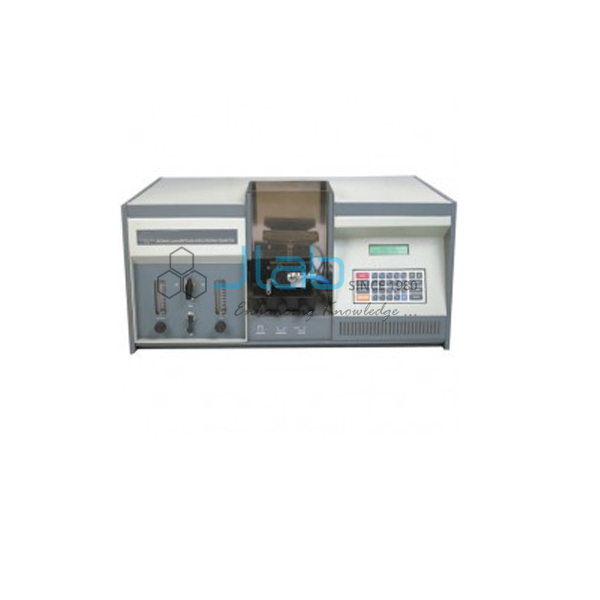
A flame atomic absorption spectrophotometer measures metals in solution, one element at a time. This microprocessor model uses hollow cathode lamps, a 100 mm titanium burner and a Czerny-Turner monochromator with a photomultiplier detector over 185 to 900 nm. It works in absorbance, emission, concentration and standard addition modes, and shows results on a backlit two-line display with a port for a printer.
Specifications
| Spectral range | 185 to 900 nm |
| Bandwidth | 0.15 to 3.0 nm, variable in steps of 0.15 nm |
| Photometric range | 0 to 2 Abs |
| Integration time | 0.01 to 99 s |
| Modes | Absorbance, emission, concentration and standard addition |
| Light source | Hollow cathode lamps, quick change, with warm-up facility |
| Burner | Titanium, 100 mm, vertical, horizontal and rotational alignment |
| Nebuliser | Pneumatic, capillary of 90% platinum and 10% iridium alloy; SS capillary nebuliser supplied |
| Monochromator and detector | Czerny-Turner 1/3 m, 1200 lines/mm holographic grating, hard coated optics; photomultiplier tube |
| Control and readout | Microprocessor, menu driven, self-diagnostics; 2 line 24 character backlit LCD; parallel printer port; optional PC interface and software |
| Minimum order quantity | 1 unit |
| Dispatch time | Usually 7–10 working days |
| Manufacturer | JLab (Jain Laboratory Instruments Pvt Ltd), Ambala, India |
How the Measurement Works
The lamp has a cathode made of the element being measured, so it gives out that element’s own sharp lines. The sample is sprayed by the nebuliser into the flame, where it is broken down into free atoms. Ground-state atoms in the flame absorb part of the lamp line, and the monochromator passes only that line to the detector. The absorbance is compared with a calibration curve made from standards of the same element.
Metal Analysis Practicals for College Labs
In an analytical chemistry course, students prepare standards for one metal, such as copper or zinc. They dilute a stock in Volumetric Flasks, Class A Borosilicate Glass Plastic Stopper JLab. Standards and water samples are acidified alike with Nitric Acid Dilute. They aspirate a blank, the standards and the samples, plot the calibration curve and read the unknowns from it.
A follow-up exercise uses standard addition on a soil or fertiliser extract. Known amounts of the metal are added to equal portions of the sample, and the line is extended back to zero absorbance. The class compares this result with the plain calibration result to see the effect of the sample matrix.
Frequently Asked Questions
Why has the sensitivity dropped over time?
The usual causes are a partly blocked nebuliser capillary, salt or carbon on the burner slot, or a burner that has moved out of line with the beam. Check the sample uptake, clean the burner and realign it, then run a standard again.
Why does each element need its own lamp?
Atoms absorb only at their own very narrow lines. A hollow cathode lamp made of that element produces exactly those lines, so the absorption can be measured. Give a newly fitted lamp time on the warm-up facility so its output is steady before setting zero.
When should standard addition mode be used?
Use it when the sample matrix, such as high salt or acid, changes how well the element atomises compared with simple standards. Because the standards are added to the sample itself, the matrix acts on both equally and the result is less affected.
Why is the signal noisy?
A dirty or misaligned burner gives a ragged flame, and a lamp that is not yet steady or dirty lamp windows add noise too. Particles left in poorly digested samples also cause spikes. Clean and align the burner, let the lamp settle and filter samples that are cloudy.
What is the emission mode for?
In emission mode no lamp light is measured. The flame itself excites the atoms and the instrument reads the light they give out. This suits easily excited elements such as sodium and potassium, as in flame photometry.
Other Atomic and Molecular Spectroscopy Instruments
- True Double Beam Atomic Absorption Spectrophotometer
- Double Beam UV-VIS Spectrophotometer
- Digital Photoelectric Colorimeter
For a quote, use Add To Cart or send us a message through the contact page.
Last updated: 12 November 2026