Digital Photoelectric Colorimeter Manufacturer,Supplier and Exporter in India
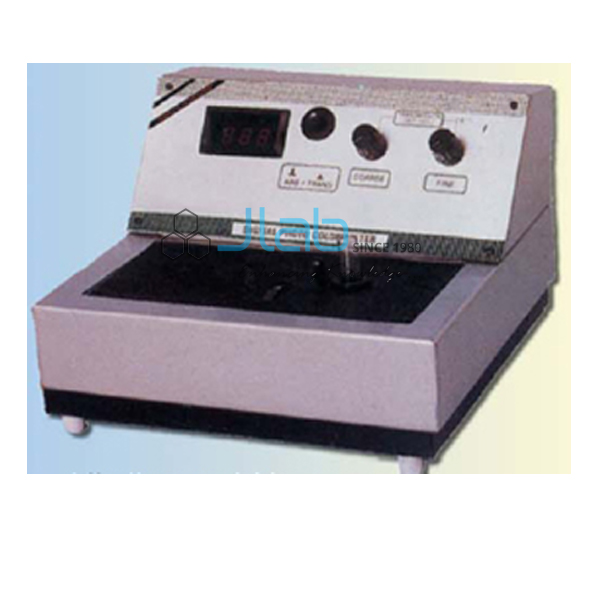
Product Code : EL-PALE-9839
Jlab Export is a leading Digital Photoelectric Colorimeter Manufacturer,and suppliers in India
This photoelectric colorimeter covers the visible range with eight filters, from 400 nm violet to 700 nm deep red. Light from a 6 V tungsten lamp passes through the chosen filter and the sample, and a photocell measures what gets through. The result is read directly as optical density or percent transmission from 1 ml of solution.
Specifications
| Filters | 8 filters: 400, 490, 520, 540, 590, 620, 650 and 700 nm |
| Readout | Direct reading of optical density or % transmission |
| Light source | 6 V, 10 W tungsten lamp |
| Detector | Photocell |
| Minimum sample volume | 1.0 ml |
| Power supply | 230 V, 50 Hz AC |
| Weight | About 5.5 kg |
| Minimum order quantity | 1 unit |
| Dispatch time | Usually 7–10 working days |
| Manufacturer | JLab (Jain Laboratory Instruments Pvt Ltd), Ambala, India |
Absorption Curve and Beer-Lambert Practicals
With eight filters spread across the visible range, students can draw a rough absorption curve. They dissolve Potassium Permanganate in Distilled Water, set the blank at each filter and record the optical density of one solution at all eight wavelengths. The purple solution absorbs green light most, so the peak falls at the 520 or 540 nm filter.
Using that filter, they make up a dilution series in Volumetric Flasks Class B Soda Glass Plastic Stopper JLab and plot optical density against concentration. The Beer-Lambert law, A = εlc, predicts a straight line, and the class reads an unknown from it. Repeating the series at a weaker filter shows why the peak wavelength gives the steepest line.
Frequently Asked Questions
How long should the lamp warm up before readings?
Switch on and leave the colorimeter until the meter stays steady with the blank in place, which usually takes a few minutes. A cold tungsten lamp is still changing in brightness, so a zero set too early slowly wanders during the first samples.
Which part of the scale gives the steadiest readings?
The middle of the scale. Very pale samples move the reading too little to read well, and very dark ones pass so little light that the calibration line bends. Keep optical density below about 1 and dilute any sample that reads higher.
What tubes or cells can I use?
All eight filters lie between 400 and 700 nm, in the visible range, so clear optical glass or plastic cells pass enough light. Quartz cells are only needed for ultraviolet work, which a filter colorimeter does not cover. Each cell must hold at least 1.0 ml.
What is the order of steps for one reading?
Pick the filter, put the blank in the holder and set the meter to zero optical density, which is full transmission. Replace the blank with the standard or sample, read the meter and note the value. Go back to the blank whenever you change the filter.
Can it be used for protein estimation?
Yes. In the biuret method, protein reacts with alkaline copper sulphate to give a violet colour. That colour absorbs green-yellow light, so the 540 nm filter is used, and a set of protein standards gives the calibration line.
Other Colorimeters and Photometers
- Digital Photocolorimeter (5 or 8 filters, meter scale)
- Digital Photo Colorimeter
- Microprocessor Photo Colorimeter
For a quote, use Add To Cart or send us a message through the contact page.
Last updated: 12 November 2026