Digital Photocolorimeter Manufacturer,Supplier and Exporter in India

Product Code : EL-PALE-9838
Jlab Export is a leading Digital Photocolorimeter Manufacturer,and suppliers in India
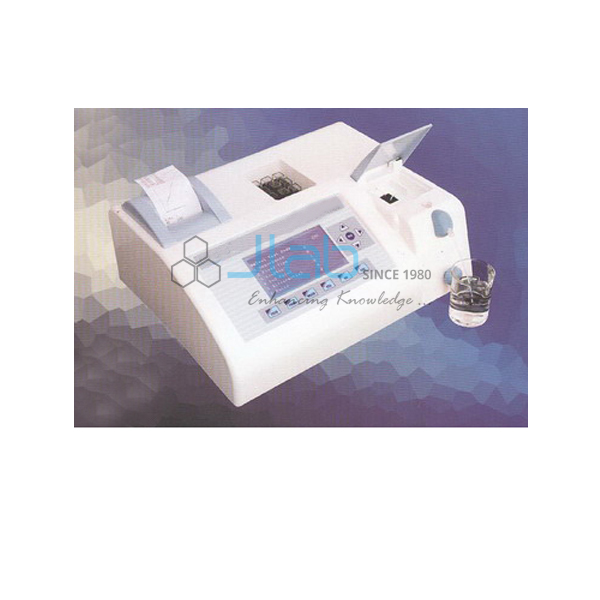
Coloured solutions are measured on this bench colorimeter by passing light from a tungsten lamp through a filter and the sample onto a photocell. A 135 mm meter shows optical density or percent transmission directly. It comes with five filters from 400 to 650 nm or with an eight-filter set, and each reading needs 1 ml of solution.
Specifications
| Filter options | 5 filters: 400 (violet), 490 (blue), 520 (green), 590 (yellow) and 650 (red) nm, or an 8-filter set |
| 8-filter set | Starts at 400 nm and includes 490, 520 and 540 nm |
| Readout | 135 mm meter for direct reading of optical density or % transmission |
| Light source | 6 V, 10 W tungsten lamp |
| Detector | Photocell |
| Minimum sample volume | 1.0 ml |
| Photometric accuracy | ±1.0% of full scale |
| Power consumption | 20 W |
| Weight | About 5.5 kg |
| Minimum order quantity | 1 unit |
| Dispatch time | Usually 7–10 working days |
| Manufacturer | JLab (Jain Laboratory Instruments Pvt Ltd), Ambala, India |
Filter Choice and Calibration Experiments
A good first exercise is choosing the filter. Students make a solution of Copper Sulphate and read it through each filter in turn. A blue solution absorbs orange and red light, so the 590 or 650 nm filter gives the highest optical density. That filter is kept for the rest of the run.
Next they make a set of standards in Volumetric Flasks, Class A Borosilicate Glass Plastic Stopper JLab, measuring the stock with Graduated Pipettes, Class B Soda Glass JLab. By the Beer-Lambert law, A = εlc, so optical density plotted against concentration gives a straight line through zero. An unknown is read and its concentration taken from the line. The two meter scales are linked by A = 2 minus log %T, so a solution passing one tenth of the light reads an optical density of 1.
Frequently Asked Questions
How do I read the 135 mm meter without error?
Look at the needle straight on, with your eye level with it, so it does not seem shifted against the marks. The optical density scale crowds together at its high end, so read percent transmission there and convert it.
What should the blank solution contain?
Everything that is in the samples except the substance being measured: the same water or solvent and the same reagents in the same amounts. If plain water is used where the samples carry a coloured reagent, the reagent colour is counted as sample and the results come out high.
How often should the blank be set again?
Set it again whenever you change the filter, because the photocell receives a different amount of light at each wavelength. In a long run, recheck it every few samples, since the lamp output can drift slowly as the instrument warms up.
What can make a blank or sample read wrongly?
Air bubbles on the tube wall, dust or fibres in the liquid, fingerprints on the glass and too little liquid all scatter or block light. Fill the tube with at least 1.0 ml, tap out any bubbles and wipe the outside with a soft tissue before each reading.
Why does stray light upset the readings?
The photocell responds to all light that reaches it, not only the beam through the filter. Light leaking in from a window or a bench lamp adds to the transmitted light, so %T reads high and optical density low. Work away from bright light and seat the tube fully.
Other Filter Colorimeters
- Digital Photoelectric Colorimeter
- Digital Photo Colorimeter
- Balanced Cell Photo Colorimeter
- Microprocessor Photo Colorimeter
For a quote, use Add To Cart or send us a message through the contact page.
Last updated: 12 November 2026