True Double Beam Atomic Absorption Spectrophotometer Manufacturer,Supplier and Exporter in India
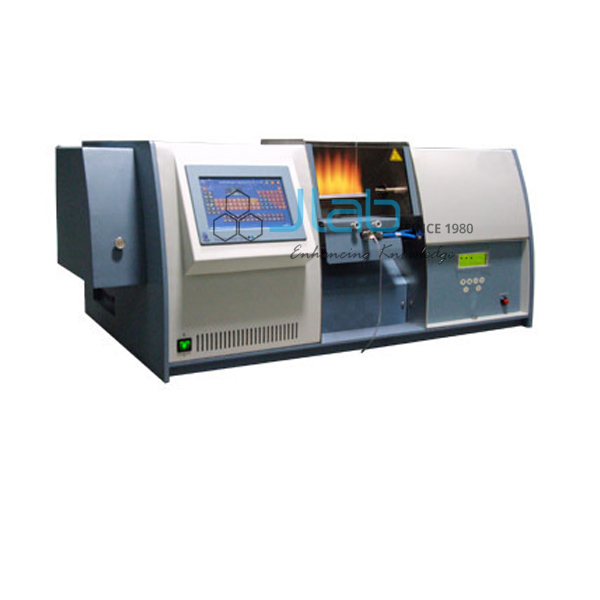
Product Code : EL-PALE-9843
Jlab Export is a leading True Double Beam Atomic Absorption Spectrophotometer Manufacturer,and suppliers in India
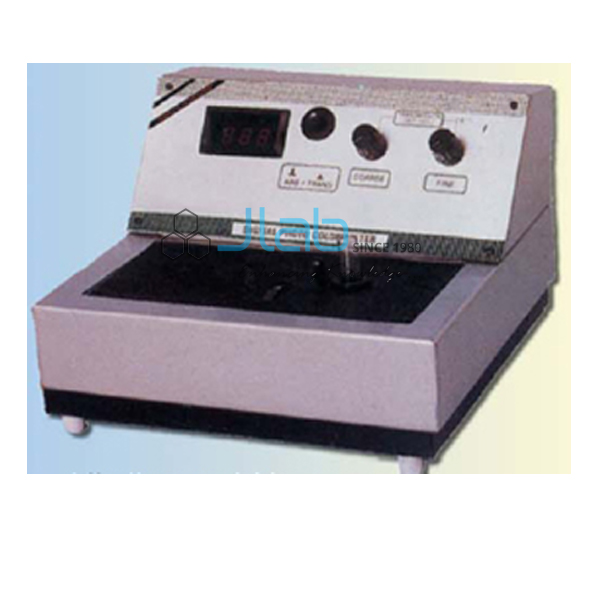
In this atomic absorption spectrophotometer the lamp beam is split into a sample path through the flame and a reference path around it. The two are compared all the time. That cancels slow changes in lamp output. A deuterium lamp corrects for background absorption, and the burner height, flame and gas box are set automatically from a colour touch screen with a built-in PC.
Specifications
| Optics | True double beam |
| Background correction | Deuterium (D2) lamp |
| Display | High resolution colour touch-screen LCD |
| Control | Built-in PC for data processing, storage, retrieval and interpretation |
| Burner | Automatic burner height optimisation, absorbance maximised from the membrane keyboard |
| Gas and flame | Microcontroller-based automatic gas box, auto flame control |
| Data and printing | USB pen drive storage, USB printing to PCL class printers |
| Applications | Metals in soil, fertiliser micronutrients, plants, foods, water, biological matter, metallurgy, plating, coal, petrochemicals, glass, cement and steel |
| Minimum order quantity | 1 unit |
| Dispatch time | Usually 7–10 working days |
| Manufacturer | JLab (Jain Laboratory Instruments Pvt Ltd), Ambala, India |
Background Correction Practicals
Zinc in a soil or plant extract is a good test of the correction system, since its line lies in the ultraviolet and salty extracts scatter light there. Students make zinc standards from Zinc Acetate in a Volumetric Flask. They then read the extract with the deuterium correction off and on. The drop in apparent absorbance shows how much of the first reading was background, not zinc.
A second exercise looks at baseline stability. The class aspirates the blank at intervals through a long run and logs the readings on the pen drive. Teachers can then explain how the reference beam keeps the zero steady while the lamp is still settling.
Frequently Asked Questions
What does true double-beam optics do?
The light from the hollow cathode lamp is split so that one beam goes through the flame and the other bypasses it. The instrument measures the ratio of the two, so a change in lamp brightness affects both beams alike and the baseline stays steady with less warm-up.
What does deuterium background correction remove?
Smoke, salt particles and molecules in the flame can absorb or scatter light over a broad band, which reads as false atomic absorption. The deuterium lamp measures only that broad background, and the instrument subtracts it. It works in the ultraviolet, where most of this background arises.
Why is the burner height optimised for each element?
Free atoms of each element are most plentiful at a different height in the flame. Automatic height optimisation moves the burner until the absorbance is at its maximum. It saves setting the height by hand and repeats the same position for every run of that method.
What are the limits of flame atomic absorption?
It measures one element at a time and needs a lamp for each element. Samples must be in solution, so solids are digested first. For very low levels, a furnace method or plasma technique may be needed instead of a flame.
How are results stored and printed?
The built-in PC keeps methods and results, and data can be copied to or loaded from a USB pen drive. Reports print straight to a USB printer of the PCL class, with no separate computer needed.
Other Spectroscopy Instruments
For a quote, use Add To Cart or send us a message through the contact page.
Last updated: 12 November 2026