DC To AC Inverter Manufacturer,Supplier and Exporter in India

Product Code : EL-PET-1446
Jlab Export is a leading DC To AC Inverter Manufacturer,and suppliers in India
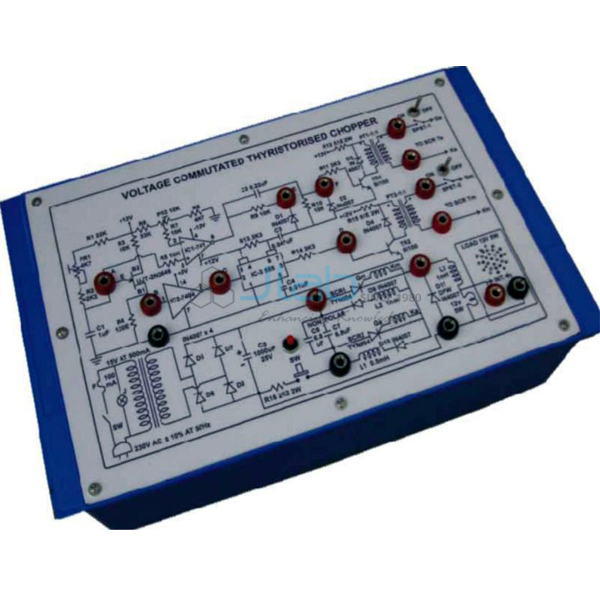
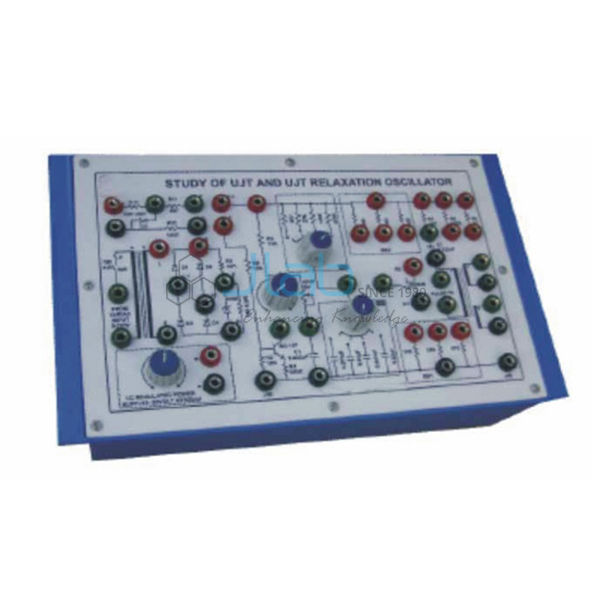
DC To AC Inverter (code EL-PET-1446) is a power electronics training board for studying how an inverter changes a DC supply into AC, using a multivibrator circuit, four low-power and four high-power NPN transistors and a 12-0-12 V, 4 A transformer. It runs from a 12 V, 80 Ah battery, which any car battery can provide, and the board carries a lamp holder with a 40 W, 230 V lamp. JLab (Jain Laboratory Instruments Pvt Ltd) manufactures it in Ambala, India.
Specifications
| Parameter | Detail |
|---|---|
| Object | To study the multivibrator circuit that converts DC to AC |
| Drive signal ICs | IC-1 and IC-2, generating the AC signals for the drive |
| Transistors | Four NPN low-power transistors; four NPN high-power transistors |
| Transformer | 12-0-12 V AC at 4 A |
| Lamp | Lamp holder with 40 W, 230 V lamp |
| Test points | Red, black and green terminals, for checking the wave shape and amplitude of the pulses and how the DC supply is changed to AC |
| Operating supply | 12 V, 80 Ah battery (any car battery) |
| Patch cords | Sufficient quantity |
| Terminals | Terminals and sockets at appropriate places on the panel for connections and observation of waveforms |
| Operating instructions | Detailed, giving the object, theory, design procedures, report suggestions and book references |
| Other apparatus required | Battery, 12 V DC, 80 Ah (any car battery); dual trace cathode ray oscilloscope, 20 MHz (unearthed) |
| Quality check | Each board is visually inspected before dispatch |
| Pack quantity | Each (sold individually) |
| Minimum order quantity | 10 units |
| Dispatch time | Usually 7–10 working days |
| Product code | EL-PET-1446 |
| Manufacturer | Jain Laboratory Instruments Pvt Ltd (JLab) — OEM |
| Country of origin | India (made in Ambala, Haryana) |
How Does It Compare with the Single Phase Series Inverter?
| Board | Power source | Switching devices | Other apparatus required |
|---|---|---|---|
| This board (EL-PET-1446) | 12 V, 80 Ah battery | Four low-power and four high-power NPN transistors | Battery; 20 MHz dual trace oscilloscope |
| Single Phase Series Inverter | 230 V mains, with a bridge rectifier for making the DC voltage | Two SCRs with two 1:1 pulse transformers | 20 MHz dual trace oscilloscope |
Choose this board to study a transistor inverter of the kind used in battery backup supplies; the series inverter board is the one for a thyristor inverter with self-commutation.
What Is the DC To AC Inverter Board Used For?
Inverters let a battery run equipment that needs AC, as in home backup supplies, vehicles and solar systems. In the circuit studied here a multivibrator produces the alternating drive signals and the transistor stages turn the battery’s DC into AC. Battery inverters commonly switch the current alternately through the two halves of a centre-tapped transformer winding, and the transformer raises the voltage to the level the load needs. Science and engineering students use the coloured test points to check the wave shape and amplitude of the pulses at each stage on an oscilloscope.
What to Specify When Ordering
- Quantity — the number of inverter boards needed.
- Companion boards — for example the series inverter or the MOSFET chopper for the same course.
- Oscilloscope — whether one should be quoted with the boards.
Frequently Asked Questions
What is the multivibrator used for in an inverter?
A multivibrator is an oscillator that switches between two states, giving two alternating square-wave outputs. In an inverter these outputs drive the switching transistors alternately, so the current in the transformer reverses each half cycle and an AC voltage appears at the output.
Why are both low-power and high-power transistors used?
In a transistor inverter the drive signals from the oscillator ICs can supply only a small current, so low-power transistors are commonly used as drivers and high-power transistors switch the much larger current drawn from the battery.
Why do battery inverters use a transformer?
A low-voltage battery cannot drive mains-voltage equipment directly. The transformer steps the switched low voltage up to the level the load needs, and a centre-tapped winding lets two switching stages take turns driving it.
What other apparatus is required?
A 12 V DC, 80 Ah battery (any car battery can be used) and a 20 MHz dual trace cathode ray oscilloscope, used unearthed. JLab’s Dual Trace Oscilloscope is a separate item that can be quoted on the same enquiry.
What should an export enquiry give?
The number of boards, the destination country and port or city, the delivery terms (for example FOB or CIF), packing or labelling instructions and the tender reference if there is one.
Who manufactures the DC To AC Inverter board?
Jain Laboratory Instruments Pvt Ltd, known as JLab, makes it at its works in Ambala, Haryana, India.
OEM Manufacturer
JLab is the trading name of Jain Laboratory Instruments Pvt Ltd, an engineering lab equipment and power electronics trainer manufacturer in India, incorporated in 2017 and based on Hargolal Road, Ambala, Haryana. The inverter board is made at JLab’s own works rather than bought in from a trader, so colleges, institutes, dealers and importers obtain it straight from the maker, each board is visually inspected before dispatch and repeat orders are handled by the same works. JLab exports worldwide and ships to buyers in every region — for example Spain in Southern Europe, Moldova in Eastern Europe, Sierra Leone in West Africa, Norway in Northern Europe and Tunisia in North Africa. For tender purchases, see the JLab lab tenders page.
Related Inverter and Oscillator Trainers
- Single Phase Series Inverter — a mains-operated board for a series inverter built around two SCRs and a centre-tapped inductor.
- Astable Multivibrator using IC 555 — a trainer for the wave shape and frequency of a 555 timer working as a free-running astable multivibrator.
- DC Step Down Mosfet Chopper — a DC-to-DC step-down chopper board switched by a MOSFET.
- Dual Trace Oscilloscope — a 20 MHz dual-channel cathode ray oscilloscope, sold separately.
Find more boards in the Power Electronics Trainers category and across Electronics Lab Equipments.
Request a Quote
To get a quotation, use the Add To Cart button on this page or the contact page, telling us how many boards you need, where they should be delivered and whether an oscilloscope or other trainers should be added.
Last updated: 22 October 2026