Digital Storage Oscilloscope 40MHz Manufacturer,Supplier and Exporter in India
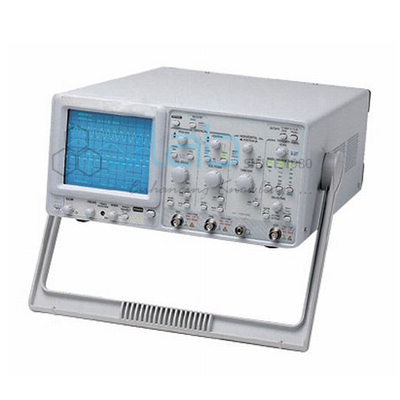
Product Code : EL-DSO-1528
Jlab Export is a leading Digital Storage Oscilloscope 40MHz Manufacturer,and suppliers in India
Digital Storage Oscilloscope 40MHz (code EL-DSO-1528) is a two-channel digital storage oscilloscope with an external trigger input, used to capture, store and measure electrical waveforms in electronics and electrical labs. Its most sensitive vertical range is 2 mV/div. It is made by Jain Laboratory Instruments Pvt Ltd (JLab) at its works in Ambala, India.
Specifications
| Parameter | Detail |
|---|---|
| Bandwidth | 40 MHz |
| Rise time | 8.7 ns |
| Channels | 2 channels plus external trigger input |
| Equivalent sample rate | 50 GSa/s |
| Input impedance | 1 MΩ // 13 pF |
| Input coupling | DC, AC, GND |
| Vertical sensitivity | 2 mV/div to 5 V/div |
| Vertical resolution | 8 bit |
| Maximum input voltage | 400 V (DC + AC peak); 5 Vrms at 50 Ω |
| Horizontal accuracy | ±0.01% |
| Trigger types | Edge, video, pulse, delay |
| Trigger sources | CH1, CH2, Ext, Ext/5, Ext (50 Ω) |
| Acquisition modes | Auto, normal, single |
| Automatic measurements | Vpp, Vamp, Vrms, Vmin, Vtop, Vbase, Vavg, frequency, period, rise time, fall time, +width, −width, overshoot, preshoot, +duty, −duty |
| Waveform maths | Add, subtract, multiply, divide and FFT |
| Quality check | Each oscilloscope is visually inspected before dispatch |
| Pack quantity | Each (sold individually) |
| Minimum order quantity | 10 units |
| Dispatch time | Usually 7–10 working days |
| Product code | EL-DSO-1528 |
| Manufacturer | Jain Laboratory Instruments Pvt Ltd (JLab) — OEM |
| Country of origin | India (made in Ambala, Haryana) |
What Is the 40MHz Digital Storage Oscilloscope Used For?
A digital storage oscilloscope samples the input signal, converts it into digital values and keeps the trace in memory, so a waveform can be frozen, measured and compared after the event instead of only while it repeats on the screen. As a digital oscilloscope for lab teaching, its two input channels let students view an input and an output together — for example across an amplifier, filter or rectifier circuit — and compare their shape, timing and phase.
The automatic measurements read values such as peak-to-peak voltage, RMS voltage, frequency, period and duty cycle straight from the captured trace, which saves counting divisions on the graticule, and the FFT function shows the frequency content of a signal alongside its time-domain view.
What to Specify When Ordering
- Bandwidth — this is the 40 MHz model; the same series comes in 25, 60, 100, 150 and 200 MHz versions, so state the bandwidth you need.
- Quantity — the number of oscilloscopes, for example one for each bench to be equipped.
- Other bench instruments — function generators and other electronic lab instruments are separate items and can be quoted on the same enquiry.
Frequently Asked Questions
What does the 8.7 ns rise time mean in practice?
It is the fastest edge the oscilloscope itself can display. Edges that are much slower than 8.7 ns are shown close to their true shape, while a faster edge appears stretched to about that time, so the figure sets how sharp a pulse or square-wave edge you can measure.
What is the 50 GSa/s equivalent sample rate?
It is an effective rate for repetitive signals: the oscilloscope builds the displayed trace from samples taken over many cycles of the same waveform. It does not apply to a one-off event, which is captured in a single pass.
What is the maximum input voltage?
The input is rated at 400 V (DC + AC peak), and at 5 Vrms into 50 Ω. Keep the signal applied to the instrument within these ratings.
Which trigger options does it have?
Edge, video, pulse and delay triggering, from CH1, CH2, Ext, Ext/5 or Ext (50 Ω), with auto, normal and single acquisition modes. Single mode is the one to use for catching a one-time event.
How does it differ from the Digital Storage Oscilloscope Dual Channel?
Both are two-channel digital storage oscilloscopes. This model has a 40 MHz bandwidth; the Digital Storage Oscilloscope Dual Channel is a 60 MHz model.
What information is needed for an export quotation?
Send the quantity, the destination country and port or city, your preferred delivery terms (for example FOB or CIF), any packing or labelling needs, and the tender reference if there is one.
Who manufactures this oscilloscope?
Jain Laboratory Instruments Pvt Ltd, trading as JLab, makes it at its works in Ambala, Haryana, and quotes for it as the manufacturer.
OEM Manufacturer
JLab is the trading name of Jain Laboratory Instruments Pvt Ltd, a manufacturer of electronics and laboratory equipment in India, incorporated in 2017 and based on Hargolal Road, Ambala, Haryana. This oscilloscope comes from JLab’s own works rather than from a trader, so colleges, training institutes, dealers and importers deal with the maker directly, and repeat orders and after-sales questions go back to the same company. JLab holds MSME Udyam registration UDYAM-HR-01-0003849 (manufacturing enterprise) and Importer-Exporter Code 3317504552. JLab exports worldwide and ships to buyers in every region — for example Colombia in South America, Ukraine in Eastern Europe, Vanuatu in Oceania, Indonesia in Southeast Asia and Congo in Central Africa. Tender buyers can find more on the JLab lab tenders page.
Related Electronics Lab Instruments
- Digital Storage Oscilloscope Dual Channel — a two-channel 60 MHz DSO with a colour TFT LCD.
- 70 MHz Digital Storage Oscilloscope — a two-channel DSO with 2 GS/s real-time sampling and a colour TFT LCD.
- 30MHz Dual Channel with frequency Counter — a dual-channel cathode ray oscilloscope (CRO) with a built-in 6-digit frequency counter.
- Function Generator 2 MHz — a signal source with sine, square, triangle, ramp and pulse outputs.
- Function Generator 5 MHz with Frequency Counter — a function generator with TTL/CMOS output and a built-in frequency counter.
See every model in the Digital Storage Oscilloscopes range or the full Electronics Lab Equipments range.
Request a Quote
For a quotation, press the Add To Cart enquiry button on this page or write through the contact page, giving the bandwidth, the number of oscilloscopes and the delivery location.
Last updated: 22 October 2026